What Is Offsite Backup? Benefits, Uses and Best Practices
If a complete office network is compromised, restoring data from backups can be a challenge. If the organization's data and backups are breached, it may be difficult to recover the information, potentially leading to significant losses. This situation highlights the importance of having reliable backup systems in place to ensure business continuity and minimize the impact of a cyber attack.
Many businesses have multiple backups, but a significant portion of those backups are often stored in the same physical location, such as a single building or office, making it a single point of failure from a broader perspective.
Businesses can easily back up their corporate data in two ways: onsite and offsite backup. This means that data can be securely stored on the company's own servers (onsite) or in a remote location (offsite) to ensure its safety and accessibility in case of a disaster or system failure.
This guide provides a comprehensive overview of offsite backup, including its benefits and security aspects. Offsite backup is a method of data protection that involves storing backup copies of data in a remote location, such as a cloud storage service or a data center, to ensure business continuity and data recovery in the event of a disaster or data loss.
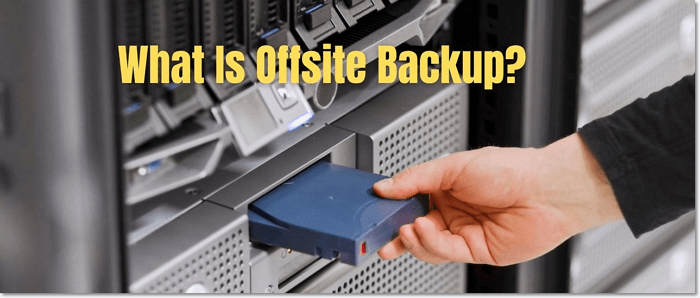
What Is Offsite Backup?
Offsite backup involves storing backup data or applications outside the core IT environment, typically by replicating data to a server in a different geographical location from the production system site. This process can be accessed directly over a Wide Area Network or the Internet, or by sending backup storage devices to the remote location.
The offsite backup process is similar to the standard backup process, but the storage media or facility is located outside the organization's core infrastructure.
What Is the Difference Between Offsite Backup and Onsite Backup?
Let's understand the major differences between Onsite and Offsite Backup. Onsite backup stores your data on a local device, such as an external hard drive or NAS, which can be vulnerable to physical damage, theft, or data corruption.
Onsite data backup refers to storing data on a local device, such as a hard drive or server, allowing for easy access and quick recovery without relying on the internet or IT support.
However, it is as secure as your company's network, with a minimum chance of surviving in the event of a cyber attack or natural disaster.
There are limitations to consider, including a cap on the number of servers and storage that can be added, as well as a budget constraint for ongoing maintenance.
Offsite backup is more secure and better than onsite data storage, as it's located elsewhere and replicated over many servers, requiring a stable internet connection to sync with the offsite server. However, it can be costlier than onsite storage.
The same keeps your data secure from hackers by keeping it off the grid, with some stringent offsite backups that can only be accessed by physically going to the server and getting a copy from IT support.
Many businesses today prefer a blended approach to data backup, which allows them to securely store a large volume of data in multiple locations and have the flexibility to independently own a data recovery solution.
What Are The Merits of Offsite Backup?
Offsite backup solutions offer a more secure and accessible option for data storage, providing numerous benefits. They are designed to be more secure, accessible, and offer a range of advantages. This makes them a popular choice for individuals and businesses looking to protect their data.
Disaster Recovery
Users typically choose offsite data recovery solutions to safeguard their data during natural or artificial disasters. Offsite data backup ensures data security during events like fires, tornadoes, hurricanes, and other conditions, and allows for quick and effortless restoration. This solution also provides unlimited storage capacity.
Cyber security
Offsite backup solutions are isolated from main networks and the internet, making them immune to cyberattacks and data breaches, and ensuring they can survive malware attacks.
Cost Effective
Offsite data backup is a cost-effective option that leverages existing IT resources to provide complete data protection without the need for hardware purchases or maintenance. This approach allows for quick access to backup data and eliminates the responsibility of updating data protection services, making it a convenient and efficient solution.
High-End Security
Offsite backup provides high-end security without issues, as most cloud service providers follow best practices and have cybersecurity experts on their teams.
High-End Scalability
Scaling offsite backup services is relatively easy and affordable, with subscription charges directly tied to the storage capacity you choose, making it a flexible and budget-friendly option.
Conclusion
The offsite backup is a perfect option for ensuring high-end security and complete access to data, making it easier to retrieve from any device effortlessly. This platform provides a secure and convenient way to store and access data, offering peace of mind for users.
Related Articles
- What Is SMB? Server Message Block Protocol Explained
- Windows Command Line Cheat Sheet (Online Table and PDF)
- What Is Disk Utility on Mac? Introduction to the Storage Device Manager on macOS
- USB Splitter vs. USB Hub - Which is Better[ A Thorough Guide]
- Tutorial on PowerShell Format Disk on Windows [Easiest Way]
Learn how to format a disk with PowerShell in Windows using Format-Volume, disk commands, and safe preparation steps. - Efficient Ways To Fix PS4 Disc Drive Not Working! Error Reading!
Are you facing a disc drive reading error on your PS4 or is it just not working? This is an easy-to-fix issue. Continue reading this article to learn exactly how to fix the issue and what you can do to prevent it from happening again.
Products
Articles & Tutorials
- Data Recovery
- Data Backup
- File Recovery
- File Backup
- System Backup and Restore
- Disk and Partition Clone
- Technical articles
- Mobile articles
- Disk Master Help
- Windows Data Recovery Tutorials
- Windows Secure Delete Tutorials
- Windows Partition Management Tutorials
- Windows File Backup and Restore Tutorials
- Windows System Backup and Restore Tutorials
- Windows Disk Backup and Restore Tutorials
- Windows Clone Tutorials