How to Restore System Image from External Hard Drive Windows 10
Why Create a System Image on External Hard Drive
A Windows 10 system image is an exact copy of the operating system, boot sectors, settings, programs, registry, and essential files on the C drive, providing complete protection of your computer and allowing for a quick and easy revival of your Windows 10 installation.
Creating a system image on an external hard drive is a good practice because it allows you to recover your system even if your computer is inaccessible due to corruption, breakage, or a virus attack. By backing up to an external drive, you can avoid the issue of not being able to make a system image recovery on the computer itself if it's not working. Additionally, this approach saves space on your local hard drive or solid-state drive (HDD/SSD).
How to Create a Windows 10 System Image Backup
Before restoring a system backup, create a system image on an external hard drive and a system repair disc to access recovery options if the computer won't boot.
Step 1. Connect the external hard drive to your computer.
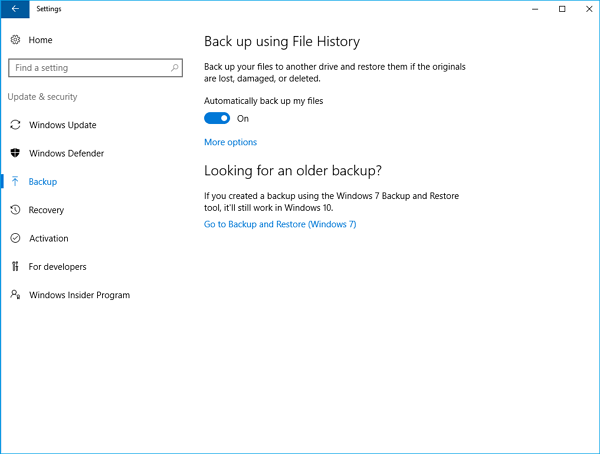
Step 2.To access the Backup and Restore (Windows 7) utility, go to Settings, click on Update and Security, then navigate to Backup, and finally click on "go to Backup and Restore (Windows 7)".
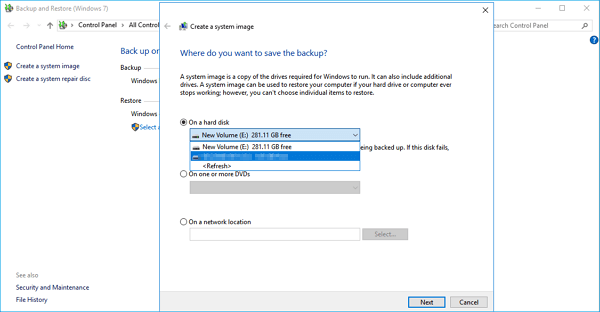
Step 3.To create a system image, select the "Create a system image" option on the left pane, then choose "On a hard disk" from the "Where do you want to save the backup?" section. Finally, select the target external hard drive from the "On a hard disk" drop-down menu.
Step 4. Wait for a full backup of your system to complete, then click "Next" and "Start backup".
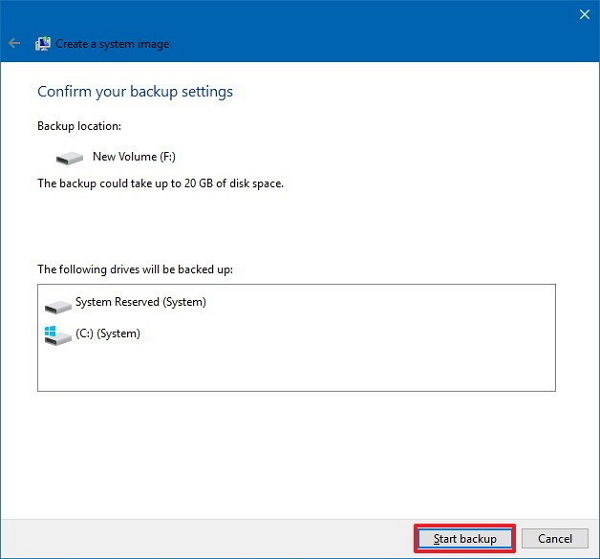
When the backup is done, you'll be prompted to create a system repair disk to access recovery options if your computer can't boot.
How to Restore a System Image Backup of Windows 10
If your computer boots normally, you can easily restore the backup image.
To restore a Windows 10 system image from an external hard drive, go to Settings > Update & Security > Recovery, click Restart now in the Advanced startup section, and then follow the instructions to restore the system image in the Troubleshoot > Advanced Options > System Image Recovery section.
If your computer can't boot properly, you can try restoring from a previous system backup to start over a Windows installation.
Step 1.Connect the external drive with the system image backup and the system repair disc to your computer.
Step 2. To fix a computer that won't boot, create a repair disk, and use it to reboot your computer. You may need to change the BIOS settings to allow the computer to boot from the CD or DVD drive, which can usually be done by hitting the "Delete/F2" key.
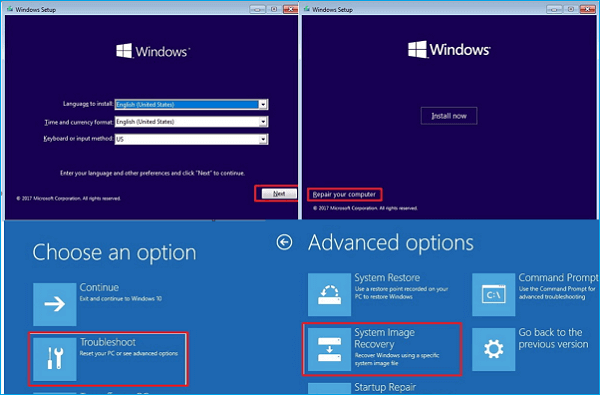
Step 3. When the "Windows Setup" appears, click "Next" and then select "Repair your computer" from the bottom-left corner, followed by "Troubleshoot" and then "System Image Recovery", where you can choose Windows 10.
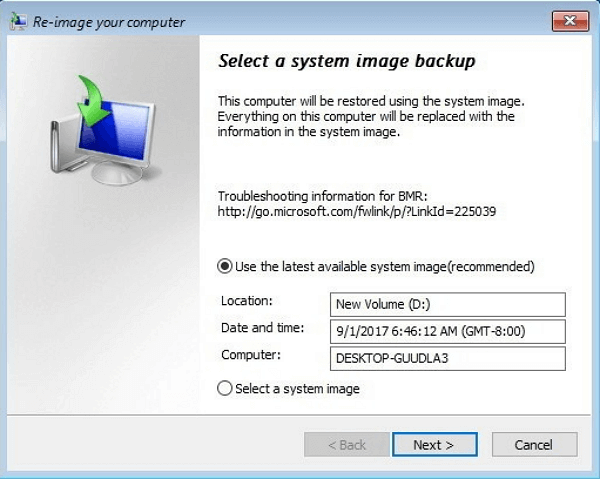
Step 4. Select the "Use the latest available system image" > "Next".
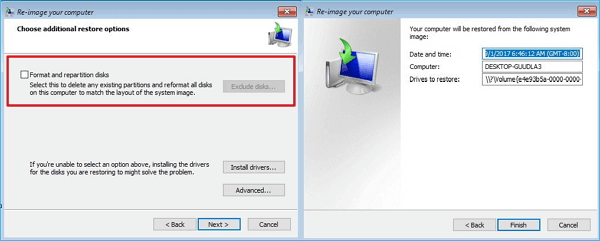
Step 5. To restore the Windows 10 system image from an external hard drive, select the "Format and repartition disks" option if you want to restore the image to a new drive. This will erase any existing partitions and disks on your computer, so be sure to confirm this action by clicking "Next", then "Finish", and finally "Yes" to start the recovery process.
- Notice:
- While the system repair disc can be used to boot and restore a backup image, it can be cumbersome, especially if there's no CD drive. Fortunately, there's a simpler method to create and restore a Windows 10 system image, which we'll cover in the next section.
How to Create and Restore Windows 10 System Image Without System Repair Disc
Here, we highly recommend using Qiling Backup, a reliable and professional backup & recovery tool, to back up your system, hard drive, partition, personal data, and installed applications with simple steps. Additionally, it allows you to clone HDD to SSD, MBR disk to GPT disk, or GPT disk to MBR disk from an old hard disk to a new one or small-size disk to large-size disk. To restore a Windows 10 system image from an external hard drive, follow the guides provided.
To perform system recovery on a non-bootable machine, try booting the computer through the installation media, such as a USB drive or CD/DVD, to access the recovery options.Qiling Backup emergency disk.
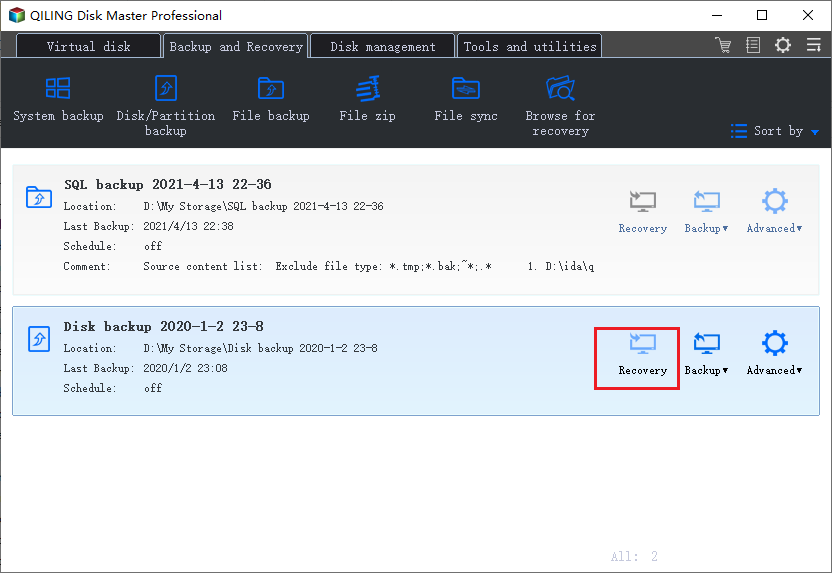
Step 1. Launch Qiling Backup, click "Browse for Recovery".
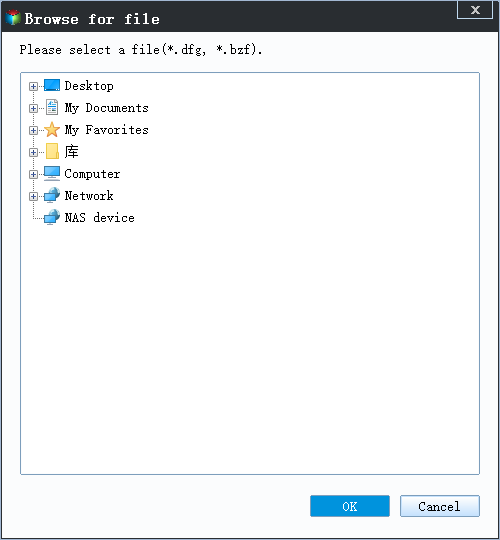
Step 2. To access your backups, navigate to your backup destination and select the system backup file you need. The backup file created by Qiling Backup is typically a .fvd file.
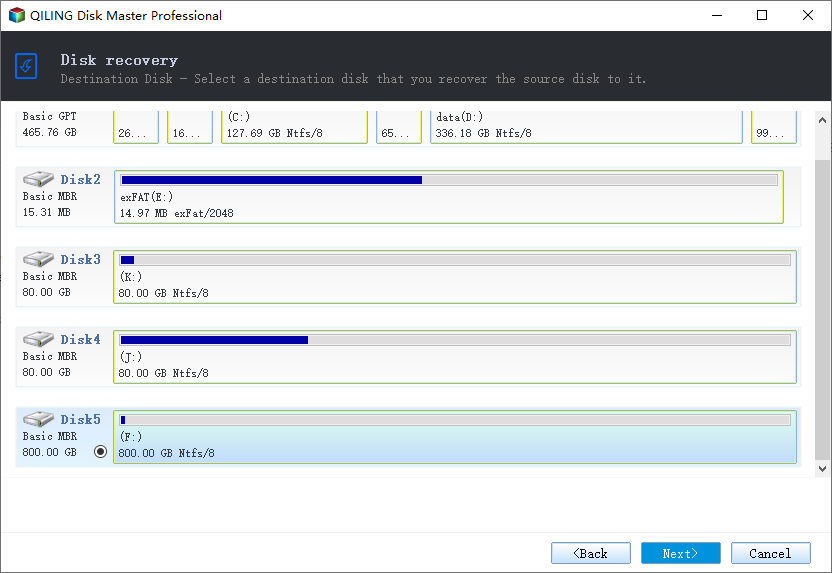
Step 3. Ensure the recovery disk has the same partition style as the source disk, then select it for cloning.
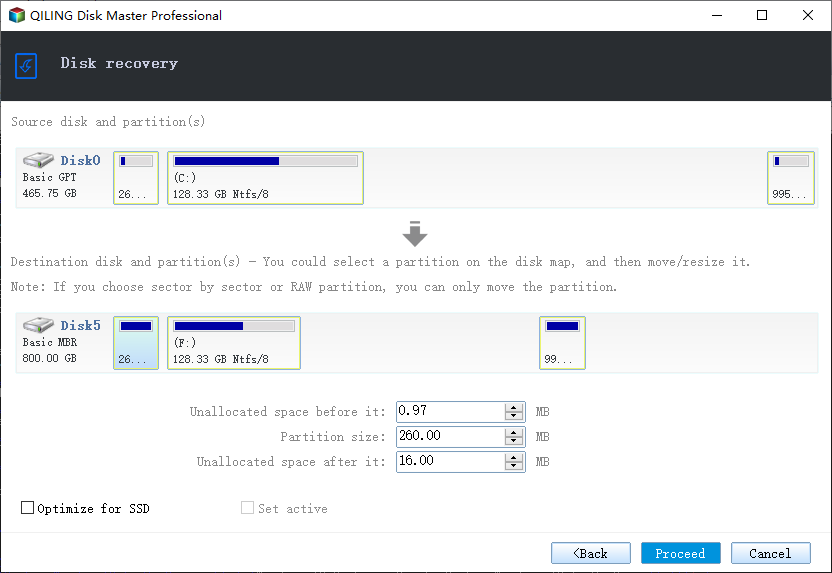
Step 4.To customize the disk layout, select the desired configuration and click "Proceed" to start system backup recovery.
Related Articles
- Windows 10 System Restore Points Gone and Missing
- Fix: Windows 10 Upgrade Stuck at 75% or 76%
- How to Cancel Windows 10 Updates Once Started
- Fix Hard Drive Won't Power Up/Turn on Without Data Loss
- CPU OPT vs. CPU FAN: How Do They Differ? [Distinct Comparison]
Are you building your system and wondering between CPU OPT and CPU FAN and where you should add the cooling fan on the motherboard? Continue reading this article to find out what CPU OPT and FAN headers are and the difference between them. - Crucial BX500 VS MX500: What's Their Difference [2024 New]
Do you know the difference between Crucial BX500 and MX500? This article focuses on Crucial BX500 VS MX500, so dive into learning if you want to compare them in price, appearance, capacity, warranty, and performance.
Products
Articles & Tutorials
- Data Recovery
- Data Backup
- File Recovery
- File Backup
- System Backup and Restore
- Disk and Partition Clone
- Technical articles
- Mobile articles
- Disk Master Help
- Windows Data Recovery Tutorials
- Windows Secure Delete Tutorials
- Windows Partition Management Tutorials
- Windows File Backup and Restore Tutorials
- Windows System Backup and Restore Tutorials
- Windows Disk Backup and Restore Tutorials
- Windows Clone Tutorials