[Solved] Windows 11/10 Show Hidden Files Not Working
To resolve the Show Hidden Files Not Working issue in Windows 11/10, you can try one of the following four reliable fixes: enable the "Show hidden files" option in File Explorer settings, disable the "Hide protected operating system files" option, reset File Explorer to its default settings, or check for corrupted system files and repair them using the System File Checker (SFC) tool.
| Workable Solutions | Step-by-step Troubleshooting |
|---|---|
| Fix 1. Show Hidden Files | Open Folder > View > Check "Hidden items"...Full steps |
| Fix 2. Run SFC | Open Command Prompt as Administrator > Enter DISM.exe /Online /Cleanup-image /Restorehealth...Full steps |
| Fix 3. Adjust Registry | Press Windows + R > Enter regedit > Click "OK"...Full steps |
| Fix 4. Recover Hidden File | Run Deep Data Recovery > Scan and recover hidden files...Full steps |
Show Hidden Files Not Working in Windows 11/10
On Windows 10, the option to show hidden files and folders may keep unchecking itself. This is often caused by a Group Policy setting or a third-party application interfering with system settings. To resolve this, check the Group Policy settings by typing "gpedit.msc" in the Run dialog (Windows key + R), navigate to Computer Configuration > Administrative Templates > System > File Explorer, and look for any policies related to hiding or showing files. If that doesn't work, try disabling recently installed third-party applications that might be causing the issue. Additionally, running the System File Checker (SFC) and DISM tools can help scan and repair corrupted system files.
If the File Explorer Options "Show hidden files, folders, and drives" checkbox does not work as expected, the hidden files may still not appear even after checking the option. This is a common issue, and the solutions below can help resolve it.
How to Fix "Show Hidden Files Not Working" in Windows 11/10
Before attempting to recover hidden files, try the following fixes to make them visible again. There are certain methods to recover hidden files, but first, it's recommended to try these solutions.
Method 1. Use Alternative Ways to Show Hidden Files
The first way is to enable the File Explorer's "Show hidden files, folders, and drives" option. To do this, open File Explorer, click on the three dots, and select "File Explorer Options.
To view hidden files, open the folder that contains them, go to the "View" tab, and check the box next to "Hidden items".
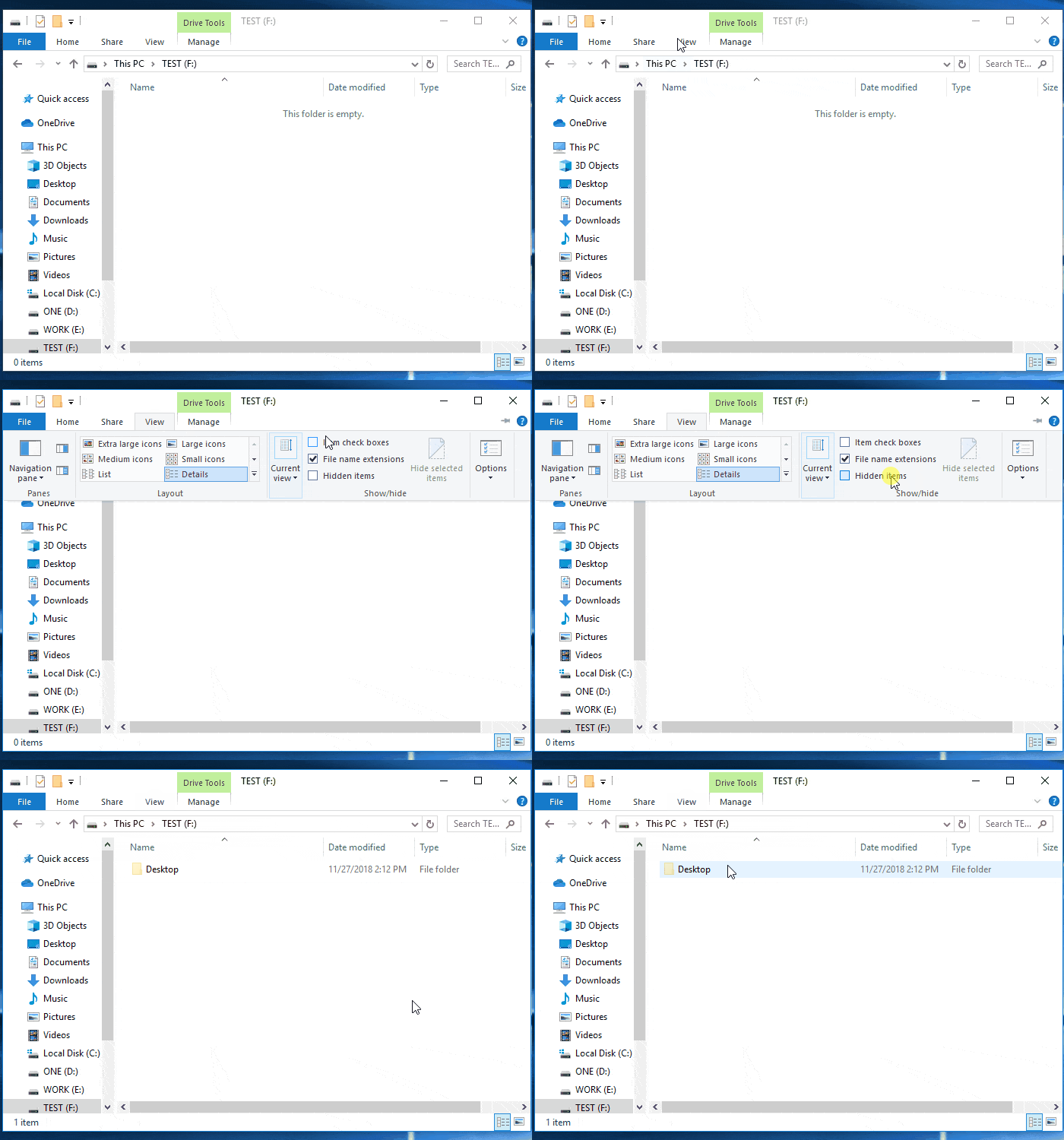
To show hidden files, folders, and drives in Windows, go to the "Control Panel" and select "File Explorer Options". Then, navigate to the "View" tab and tick the box that says "Show hidden files, folders, and drives".
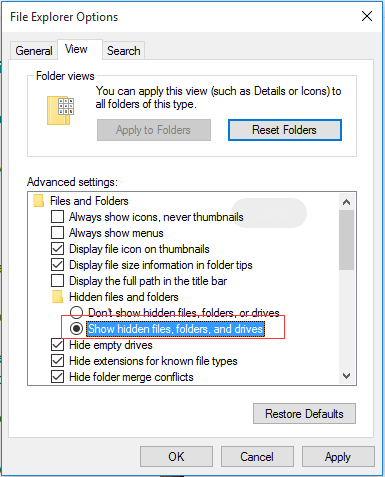
If you're having trouble showing hidden files in Windows 10, there are a few other options to try. You can also use the File Explorer settings to show hidden files, by going to View, then Options, and selecting the "Show hidden files, folders, and drives" checkbox. Alternatively, you can use Command Prompt to show hidden files.
Option 3. Show Hidden Files Using CMD
Step 1. Click "Start" and enter cmd.
Step 2. Right-click "Command Prompt" and choose "Run as administrator".
Step 3. To remove the hidden, read-only, and system attributes from all files on a drive, open Command Prompt and enter `attrib -h -r -s /s /d f:*.*` (Replace "f" with the drive letter of the partition that contains the hidden files).

For users who prefer a simpler approach over manual command-line operations, Qiling CleanGenius offers a one-click solution to show hidden files.
To show hidden files using this 1-click-fix software, follow these simple steps.
Step 1. DOWNLOAD Qiling CleanGenius for Free.
Step 2. Start Qiling CleanGenius, choose "Optimization" on the left panel. Next, click "File Showing" on the right panel.
Step 3. Select the hard drive and click "Execute".
Step 4. After the operation completes, click the here link to check the hidden files.
Method 2. Run System File Checker Tool
If you're unable to check the "Show hidden files" option in Windows 10, it's likely due to corrupted system files. Running the System File Checker tool can help repair missing or corrupted system files, which may resolve the issue.
Step 1. Click "Start" and type cmd.
Step 2. Right-click "Command Prompt" and choose "Run as administrator".
Step 3. Enter the following command lines in order. (The DISM command is used to make a Windows image to protect your data.)
DISM.exe /Online /Cleanup-image /Restorehealth sfc /scannow
Step 4. Restart the computer and check whether the problem persists.
Method 3. Adjust the Registry
Be careful when modifying the registry as it can cause serious system errors if done incorrectly.
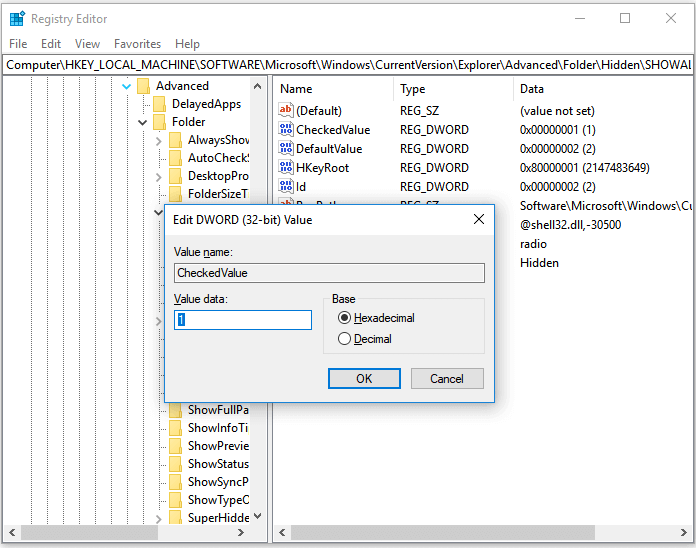
Step 1. Press "Windows + R" keys and enter "Regedit". In the prompt, click "OK".
Step 2. Go to:
HKEY_LOCAL_MACHINE\SOFTWARE\Microsoft\Windows\CurrentVersion\Explorer\Advanced\Folder\Hidden\SHOWALL
Step 3. Double-click "CheckedValue" and set the "Value data" as "1".
Step 4. Reboot your computer and check whether "show hidden files not working" still exist.
Method 4. Recover Hidden Files
If you still can't see your hidden files, you can use data recovery software like Deep Data Recovery to recover them. This software can also help recover deleted, formatted, and lost files from your computer or external storage devices, and is 100% secure and virus-free.
To recover all your hidden files and folders:
Step 1. Select file types and click "Fast Scan" to start
Run Qiling virus file recovery software on your Windows PC. Select file types and click "Fast Scan" to proceed with the recovery process.
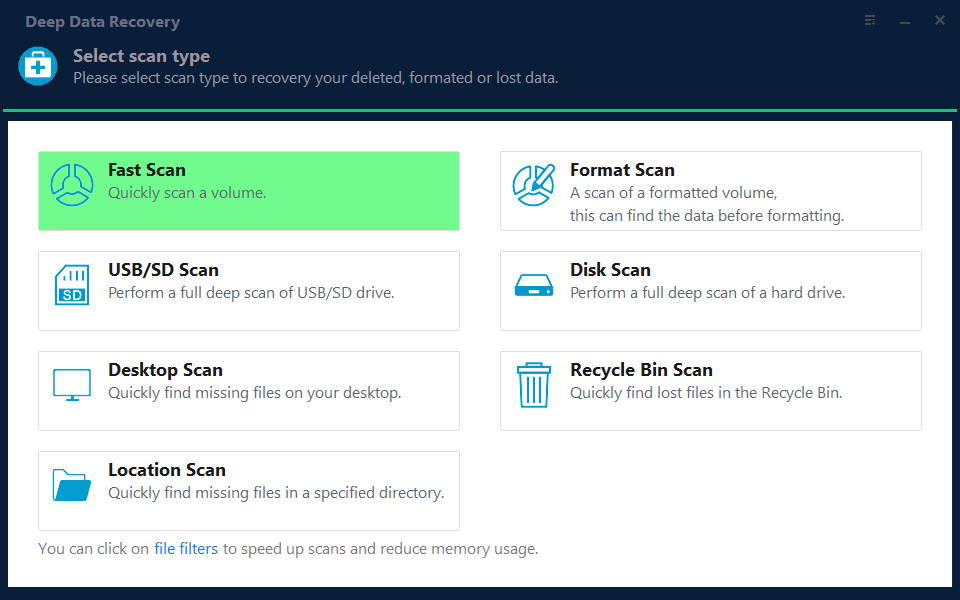
Note: You can choose different search modes based on where and why the data was lost.
Step 2. Select the virus infected drive to scan
To scan for lost or hidden files, select the disk where the files were located. Note that this process may not recover all lost data, but it can help identify files that may be recoverable.
- If the issue is caused by a virus on the HDD, it's best to install the software on a separate volume or an external USB drive to prevent data overwriting.
- If the infected device is an external hard drive, flash drive, or memory card, it's okay to install the software on the local drive of the computer.
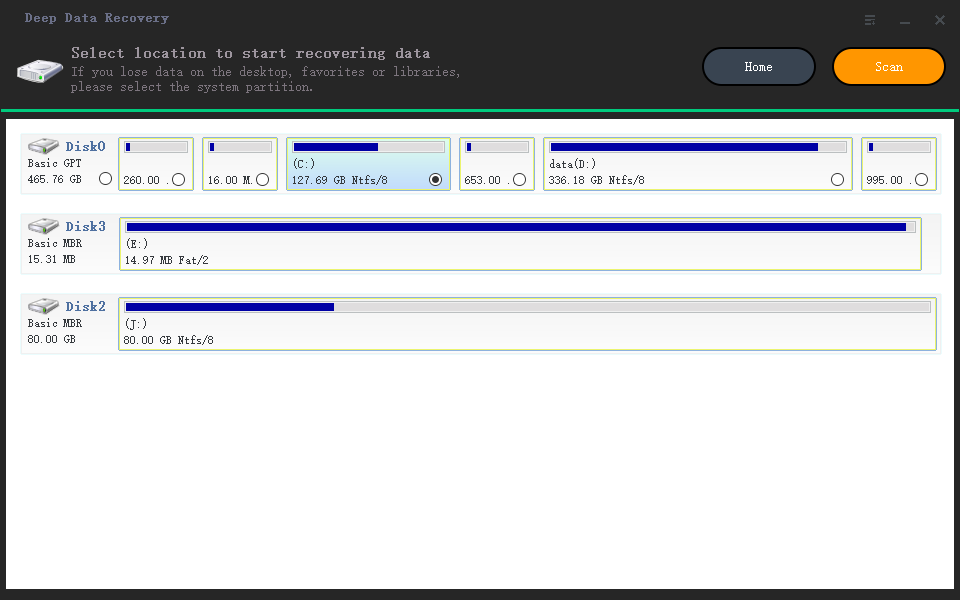
Step 3. Check all scanned results
Deep Data Recovery will initiate a scan process to locate deleted or hidden files on the virus-infected hard drive. To quickly pinpoint desired files, users can utilize the Filter or type grouping feature to display specific types of files, such as pictures, videos, documents, or emails.
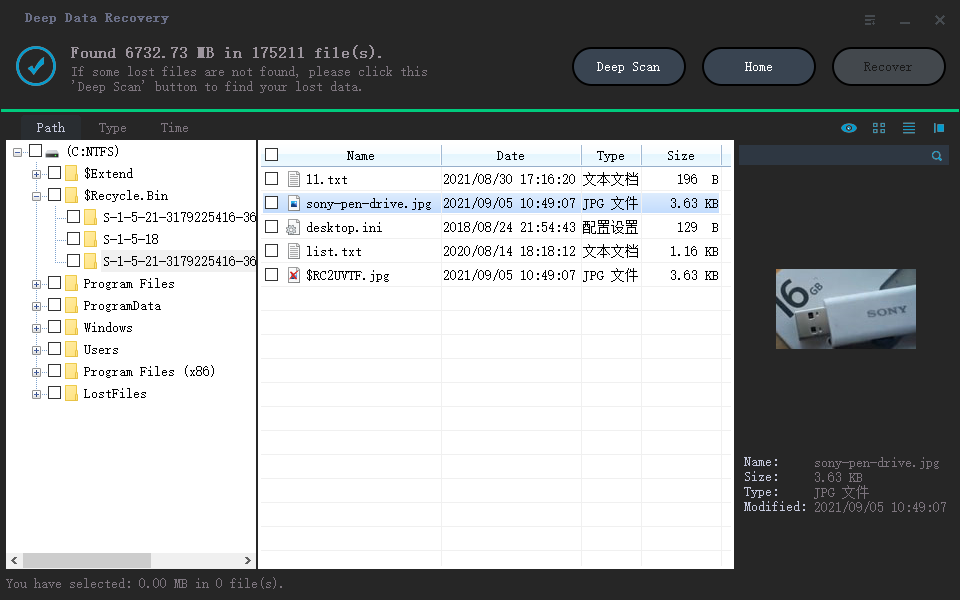
Step 4. Preview and recover deleted/hidden files
After the scanning process is complete, you can preview the recovered files. Select the files you want to recover and click the "Recover" button. It's essential to save the restored files to a different, secure location on your computer or storage device, rather than the original lost location.
The Bottom Line
If "Show hidden files" in Windows 10 isn't working, you can try using an alternative method, running the System File Checker tool, or modifying the registry key. If these tips don't help, you can recover your hidden files using data recovery software. This can help you get back your hidden files and folders.
Related Articles
- How to Convert RAW to NTFS Without Losing Data [2022 Solutions]
- Should You Wait for a Response or Close When Excel Frozen but Not Crashed? 10 Tricks Here
- 10 Best Data Recovery Software for Windows 7 Free Download Full Version
- How to Reset Windows 10 Password in 4 Ways (Step-by-Step Tutorial)
- Does BitLocker Slow Down SSD? Yes, up to 45%
Many users wonder if BitLocker slows down SSDs, and if there's a way to disable it to enhance performance. If you're curious about this, keep reading for comprehensive answers to your questions. - How to Downgrade from Monterey to Big Sur [macOS 12 to 11]
To downgrade from Monterey to Big Sur, follow these three proven methods. Downgrading macOS Monterey becomes straightforward with these steps. If you lost some of your critical data while downgrading the macOS, Deep Data Recovery could be your great helper.
Products
Articles & Tutorials
- Data Recovery
- Data Backup
- File Recovery
- File Backup
- System Backup and Restore
- Disk and Partition Clone
- Technical articles
- Mobile articles
- Disk Master Help
- Windows Data Recovery Tutorials
- Windows Secure Delete Tutorials
- Windows Partition Management Tutorials
- Windows File Backup and Restore Tutorials
- Windows System Backup and Restore Tutorials
- Windows Disk Backup and Restore Tutorials
- Windows Clone Tutorials