3-Minute Guide | How to Restore Outlook Backup with Ease
Microsoft Outlook is a personal information management program that manages email, contacts, and calendars, and is part of the Microsoft Office Suite. It stores data in PST (Personal Storage Table) files, which contain email messages, contacts, calendar items, and other information.
If your computer crashes or you lose your Outlook data, you can restore it from a backup. Backups are usually stored as PST files if you use the Import and Export wizard in Outlook, or through third-party software that specifically backs up Outlook files. This post will guide you on how to restore your Outlook backup using both the Import and Export wizard and third-party software.
What Should You Do Before Restoring Outlook Backup
Before restoring backups, ensure the file you want to restore is not being used by another program, and close the program if it is.
You should also check the file size of the backup file. If it is larger than 50GB, it is recommended that you use a professional Outlook backup and restore tool, Qiling Backup, to help you backup and restore files.
Here are some other items you should pay attention to:
- Make sure your Outlook data is backed up
The first premise of restoring Outlook data is to ensure that your data files have been backed up. Otherwise, there is no way to restore them.
- Identify what tools you use to back up Outlook data
To restore Outlook data, it's essential to know what tool was used for the backup. Some users rely on Outlook's built-in Import and Export Wizard, while others utilize third-party tools like Qiling Backup. Knowing the specific tool used will be helpful in initiating the restoration process.
- Identify where your backup is stored
When using Outlook's Import and Export Wizard, backups are stored as PST files on the local drive. In contrast, Qiling Backup stores backups in the specified location, which can be the local drive, a Network-Attached Storage (NAS), or the Qiling Cloud.
Related articles:
How to Restore Outlook Backup – 2 Solutions
Solution 1. Restore Outlook Backup with Import/Export Wizard
If you use Outlook's Import and Export Wizard to back up your data, your backups will be stored as a PST file, which can be restored by locating the PST file.
- Notice:
- The method you're referring to is likely the process of attaching a PST file to Microsoft Outlook. To do this, you need to know the exact location where the PST file is stored, which can usually be found in the "Roaming" or "Local" folders within your user account, depending on the version of Windows you're using. Once you've located the PST file, you can simply drag and drop it into the "Outlook Data File" section within the Outlook application, or you can use the "File" menu to import the PST file.
You can find them according to the path:
For Outlook 2010/2013/2016/2019: C:\Users\username\Documents\Outlook Files
For Outlook 2007: C:\Users\username\AppData\Local\Microsoft\Outlook
Here are the detailed steps:
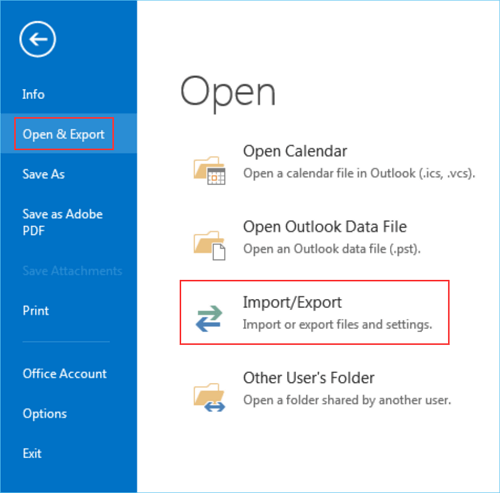
Step 1. Open Microsoft Outlook and click "File".
Step 2. Click "Open & Export" > "Import/Export".
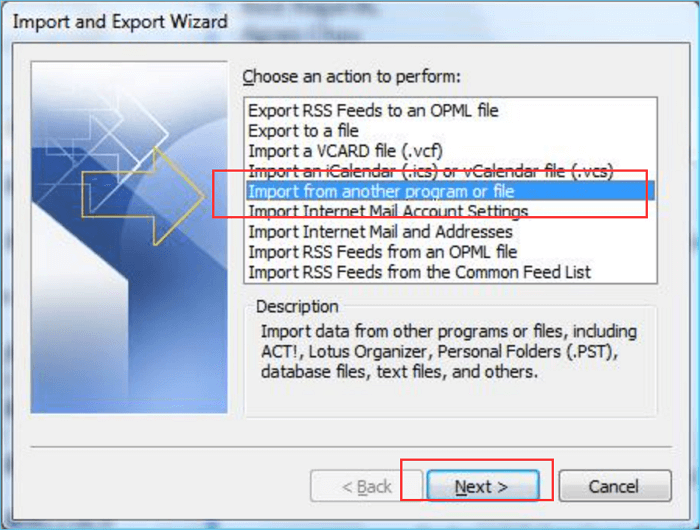
Step 3. Select the "Import from another program or file" option, and then click "Next".
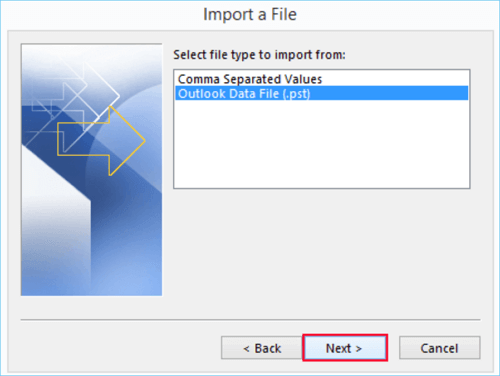
Step 4. Choose "Outlook Data File (.pst)" and click "Next".
Step 5. Locate the PST file you want to restore and click "Finish".
Step 6. Select how you want to handle duplicates and click "Next".
Step 7. Select the destination for your imported items and click "Finish".
Step 8. Click "Close" when the import is complete.
Solution 2. Restore Outlook Backup with Backup Software
Qiling Backup is a free backup software that allows you to easily back up and restore Outlook files. It enables you to save your Outlook data to an external hard drive, NAS, or Qiling Cloud, providing a convenient way to safeguard your important information.
This software allows for incremental or differential backups, saving time by only backing up changed data since the last full backup. It also compresses and encrypts backups to save storage space and protect data security.
Follow the guide to backup and restore your Outlook data:
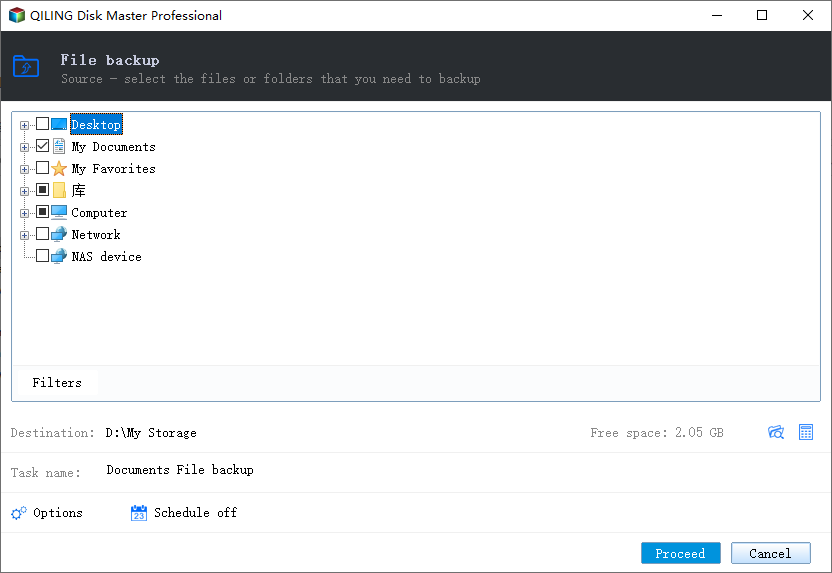
Step 1. Launch Qiling Backup on your computer, and click File Backup on the home screen.
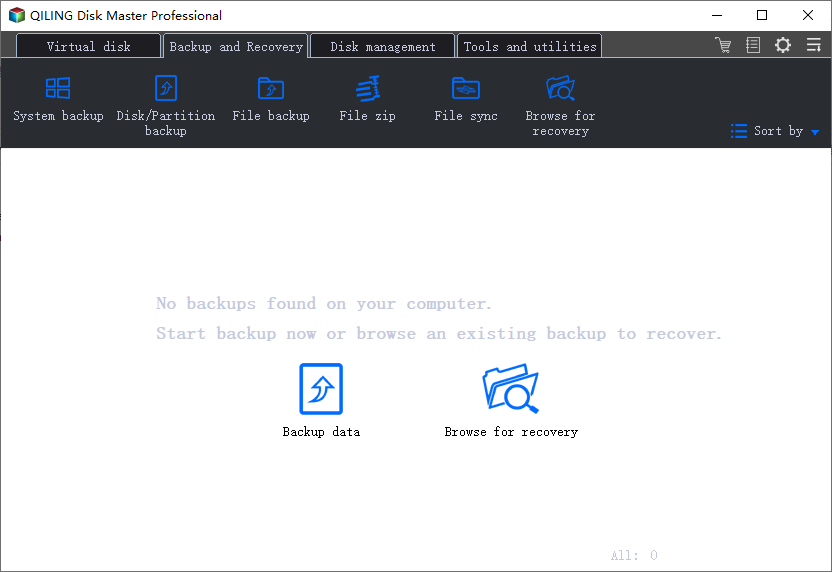
Step 2. To make a backup of your Microsoft Outlook emails, contacts, or calendars, select the mailbox addresses you want to backup from your Microsoft Outlook database folder.
Step 3. To save the Outlook backup, select a location by clicking the illustrated area.
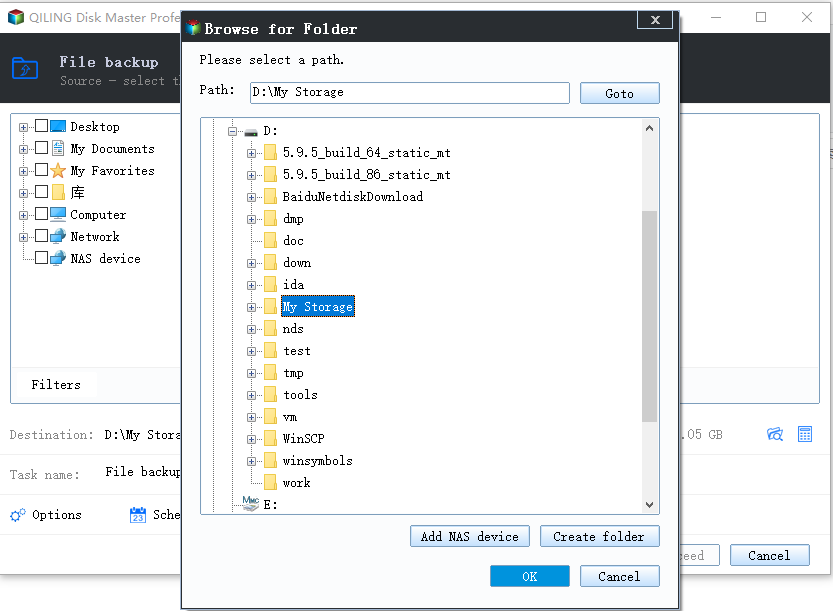
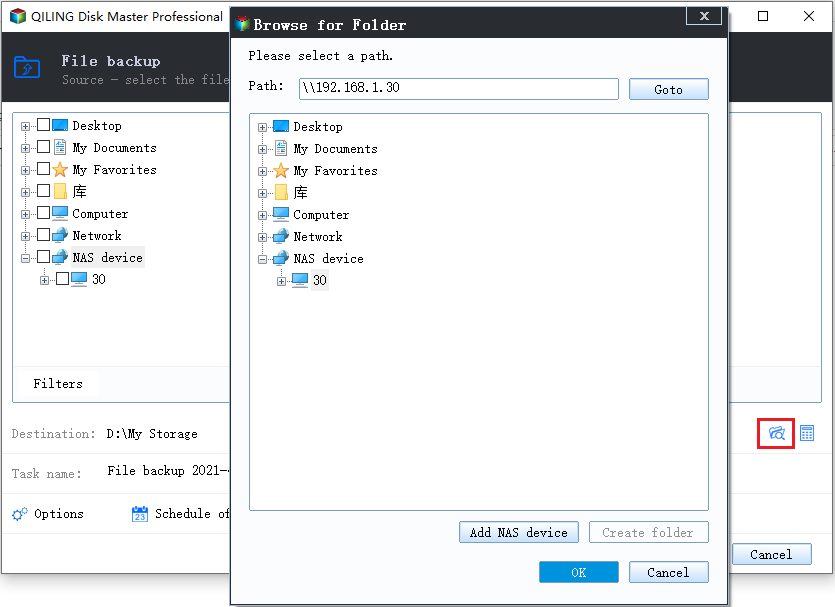
Step 4. The backup location can be another local drive, external hard drive, network, cloud, or NAS, with external drives or cloud storage being recommended for preserving backup files.
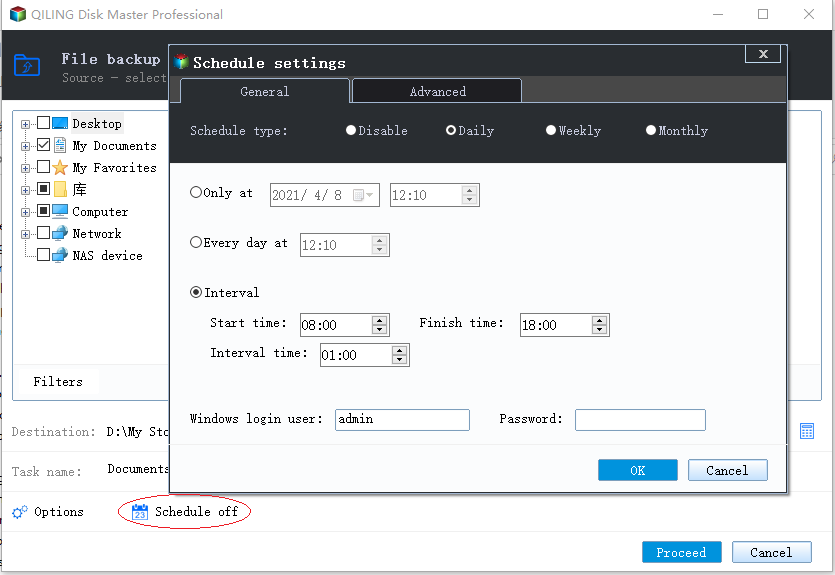
Step 5. In the Options section, you can set up automatic backup schedules in daily, weekly, monthly, or upon an event, and also choose to make differential and incremental backups. Once you've made your selections, click "Proceed" to start the Outlook backup process. The completed task will be displayed on the left side in a card style.
Now you can restore Outlook backup with the following steps:
Step 1. Launch Qiling Backup, click "Browse to Recover".
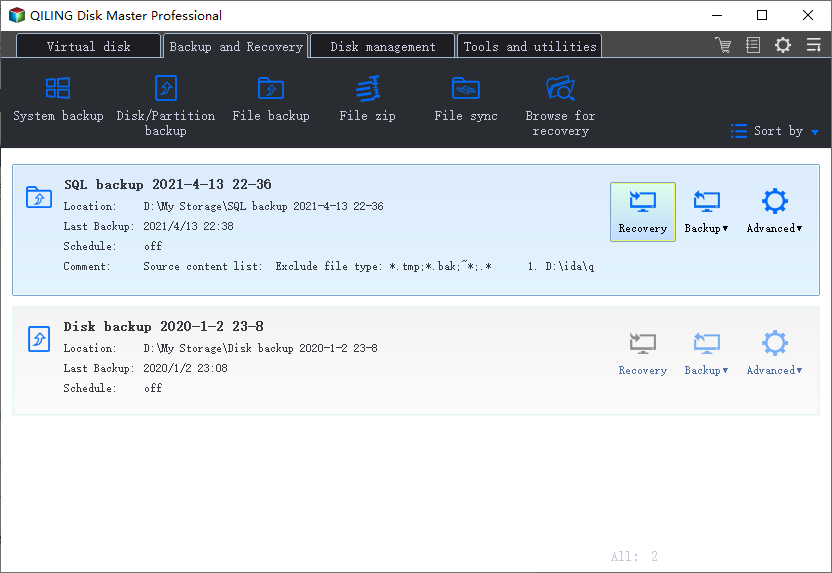
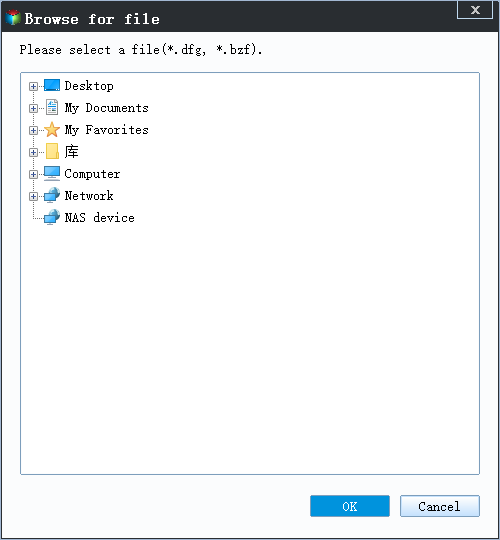
Step 2. To recover a backup, go to the backup destination you specified earlier, and choose the fvd file you created with Qiling Backup. This file contains the backup data you want to restore.
Step 3. You can recover data to a specific location or to the original location that it was saved in.
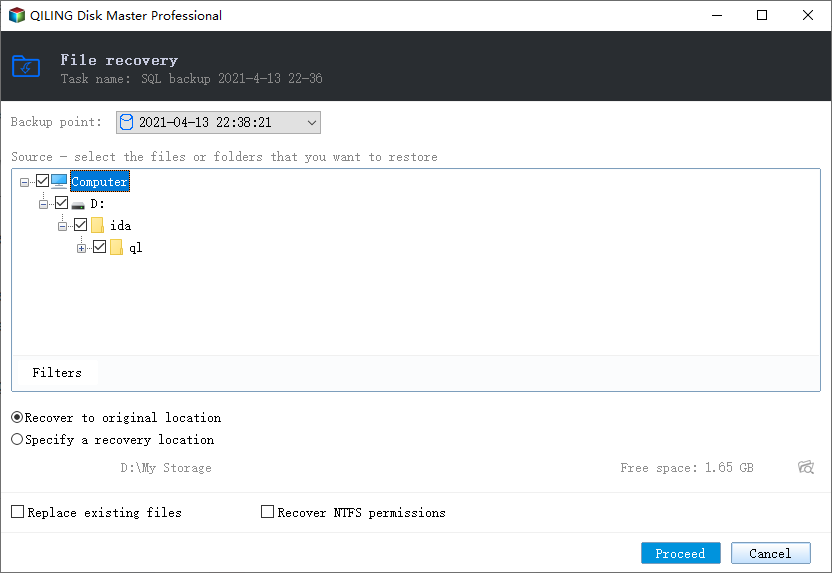
Step 4. Click "Proceed" and the recovery would start.
Conclusion
We have shown you how to restore Outlook backup in two ways. If you use Outlook's Import and Export Wizard to back up your data, you can use it to restore your backup files from the PST files.
With Qiling Backup, you can easily restore your backup and enjoy the convenience of saving space on your local drives by backing up Outlook to Cloud. The best part? It's completely free, with no fees for backup and restore functions, and comes with a generous 250GB of free cloud storage, making it a must-have backup tool for your work and life. Download and try it now!
FAQ about How to Restore Outlook Backup
1. How do I restore emails from Outlook backup?
To restore your emails from a backup file, open Microsoft Outlook, go to File > Open & Export > Import/Export, select "Import from another program or file", and then choose "Outlook Data File (.pst)" to select the backup file and restore your emails.
2. How do I access my Outlook backup files?
Your backups will be stored as PST files, located in a designated folder.
For Outlook 2010/2013/2016/2019: C:\Users\username\Documents\Outlook Files
For Outlook 2007: C:\Users\username\AppData\Local\Microsoft\Outlook
Related Articles
- How to Clone RAID Disk Safely and Easily
- Top 5 Best Free SSD Backup Software for Windows in 2022
- Top 7 Best Backup Software for Windows 7 64 Bit/32 Bit Recommends [Free & Paid]
- How to Backup Dell Laptops in Windows 10 [Ultimate Guide]
- How to Incremental Backup HDD to External Hard Drive
How to incremental backup internal hard drive (HDD) to external hard drive when you frequently change and Filess or applications on the hard drive? In fact, it could be easier than ever. - How to Install OS on Multiple Computers Simultaneously?
In order to install OS on multiple computers simultaneously, a must-be access is to create system backup image. Besides, you should deploy system image files to multiple computers in a same LAN.
Products
Articles & Tutorials
- Data Recovery
- Data Backup
- File Recovery
- File Backup
- System Backup and Restore
- Disk and Partition Clone
- Technical articles
- Mobile articles
- Disk Master Help
- Windows Data Recovery Tutorials
- Windows Secure Delete Tutorials
- Windows Partition Management Tutorials
- Windows File Backup and Restore Tutorials
- Windows System Backup and Restore Tutorials
- Windows Disk Backup and Restore Tutorials
- Windows Clone Tutorials