Does Caching Leave Your Data Behind? A Privacy Guide
Every cache is a copy. That is the whole point: instead of fetching something twice, the system keeps a duplicate close at hand. Which means that when you view a photo, open a document, or visit a website, a copy of some of that content may be sitting on your disk long after you move on. Understanding which caches keep what — and what clearing them actually removes — is the difference between feeling private and being private.
This guide covers what the common caches store, what clearing really does, where a RAM disk genuinely helps, and the limits you should be honest about.
PAGE CONTENT
- Caches Are Copies
- What Different Caches Actually Keep
- What Clearing a Cache Really Removes
- Where a RAM Disk Genuinely Helps
- Reducing Traces on a Shared PC
- The Honest Limits
- FAQs About Caches and Privacy
- Back Up Windows Before You Change Settings
Caches Are Copies
A cache stores data so that the next request is faster. Three consequences follow, and all three matter for privacy:
- A copy exists somewhere other than the original. Deleting the original does not necessarily delete the cached copy.
- The copy is usually unencrypted and readable by anything running with your user account, and by anyone with access to the drive.
- How long it survives depends on where it lives. A cache in memory disappears at shutdown; a cache on disk persists until something removes it.
That last point is the most useful one, and it explains why memory-backed storage is attractive for temporary work and why disk caches are not a privacy feature on their own.
What Different Caches Actually Keep
| Cache | What it holds | Survives a reboot |
|---|---|---|
| Browser cache | Images, scripts, styles, fonts, and sometimes page fragments | Yes |
| Cookies and site data | Login sessions and tracking identifiers | Yes, until they expire |
| Browser history | URLs, titles, and visit times | Yes |
| Thumbnail cache | Previews of images and videos you viewed | Yes |
| Search index | File names, paths, and indexed content for fast search | Yes |
| Recent files and jump lists | Documents and locations you opened | Yes |
| Application temp files | Scratch data, auto-save copies, previews | Usually not, if cleaned on exit |
| Disk cache in RAM | Copies of recently read blocks | No |
Note the pattern: the caches people worry about most — browser data, thumbnails, search index — are precisely the ones stored on disk, and the ones that vanish at shutdown are the technical caches nobody asks about.
What Clearing a Cache Really Removes
Clearing is useful, but it is not a general eraser. In a browser, the cache, cookies, site data, and history are separate categories, and clearing one does not clear the others. In Windows, removing thumbnails does not remove the search index or your recent files list.
What clearing does not touch:
- Cloud copies. If your data synced to a cloud service, it exists there independently of anything on your PC.
- Backups. A system image or file backup contains whatever was present when it was made, cache files included.
- Data inside other applications. Each program keeps its own caches and histories, and each must be cleared on its own.
- Deleted data still on the drive. Removing a file does not guarantee its contents are unrecoverable; see the limits below.
- Note
- If the goal is to leave no useful copy behind on a machine you do not control, clearing caches after the fact is the weaker approach. Keeping the data off the disk in the first place is much stronger.
Where a RAM Disk Genuinely Helps
A RAM disk is volatile storage: everything on it is gone when the PC shuts down or restarts. That makes it the right home for temporary data you would rather not leave on disk.
- Browser cache — images and scripts written constantly, none of which needs to persist. See Move Browser Cache to a RAM Disk.
- The Windows TEMP folder — installers, extractors, and editors leave behind partially written files. See Move the TEMP Folder to a RAM Disk.
- Application scratch space — the working data from image, video, and 3D tools.
- Sensitive documents you are working on, as long as you save the real copy to encrypted storage.
Qiling Disk Master creates the RAM disk in a few clicks and remounts it automatically at every startup, so the temporary paths always exist:
Two honest caveats. First, a RAM disk does not automatically wipe its contents at shutdown if the machine hibernates, because the memory image is written to disk to preserve the session. Second, the memory could in theory be read by an attacker with physical access and specialized techniques for a short time after power loss. For normal personal and business use these are edge cases, but they are worth knowing.
Reducing Traces on a Shared PC
On a machine used by several people, or one you borrow, the order of priority is different from your own PC:
- Use separate Windows accounts. This is the single most effective measure, because user data, caches, and profiles are isolated by design.
- Use separate browser profiles rather than one shared profile, so caches, cookies, and history do not mix.
- Turn on device encryption. BitLocker or Device Encryption protects everything at rest, including cached copies, if the drive is removed or the PC is stolen.
- Prefer portable or session-limited tools for sensitive work, and use private browsing windows for one-off tasks.
- Restart rather than sleep when using a RAM disk for temporary work, so the volatile data is actually discarded.
- Clear what matters, not everything. Cookies sign you out of every site and Caches rebuild, so decide deliberately what to remove; see Windows 11 Thumbnail Cache for how one of these behaves in practice.
The Honest Limits
- Deleting is not erasing on flash storage. Solid-state drives use wear leveling and TRIM, so overwriting a file's logical location does not guarantee the physical cells are rewritten. Full-disk encryption is a far more reliable protection than post-hoc deletion.
- Encryption changes the question. With BitLocker enabled, a cached copy on the drive is unreadable without the key, which makes the presence of the cache far less important.
- Cloud and sync services keep their own copies. Nothing you do locally removes data already uploaded.
- Backups preserve the past. Cached data inside an old system image can surface years later; treat backups as sensitive too.
- Physical access beats most software measures. If someone can log in as you, they can read everything you can read, cache or no cache.
For individual files where deletion genuinely matters, use a file shredder that overwrites their contents before removal instead of relying on the Recycle Bin. Combine that with full-disk encryption, which is what makes any remaining cached copy harmless if the drive ever leaves your possession.
FAQs About Caches and Privacy
Does clearing my cache delete my personal files?
No. Caches hold copies, not originals. Clearing them removes the duplicates and any local traces they contain, but your documents, photos, and downloads are untouched.
Is a browser cache the same as cookies?
No. The cache stores page assets to make loading faster, while cookies store session and tracking data. Clearing one may leave the other intact, which is why "clear browsing data" offers several categories.
Does a disk cache store copies of my files?
Yes. A disk cache holds copies of blocks read from your drive, so those copies exist on the cache medium. A RAM cache is volatile and clears at shutdown; an SSD cache persists like any other data.
Is a RAM disk a security tool?
Not primarily. It reduces how long temporary data exists on disk, which is a genuine benefit, but it is not encryption and does not protect against someone who can use your account.
What actually protects sensitive data on a laptop?
Full-disk encryption, a strong account password, and keeping the only copy in a properly managed location. Caches are a secondary concern once those are in place.
Should I clear caches before selling a PC?
Clearing is not enough. Reset Windows or wipe the drive, and prefer a PC with encryption enabled so the remaining data is unreadable. See Should You Cache a Slow Drive or Buy a Bigger SSD? if the reset is part of a storage upgrade.
Back Up Windows Before You Change Settings
Clearing caches and changing storage settings is safe, but a backup protects everything else. Qiling Disk Master creates a full Windows image you can restore from if anything goes wrong.
Part 1: Create a Full System Backup
Step 1. Install and open Qiling Disk Master. On the home screen, open "Backup and Recovery" and choose "System Backup". This option automatically includes Windows and the hidden boot partitions, so you do not have to select them one by one.
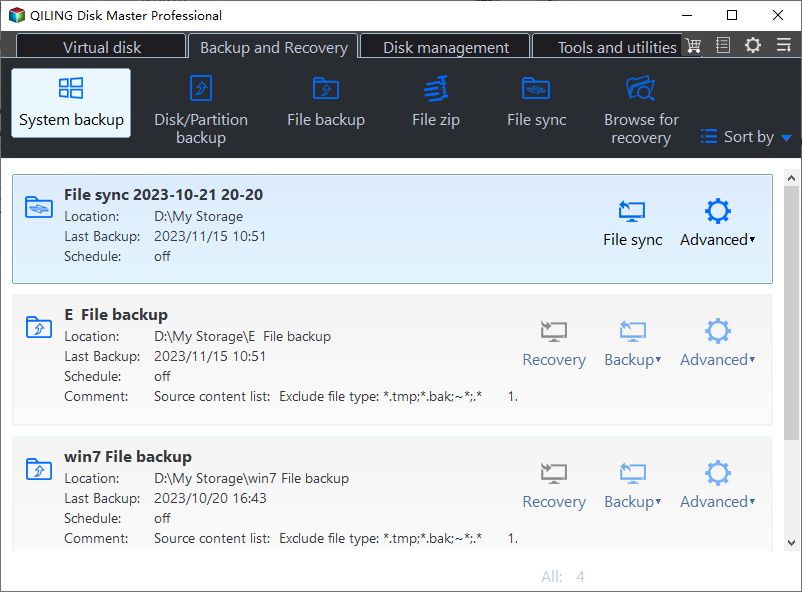
Step 2. Check the source. The disk where Windows is installed and its system partitions are already ticked for you. If you only need your personal documents, run a separate "File Backup" task instead.

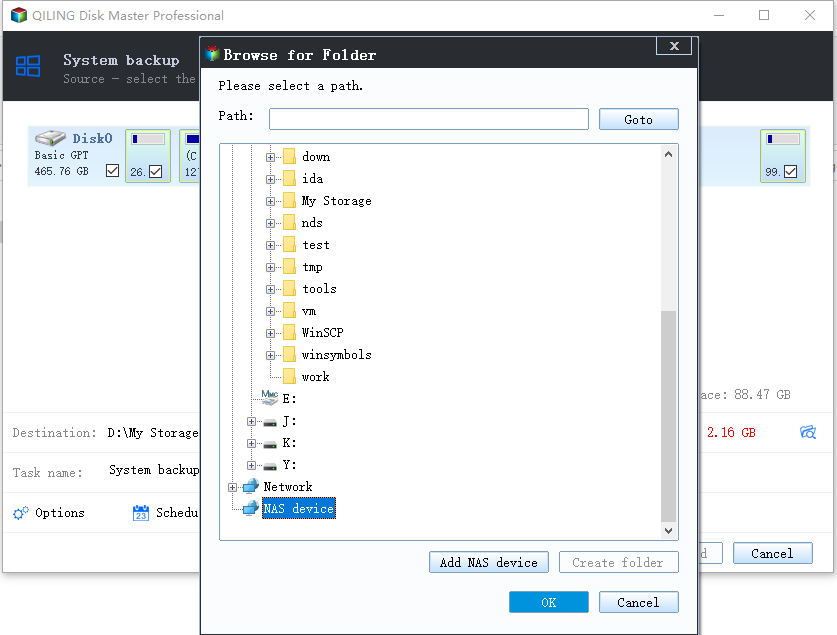
Step 3. Click the destination box and choose where the image should be saved. Use an external HDD or SSD, a NAS, or any drive other than the one Windows is installed on, and make sure it has enough free space.
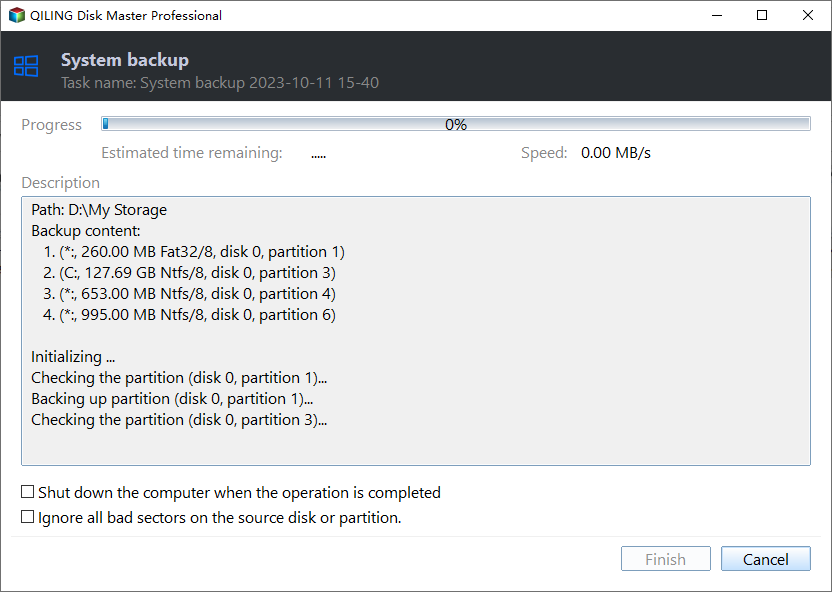
Step 4. Review the task summary and click "Proceed". Wait until the progress bar reaches 100%. Do not unplug the drive or turn off the PC while the backup is running.
Part 2: Restore Windows from the Backup
Step 1. Open Qiling Disk Master again, go to "Backup and Recovery", and select the recovery option. Your backup images are listed, so pick the one you created before the changes began.
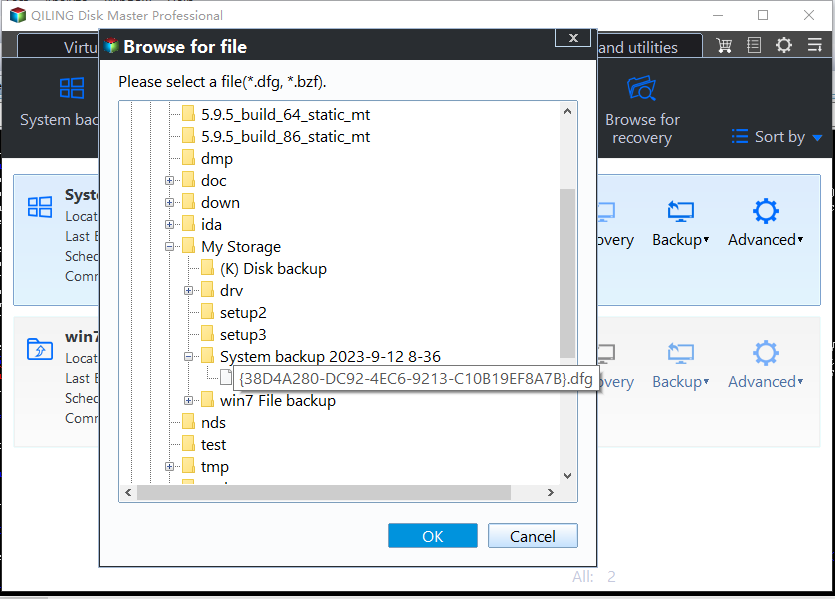
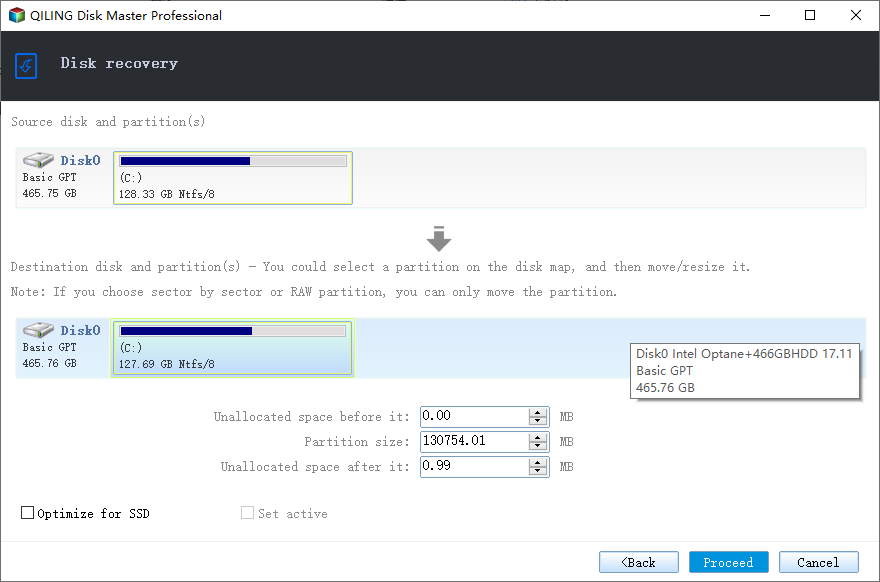
Step 2. Choose the target disk or partition. Normally you restore to the original system disk. If the drive was replaced, select the new disk instead, and the restore rebuilds Windows together with its boot partitions.
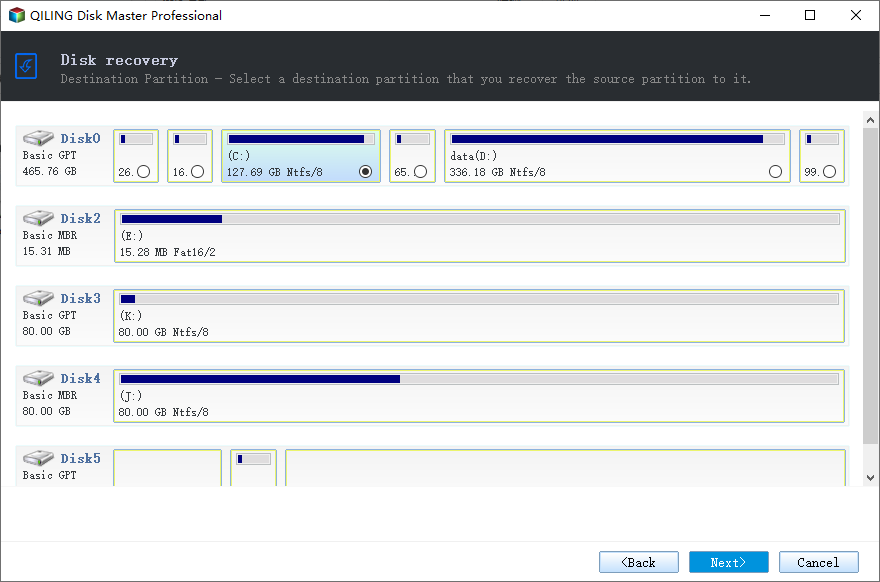
Step 3. Preview the restore plan, click "Proceed", and confirm the warning. The PC restarts to finish the job, and Windows comes back exactly as it was on the day the image was created, with your files and programs intact.
- Note
- Remember that a backup image contains cached data as well. Store it encrypted if the machine handles sensitive material.
Conclusion
Caches are copies, and the ones that store personal data — browser cache, cookies, thumbnails, search index — live on disk, where they persist until something removes them. Clearing works, but it is selective, and it cannot touch cloud copies, backups, or data that is already in a backup image. The stronger approach is architectural: keep temporary and sensitive work on volatile storage so there is nothing to clean up later. A RAM disk created with Qiling Disk Master does exactly that for browser caches, TEMP files, and scratch data, while full-disk encryption protects everything that does reach the disk. Treat clearing as a useful habit, and treat what never gets written as the real win.
Protect your PC with Qiling Backup—create a system image before your next round of settings changes.
For more Windows 11 performance guides, see Move Browser Cache to a RAM Disk, Move the TEMP Folder to a RAM Disk, Windows 11 Thumbnail Cache, Is a RAM Disk Worth It?, and Windows Update Cache.
Related Articles
- Move Browser Cache to a RAM Disk
The practical version of keeping browsing data off the disk. - Move the Windows TEMP Folder to a RAM Disk
Auto-save copies and installer leftovers never touch the drive. - Windows 11 Thumbnail Cache: Why Explorer Is Slow
- What Are L1 and L2 Cache? RAM and SSD Tiers Explained
- Windows Update Cache: Why It Grows
- Does Disk Caching Work with BitLocker Encryption?
Products
Articles & Tutorials
- Data Recovery
- Data Backup
- File Recovery
- File Backup
- System Backup and Restore
- Disk and Partition Clone
- Technical articles
- Mobile articles
- Disk Master Help
- Windows Data Recovery Tutorials
- Windows Secure Delete Tutorials
- Windows Partition Management Tutorials
- Windows File Backup and Restore Tutorials
- Windows System Backup and Restore Tutorials
- Windows Disk Backup and Restore Tutorials
- Windows Clone Tutorials