PowerShell Check If File Exists | 4 Examples
PowerShell Check If File Exists Overview
In Windows systems, PowerShell offers a powerful scripting language and automation framework, featuring various file operations, making it a popular choice among system administrators and developers, allowing for file management and deletion.
Verifying the existence of a file is a crucial task in many PowerShell scripts, ensuring that subsequent operations can be performed safely and efficiently. Before deleting any files, it's essential to check for their existence to avoid accidental deletion, which can be avoided by verifying the file's presence beforehand.
Executing the program in the context of a folder containing test files is recommended, rather than running it on the actual files themselves. This approach helps prevent unintended modifications to the original files.
We will use PowerShell commands such as Test-Path, Get-Item, Get-Item-File, and System.IO to check if a file exists. These commands can be used to test for the file's existence before performing an operation, making it a useful tool for creating simple programs that can be used anywhere.
| Workable Solutions | Step-by-step Troubleshooting |
|---|---|
| Fix 1. PowerShell Check If File Exists [Test-Path] | The Test-Path cmdlet is commonly used to check if a file exists in PowerShell. It verifies...Full steps |
| Fix 2. PowerShell Check If File Exists [Get-Item] | The Get-Item cmdlet lets you recover deleted files or directories at a specified path. If the...Full steps |
| Fix 3. PowerShell Check If File Exists [Get-ChildItem] | Get-ChildItem is another useful cmdlet for file existence checks. It retrieves the child items...Full steps |
| Fix 4. PowerShell Check If File Exists [System.IO] | PowerShell also provides access to the System.IO namespace, which offers various classes...Full steps |
The 2023-24 NBA season is expected to be a highly competitive one, with several teams vying for a championship title. The Los Angeles Lakers, led by LeBron James, are looking to make a strong comeback after a disappointing season last year.
Method 1. PowerShell Check If File Exists [Test-Path]
The Test-The Test-Path cmdlet in PowerShell is used to check if a file or directory exists, returning a Boolean value indicating the result. It can verify the existence of local and remote file paths, making it a convenient tool for file system operations.
Example:
if ($fileExists) {
Write-Host "The file exists."
} else {
Write-Host "The file does not exist."
}
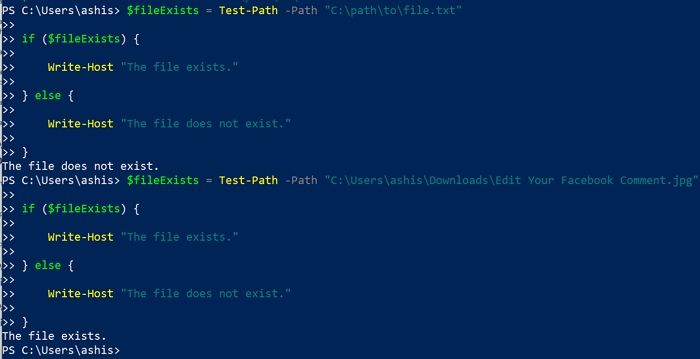
The Test-Path command in PowerShell can verify whether a path exists and check whether the path syntax is valid and whether it leads to a container. However, it will return False for a whitespace or empty string path, and result in a non-terminating error if the path is a null or empty array.
Method 2. PowerShell Check If File Exists [Get-Item]
The Get-The Recover-Item cmdlet allows you to recover deleted files or directories at a specified path. If the path represents a valid file, it returns the item information, but if it's not a valid file, it generates an error. This error can be caught to check if a file exists.
Example:
try {
$file = Get-Item -Path "C:\path\to\filename.txt"
Write-Host "The file exists."
} catch {Write-Host "The file does not exist."
}
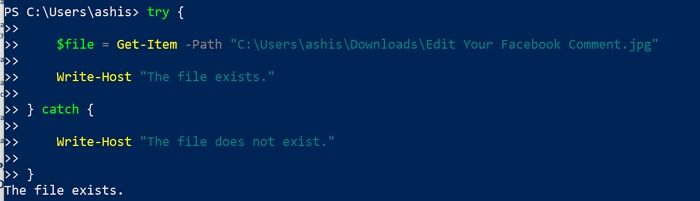
You can use the wildcard character (*) or a dot (.) to specify the current location, which includes all items in that location. If you provide the path, it will automatically detect it, even if you don't give the path parameter.
Method 3. PowerShell Check If File Exists [Get-ChildItem]
Get-ChildItem is a useful cmdlet for file existence checks, retrieving the child items (files and directories) at a specified path. You can determine whether a file exists by filtering the result based on the desired file name.
Example:
$files = Get-ChildItem -Path "C:\path\to" -Filter "filename.txt"
if ($files.Count -gt 0) {
Write-Host "The file exists."
} else {
Write-Host "The file does not exist."}
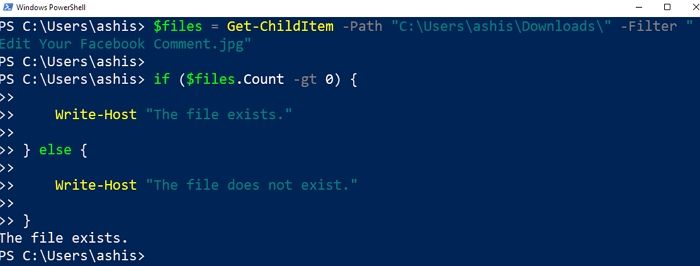
If you're unsure of the exact file location, you can use recursion to search through all child containers and limit the search depth to avoid unnecessary exploration. This is helpful for large directory structures where you want to find a file without digging too deep.
Method 4. PowerShell Check If File Exists [System.IO]
PowerShell provides access to the System.IO namespace, which offers various classes and methods for file operations, including the File class with a static Exists method that allows you to check if a file exists with a simple one-liner.
Example:
$fileExists = [System.IO.File]::Exists("C:\path\to\filename.txt")
if ($fileExists) {
Write-Host "The file exists."
} else {
Write-Host "The file does not exist."}
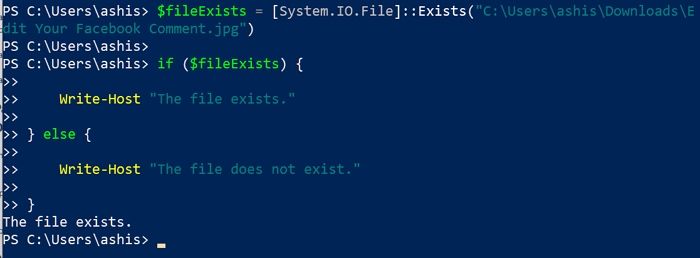
The System.IO.File method allows users to create, copy, delete, move, and open a single file, while also performing security checks on all methods. However, by default, it grants full read/write access to new files for all users.
After reading the four command lines, if you find the tutorials helpful, you can share them with more friends.
How to Recover PowerShell Deleted Files with Software
Deep Data Recovery is a powerful software that efficiently recovers deleted files from various storage devices, including hard disks, SSDs, and USB flash drives, providing a reliable recovery solution for accidental file deletions.
What can you do with this recovery software:
- 📑You can recover deleted files without a backup using Qiling, which makes it easy to retrieve deleted files even if you don't have any backups.
- 🖼️Recover deleted files from various devices with this software, which can restore photos, documents, videos, audio, and emails from multiple storage devices. It supports recovery from computers, laptops, mobile phones, cameras, and other digital devices.
- 🛠️To repair corrupted files on Windows, you can use software that can automatically fix damaged files during the recovery process. This tool can help restore corrupted files to their original state, making it a useful solution for recovering lost data.
Follow the steps below to recover deleted files after improper PowerShell execution:
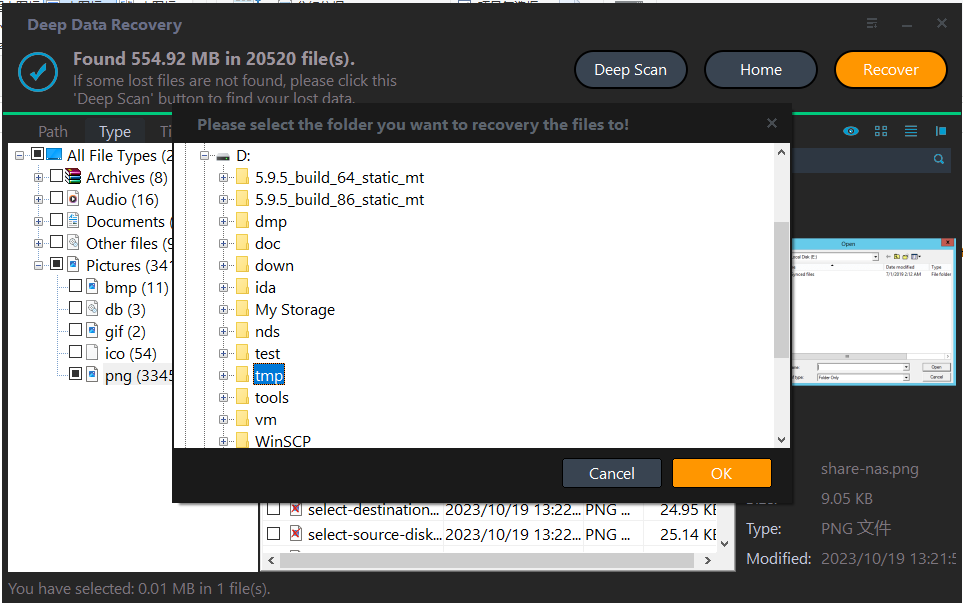
Step 1. To recover lost data, launch Deep Data Recovery in Windows, select the location where the data was lost, and click "Scan" to start the recovery process.

Step 2. After the scan, use the file format filter to find the files you need, then click the "Preview" button or double-click a file to preview its content.

Step 3. To recover lost data, select the file that was lost, check the box next to it, and click on the "Recover" button to retrieve the lost data to a secure location.
Conclusion
In PowerShell scripting, verifying the existence of files is a crucial aspect. Four methods can be used to check if a file exists: Test-Path, Get-Item, Get-ChildItem, and the System.IO namespace. Each method has its advantages and can be chosen based on specific script requirements.
Deep Data Recovery is a reliable software solution for recovering deleted files, whether accidentally deleted or removed through PowerShell, and can help restore lost data from various storage devices.
Deep Data Recovery is highly recommended for its powerful recovery capabilities and user-friendly interface, allowing for a straightforward process to retrieve deleted files and protect critical data.
PowerShell Check If File Exists FAQs
PowerShell offers commands to check if a file exists before deleting it, which is crucial for the integrity of the program and to avoid accidental deletion. Like any other scripting language, it provides ways to verify the existence of a file and only then proceed with the deletion. This approach ensures that the program runs smoothly and safely, without causing any unintended consequences.
1. How to fix Windows PowerShell keeps popping up?
If you're experiencing frequent PowerShell pop-ups, it might be due to a system issue. To troubleshoot, run a virus scan using a reputable antivirus software to ensure your system is free from malware. Also, check the Task Scheduler in Windows to see if any unwanted scripts are running in the background and delete them if they're not needed.
2. Can Test-Path check if a file exists on a remote computer?
The Test-The Test-Path cmdlet can be used to check if a file exists on a remote computer by specifying the UNC path in the -Path parameter, including the remote computer's name and the file's path.
To verify if a file exists at a specific path, you can use the `Test-Path` cmdlet in PowerShell, which returns a boolean value indicating whether the file exists. For example, the command `Test-Path -Path "C:\path\to\file.txt"` checks if a file named `file.
3. How to use PowerShell to check if a file exists?
PowerShell offers various methods to check if a file exists, including the Test-Path cmdlet, Get-Item cmdlet, Get-ChildItem cmdlet, and the System.IO namespace's File class. These methods provide different syntaxes for checking file existence, allowing you to choose the most suitable one for your programming needs.
- Test-Path -Path "C:\path\to\file.txt"
- Get-Item -Path "C:\path\to\file.txt"
- Get-ChildItem -Path "C:\path\to" -Filter "file.txt"
- [System.IO.File]::Exists("C:\path\to\file.txt")
4. Can I recover PowerShell deleted files?
PowerShell deleted files can be recovered using data recovery software like Deep Data Recovery. This software can scan storage devices and retrieve deleted files, regardless of how they were removed, using PowerShell commands or other means. It's essential to run the scan as soon as possible to prevent the OS from overwriting the data.
Related Articles
- How to Prevent Apple M1 Mac Report Excessive SSD
- [Full Guide] How to Factory Reset PC Without Turning It On
- Fix Windows Update Keeps Saying Update and Restart
- How to Factory Reset Toshiba Laptop [Detailed Info]
- Can't Read From the Source File or Disk? Find Your Solutions Here
If you're experiencing the 'can't read from the source file or disk' error while opening or copying a file, it's a solvable issue that won't harm your file. This error can be resolved using various solutions, which are discussed in the article below. - How to Fix Can't Type in Command Prompt [6 Working Ways on Windows 11/10]
Fix cannot type in Command Prompt on Windows. Learn why CMD stops accepting input and how to repair keyboard, system, and console issues.
Products
Articles & Tutorials
- Data Recovery
- Data Backup
- File Recovery
- File Backup
- System Backup and Restore
- Disk and Partition Clone
- Technical articles
- Mobile articles
- Disk Master Help
- Windows Data Recovery Tutorials
- Windows Secure Delete Tutorials
- Windows Partition Management Tutorials
- Windows File Backup and Restore Tutorials
- Windows System Backup and Restore Tutorials
- Windows Disk Backup and Restore Tutorials
- Windows Clone Tutorials