Solved | How to Find iPhone Backup Location on Windows 10 and Mac
If you're unsure where to find your iPhone backup location on Windows 10 or Mac, don't worry - this page has got you covered. We'll not only guide you on how to locate your iPhone backup files, but also provide tips on how to change the backup location, delete backup files, or back up iPhone files if needed.
- Part 1. Where Does iTunes Store Backups on Windows 10 and Mac
- Part 2. How to Change iPhone Backup Location on Windows 10
- Part 3. How to Delete Backup Files in Windows 10
- Part 4. How to Backup iPhone to Mac and Windows
Part 1. Where Does iTunes Store Backups on Windows 10 and Mac
iTunes saves backups to a Backup folder in the Users folder, but the specific location varies by operating system version. On Windows, the Backup folder is typically located in C:\Users\YourUsername\Apple MobileSync\Backup, while on Mac, it's usually found in ~/Library/Application Support/MobileSync/Backup.
Be cautious when handling backup files, as copying them is acceptable, but dragging them to a different location can cause issues. Any changes made to the backup files may result in data loss.
on Windows 7,8, or 10
On Windows PCs, you can either choose to follow the below paths to find your iPhone backup location or use the below steps to get the job done.
- On Windows Vista, 7, 8, and 10, the path to the iPhone backup is located at: \Users\(username)\AppData\Roaming\Apple Computer\MobileSync\Backup.
- On Windows XP, the path to locate is: \Documents and Settings\(username)\Application Data\Apple Computer\MobileSync\Backup.
- The Microsoft Store iTunes backup in \Users\(username)\AppleMobileSync\Backup.
Step 1. Find the Search bar on your computer.
Step 2. In the Search bar, enter %appdata% or %USERPROFILE%.
Step 3. Press "Return."
Step 4. Double-click "Apple" or "Apple Computer" > MobileSync > Backup.
On macOS or OS X:
To find the iPhone backup location on a Mac, follow these steps: check if the backup is stored in the default location /Library/Application Support/MobileSync/Backup/, if not, check the path /Users/your_username/Library/Application Support/MobileSync/Backup/, if still not found, check the path /Users/your_username/Library/Application Support/MobileSync/Backup/iTunes, if still not found, check the path /Users/your_username/Library/Application Support/MobileSync/Backup/iTunes/iTunes Mobile Device Backup/.
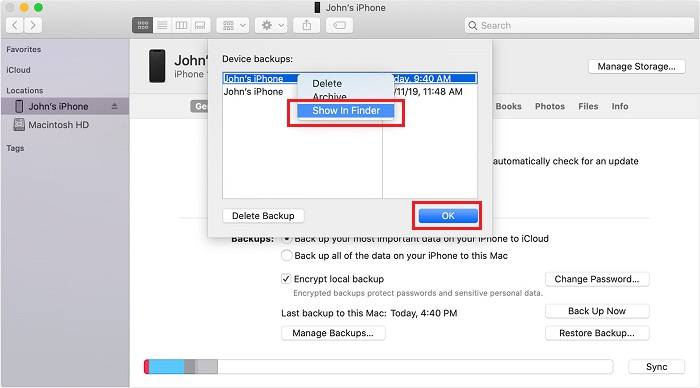
Step 1. Open the Finder or iTunes on your Mac, and then click on your device.
Step 2. To view a list of your backups, click on the "Manage Backups" option in the Finder or General tab.
Step 3. To locate a backup in the Finder or iTunes, select the backup you want and click "Show in Finder" to view its location. In the Finder, this option is available directly. In iTunes, go to Preferences, click on your device icon, and then select "Show in Finder." Click "OK" to proceed.
Part 2. How to Change iPhone Backup Location on Windows 10
You can change the iPhone backup location in two ways. The default method involves using Windows, but a non-official way using Qiling MobiMover is easier and more straightforward.
Option 1. Change iPhone backup location in the default way
Before getting started, you'll need to prepare:
- A PC running Windows Vista or newer
- Some available iTunes backup
Note: iPhones can't be restored with a backup that was made on a different location, even if it's the same device. The backup location is tied to the device and can't be changed without restoring the device to its original settings. This means that if you move the backup location, you won't be able to restore your iPhone with that backup unless you move it back to its original location.
Step 1. Open the iTunes backup location by using methods offered in Part 1.
Step 2. You'll see a folder labeled "Backup", which is the default location for your iPhone backups. Press the F2 key on your keyboard to rename the folder to a different name, such as "Backup.old".
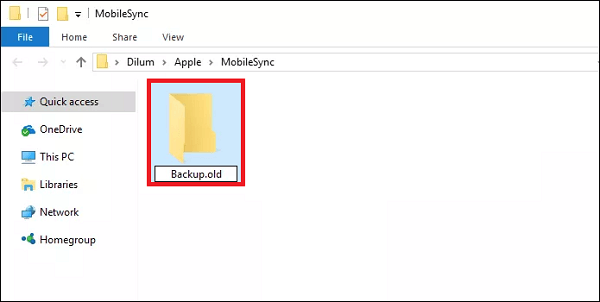
Step 3.To open the context menu in File Explorer, hold down the "Shift" key and right-click a blank area within File Explorer.
Step 4. To open a PowerShell window here, select the "Open PowerShell window here" option, also known as "Open command window here".
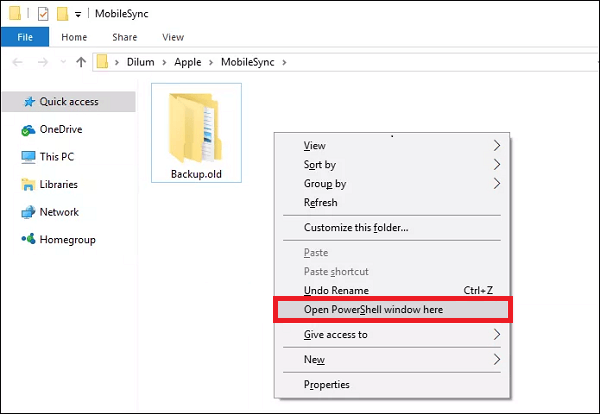
Step 5. Enter the command as listed below.
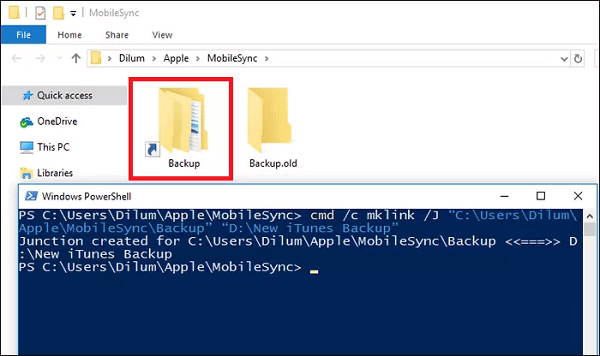
For desktop iTunes users: cmd /c mklink /J "%APPDATA%\Apple Computer\MobileSync\Backup" "D:\New iTunes Backup"
For Windows Store iTunes users: cmd /c mklink /J "C:\Users\[USERNAME]\Apple\MobileSync\Backup" "D:\New iTunes Backup"
Step 6. Press the "Enter" key to execute the command. This will create a new folder named Backup within the MobileSync folder, where all your backup files will be stored. Once the command is executed, you'll see the Backup folder appear within the MobileSync folder.
If you're running out of space on your Mac, you can change the location where iTunes backups are stored. By default, these backups are saved to your Mac's internal storage, but you can redirect them to an external drive or a cloud storage service.
Option 2. An easier way to change iPhone backup location
We advise against changing the default iPhone backup location on your computer, as improper operations may ruin your backup files. This is a technical issue that Apple has yet to resolve. If you're concerned about losing important backup files, you may want to consider alternative backup solutions instead.
Among the many backup tools available in the market, Qiling MobiMover stands out as a perfect alternative to iTunes, effectively doing a good job in data backup.
Compared to iTunes and iCloud, this program offers more backup options, including various settings to customize the backup process.
- The app offers two backup solutions, allowing users to either backup their entire iPhone or iPad, or selectively backup only the files they need.
- It allows you to set the default backup location.
- It lets you transfer iOS files between iOS devices seamlessly.
- This software offers additional features, including a video downloader, a WhatsApp manager, and a data management tool, in addition to its primary function.
You can now easily back up files with Qiling MobiMover, which is available for free download on your computer.
Step 1.Connect your iPhone to your PC running Windows 7/8/10 with a USB cable and tap "Trust" on your iPhone screen if asked. Then, run Qiling MobiMover and navigate to "Backup Manager" > "Back up" to initiate the backup process.
Step 2.All supported categories are selected by default, so you can quickly start the backup process. To initiate the backup, simply click the "One-Click" backup button to begin syncing your iPhone to your PC.
Step 3. Wait patiently until the backup process completes.
Part 3. How to Delete iPhone Backup Files on Mac
Deleting iPhone backups can be easily done on Windows and Mac computers, as long as you locate the backup files. The steps to find the iPhone backup location were previously introduced in Part 1, so they will not be listed here.
On macOS Catalina, users manage their iPhone backup files using Finder, which differs from the process on earlier versions of macOS.
Step 1. Plug your iPhone into your Mac with a USB cable.
Step 2. Launch Finder and click your iPhone in the left sidebar.
Step 3. Under the "Backup" section, click "Manage Backups..."
Step 4. Click "Delete Backup" in the bottom left corner.
Part 4. How to Backup iPhone to Mac and Windows
Backing up your data is a good habit that is worth persevering, as it provides a safety net in case your iPhone or iPad is stolen, your system crashes, or you need to recover specific files.
For those looking to backup their data, there are various options available, each with their pros and cons. Mac and Windows users can consider different solutions based on their needs, with options available for both platforms.
For Windows users, you can use iTunes, iCloud, or Qiling MobiMover to back up your iPhone.
For Mac users, you can use iTunes, iCloud, Qiling MobiMover, or Finder to make a copy of your iPhone data.
The Bottom Line
Finding and changing the iPhone backup location on Windows and Mac computers can be a challenge, but Qiling MobiMover simplifies the process. This tool not only helps you locate the backup but also allows you to modify, rename, or extract the contents of the backup.
We hope this guide is helpful to you. If it is, don't forget to share it with your friends who need it.
Related Articles
- [7 Options] How to Download Pictures from iPhone to Mac
- How to Delete Subscribed Calendars on iPhone
- Why Are My iPhone Photos HEIC and How to Convert
- How to Connect iPhone to PC in Every Way
Products
Articles & Tutorials
- Data Recovery
- Data Backup
- File Recovery
- File Backup
- System Backup and Restore
- Disk and Partition Clone
- Technical articles
- Mobile articles
- Disk Master Help
- Windows Data Recovery Tutorials
- Windows Secure Delete Tutorials
- Windows Partition Management Tutorials
- Windows File Backup and Restore Tutorials
- Windows System Backup and Restore Tutorials
- Windows Disk Backup and Restore Tutorials
- Windows Clone Tutorials