Learn to Merge Adjacent and Non-Adjacent Partitions in Windows Server 2016/2012 (NTFS and FAT32 Partition Available)
Merging partitions in Windows Server can be done quickly and effectively, but it's essential to take precautions to avoid data loss. To merge two drives, you'll need to use the built-in Disk Management tool, which allows you to combine two adjacent partitions into one, but be aware that this process will overwrite the data on the second drive, so make sure to back up any important files before proceeding. Alternatively, you can use third-party software like Qiling Partition Master, which can help you merge partitions without data loss. It's always a good idea to create a backup of your data before attempting to merge partitions, just in case something goes wrong.
Many files are often copied to a Server computer, but you may find that one partition is full, while others are empty. Combining two partitions into a single, larger section is a popular trend, providing more drive space and convenient partition management. If you're looking to merge partitions in Windows Server without losing data, you can do so using Disk Management or Qiling Partition Master, which allow you to combine adjacent or non-adjacent volumes into one.
To merge adjacent and non-adjacent partitions in Windows Server, use the built-in Disk Management tool. For adjacent partitions, select the first partition, right-click, and choose "Merge a volume".
| Workable Solutions | Step-by-step Troubleshooting |
|---|---|
| Fix 1. Merge Adjacent Disk Partition in Windows Server 2012/2016 |
1. Use Disk Management: Run programs and right-click partition...Full steps 2. Run Qiling Partition Master: Choose "Merge" feature...Full steps |
| Fix 2. Non-Adjacent Two Partitions in Windows Server 2012/2016 | Allocate space from other drive to C drive with Qiling Partition Master...Full steps |
Merge Adjacent Disk Partition in Windows Server 2012/2016
Here are two options for merging partitions: using Windows Server Disk Management, which can be more complicated, or using third-party software, which is more straightforward.
1 - Combine Disk Partitions with Disk Management
2 - Merge Two Partitions via Qiling Partition Master
1 - Combine Disk Partitions with Disk Management
The Disk Management tool in Windows can only be used to merge NTFS partitions, not other file systems. This means that if you have two or more NTFS partitions that you want to combine into one larger partition, Disk Management can be used to accomplish this. However, if you have partitions with different file systems, such as FAT32 or exFAT, you will not be able to merge them using Disk Management. In such cases, you may need to use third-party software or other methods to merge the partitions.
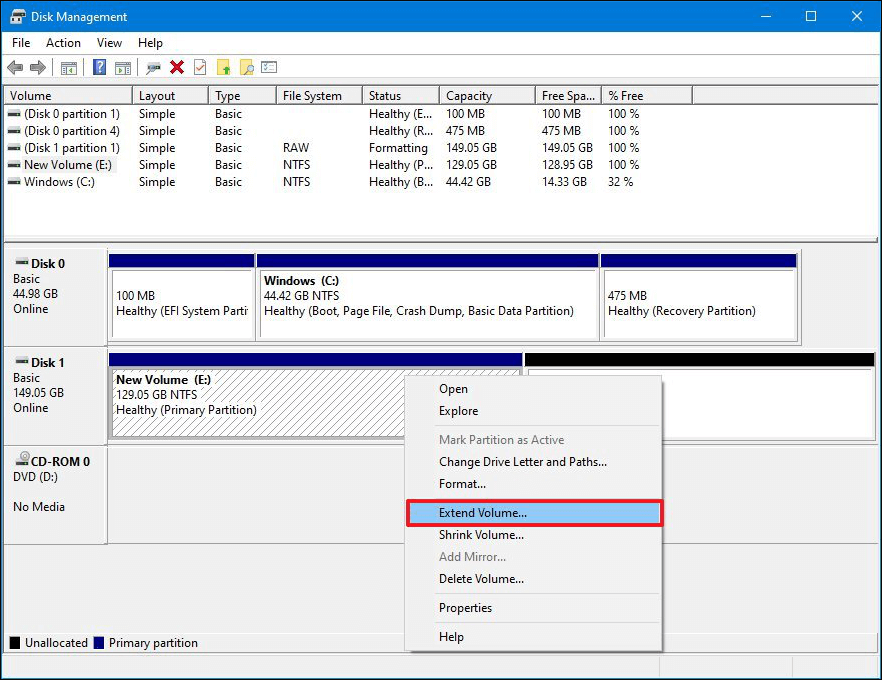
To merge partitions on Windows Server using Disk Management, you can't find a direct "Merge Partitions" function. Instead, you delete the adjacent volume, then use the unallocated space to extend the other volume using the "Extend Volume" button. This process allows you to combine sections instantly.
Use Built-in Tools to merge adjacent partitions without data:
Step 1. Right-click Windows Start icon and click Disk Management.
Step 2. Right-click the nearly empty partition, choose "Delete Volume," and confirm "Yes" after reading the notice.
- Notice:
- If you're about to delete a volume, be aware that it will completely erase all data on it. Make sure to back up all your files before proceeding.
Step 3. To merge partitions, right-click the entire drive and select "Extend Volume...".
2 - Merge Two Partitions via Qiling Partition Master
Available: Support merges NTFS or FAT32 partition. No data loss.
When merging partitions in Windows Server using Disk Management, be careful not to delete the volume, as this can result in data loss if you accidentally click "Yes" too quickly. To avoid this, consider using a third-party disk manager like Qiling Partition Master, which can help you merge partitions safely and efficiently.
This software is compatible with a range of operating systems, including Windows Server 2003-2019, Windows 11/10/8.1/8/7, and offers a range of partition management features, including merging two successive partitions without data loss, as well as creating, resizing, cloning, deleting, and formatting partitions.
Require a few seconds to download Qiling Partition Master:
Qiling Partition Master Enterprise
Your trustworthy Windows Server disk manager.
- Extend System drive, combine/split partitions.
- Clone disk, migrate OS to HDD/SSD.
- Convert MBR to GPT, GPT to MBR, no data loss.
- 1-click adjust disk layout, create volumes at one time.
Run Software to merge partitions on Windows Server:
Step 1: Select the target partition
Right-To add space to a partition, click on the partition you want to expand and select "Merge".
Step 2: Select a neighbor partition to merge
Select a partition next to the previously selected partition and click "Proceed" to merge the space and add files from the second partition to the first partition.
Merge Non-Adjacent Two Partitions in Windows Server 2012/2016
If you want to merge non-To combine non-adjacent partitions, you can use either adjacent partitions, Qiling Partition Master and Disk Management, which can merge non-adjacent volume. The steps are the same as Method 1 - Delete the targeted volume first, then choose "Extend Volume" to merge the unallocated space to the source partition.

But it is not always working when unallocated space is not existed between two partitions, like this:

We understand that deleting a volume with essential data can be a concern, but Qiling Partition Master offers a solution. Unlike Disk Management, it allows merging of non-adjacent partitions without data loss. Additionally, the "Allocate space" feature doesn't delete data, but rather allocates free space from one partition to another, ensuring data remains intact in the old partition.
Start manage space with Qiling Partition Master - Fast Download:
Steps to extend freedom of non-adjacent partitions:
Step 1. Click on the D: partition with enough free space and select "Resize/Move".
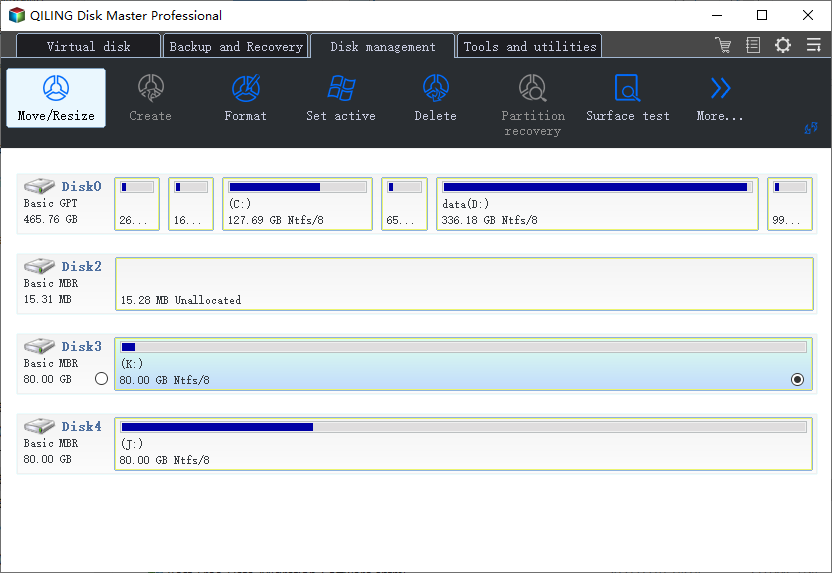
Step 2. Move the D: partition panel to the left to shrink it, freeing up space from the D: drive that can be used on the C: drive. Confirm the action by clicking "Proceed".
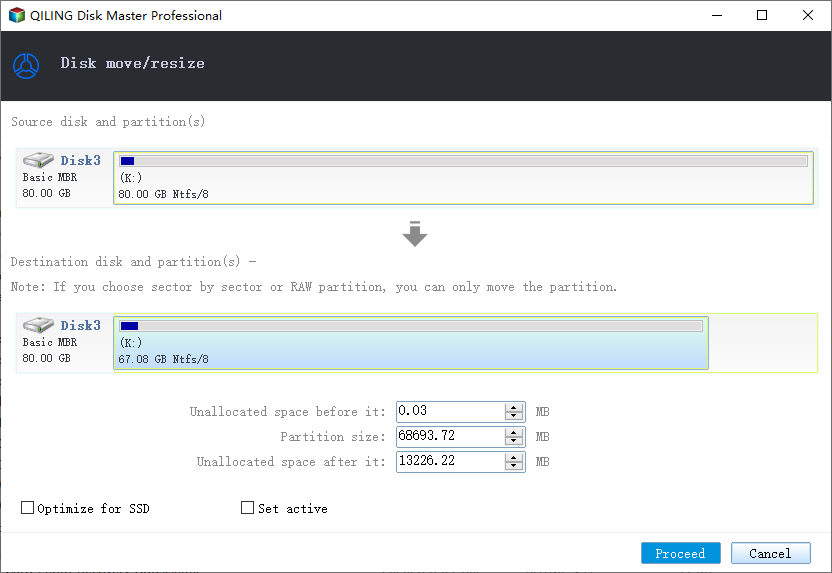
Step 3. Select the target partition - C: drive and select "Resize/Move".
Step 4. To add free space from the D: drive to the C: drive, drag the partition panel to the right. This will allocate the available space from the D: drive to the C: drive, effectively increasing the storage capacity of the C: drive.
Step 5. To proceed, you can simply click the "Proceed" button. This will initiate the process of moving free space from the D: drive to the C: drive.
Qiling Partition Master can merge partitions, including joining cross-disk partitions on Windows Server, in addition to merging partitions. A detailed guide on how to merge disk 0 and disk 1 is available.
Use Effective Way to Merge Partitions in Windows Server
To manage volumes, you can use Disk Management, a standard tool that allows you to extend, format, delete, or change the drive letter of a volume. However, deleting volumes is a prerequisite for these actions. If you want to merge adjacent or non-adjacent volumes, Qiling Partition Master is a third-party software that can help, while protecting your data in the process.
This software allows users to merge partitions, as well as resize, extend, and shrink them to free up space or improve performance. It also supports merging NTFS and FAT32 partitions.
Related Articles
- How to Format SD Card Using CMD Windows 11/10/8/7
- How to Clear Windows DNS Cache Windows Server/Workstation
- Free Download SD Card Formatter: All Memory Card Format Software Free Download
- [Fixed] Windows Resource Protection Found Corrupt Files but Was Unable to Fix Some of Them
- How to Partition SSD From BIOS [2024 New Guide]
To partition an SSD from BIOS, follow these steps: Enter the BIOS settings by pressing the designated key (usually F2, F12, or Del) when your computer starts. Navigate to the “Boot” or “Storage” section and select the SSD as the first boot device. Save the changes and exit the BIOS settings. - How to Partition Western Digital Hard Drive on Windows 11/10/8/7
To partition your Western Digital hard drive on Windows 11/10/8/7, you can use a tool like Qiling Disk Master or the built-in Disk Management feature. This will allow you to easily and quickly partition your hard drive.
Products
Articles & Tutorials
- Data Recovery
- Data Backup
- File Recovery
- File Backup
- System Backup and Restore
- Disk and Partition Clone
- Technical articles
- Mobile articles
- Disk Master Help
- Windows Data Recovery Tutorials
- Windows Secure Delete Tutorials
- Windows Partition Management Tutorials
- Windows File Backup and Restore Tutorials
- Windows System Backup and Restore Tutorials
- Windows Disk Backup and Restore Tutorials
- Windows Clone Tutorials