How Can I Merge Disk 0 and Disk 1 in Windows 11/10
Quick Access on How to Merge Disk 0 and Disk 1
You need two steps and you can merge the two disks:
- First, convert the two disks into dynamic disks
- Second, merge the two disks with Qiling Partition Master
- Notice:
- Merging Disk 0 and Disk 1 only works if the two disks are first converted into dynamic disks. Without this initial step, Qiling Partition Master cannot perform the merge operation.
How Can I Merge Disk 0 and Disk 1 to Extend Disk Space
You can merge the free space on disk 1 with disk 0 to increase the space on disk 0. To do this, you can move the unallocated space on disk 1 to disk 0, effectively combining the two disks to create more space on disk 0. This process is often referred to as "extending" the volume of disk 0 by adding the unallocated space from disk 1. You can use disk management tools or command-line utilities to achieve this. However, ensure that you have sufficient free space on disk 1 to move to disk 0, and also consider backing up your data before making any changes to avoid data loss.
If you're experiencing the problem of one disk being full while the other has plenty of unused space, merging the two disks can be a great solution. This can be achieved by merging disk 0 and disk 1, or by moving a volume from one disk to the other. The process is straightforward and can be completed with ease, and the method can also be applied to merge multiple disks on a Windows PC.
Preparations Before Combine Disk 0 and Disk 1
To merge disk 0 and disk 1, you need to do the following preparations.
1. Download reliable partition manager software
Qiling Partition Master, a professional partition manager software, can help you merge two disks effectively, utilizing the available disk space to its fullest potential. It offers several key features.
- Transfer free disk space from one drive to another directly.
- Resize/move, merge, clone partition, and check file system error.
- You can clone a disk, convert it to either MBR or GPT partitioning, convert it to a dynamic or basic disk, and even wipe all data from it.
- Migrate OS to SSD to speed up Windows without reinstalling.
2. Make sure the second disk contains enough unallocated space
If the second disk has unallocated space, you can add it to the target disk to extend partitions.
- Tip
- 1. It doesn't support merging external hard drives or devices.
- 2. Only internal hard disks can be merged as one disk.
- 3. Only unallocated space can be merged into another disk.
- 4. It doesn't support increasing C drive across two hard disks.
How to Merge Two Disks as One in Windows 11/10
To merge two disks in Windows 11/10, you need to follow these steps: First, convert the two disks into dynamic disks, and then merge the two disks. This process can be completed in two steps.
Step 1. Convert Basic into Dynamic
- Right-To merge one of the disks, click on the disk you want to merge (disk 0, disk 1 or disk 2), then select "Convert to Dynamic" from the options.
- Confirm the disk conversion from the Basic to Dynamic.
- To convert the second disk to a dynamic disk, select it in the Disk Management console, right-click it, and choose Convert to Dynamic Disk. Confirm the conversion by selecting the disk you want to convert and clicking OK.
- When both disks have been converted into dynamic disks, you can merge free space from one disk to another by following the steps to create a simple volume and then extend it to the other disk. This process will allow you to combine free space from both disks into a single, larger volume.
Step 2. Merge Two Disks into One Disk
Note: If the dynamic disk is not unallocated space, you need to delete all partitions on it using Qiling Partition Master. Additionally, you cannot merge a system partition, even after converting to dynamic.
- Select the full disk, click on it and choose "Resize/Move".
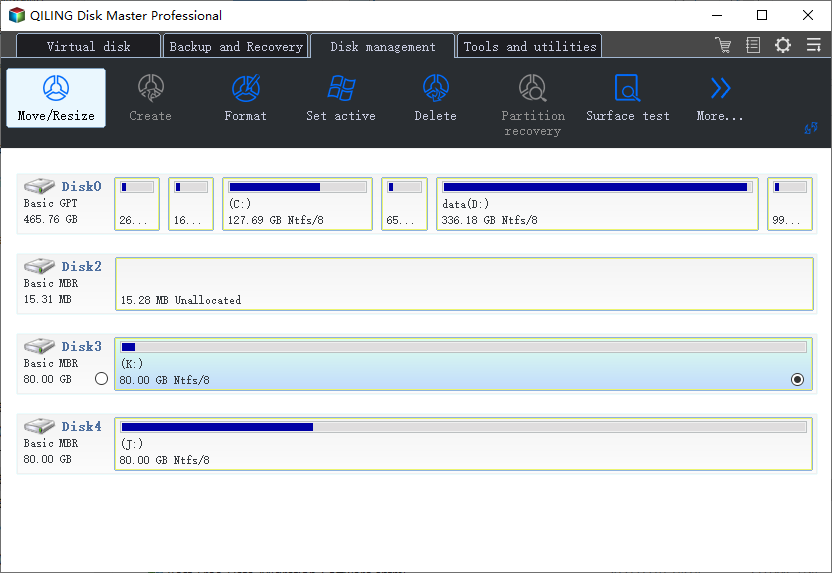
- To extend the partition size, use your mouse to drag the partition panel to the right or left, effectively increasing the partition size.
If the unallocated space is on the left of the partition you want to extend, you can move it by dragging the left partition handle leftwards to the desired size.
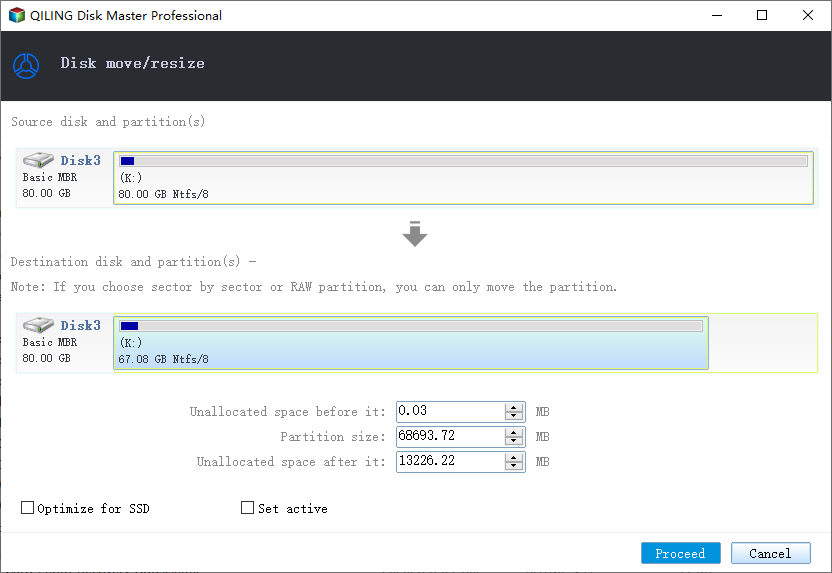
- To merge space from one disk to another, check the warning message, click "OK", and you'll be able to proceed.
How to Merge Two Partitions on the Same Disk
If you have two adjacent partitions on the same disk, you can merge them using Qiling partition software, eliminating the need to delete a volume and create a new space, unlike Disk Management. Simply combine the source partition and the target partition, which are adjacent to each other.
Steps to combine two adjacent partitions on the same disk:
Step 1: Select the target partition
Click on the partition you want to add space to and keep, select "Resize/Move".
Step 2: Select a neighbor partition to merge
Select the next partition next to the one previously selected, and click "OK" to proceed.
Step 3: Execute operation to merge partitions
To merge the space and add files from the second partition to the first partition, click the "Proceed" button. This will combine the two partitions into one, effectively adding the space and files from the second partition to the first partition.
Conclusion
You can merge two adjacent partitions to extend the C drive or other drives, or merge two disks by converting them into dynamic disks, effectively increasing your disk space. This process can be facilitated using a disk management tool like Qiling, which plays a crucial role in helping you manage your disk space and resolve any related issues.
Move Unallocated Space from One Disk To Another FAQs
We provide you with several questions and answers. If you want to get additional help, you can read on.
What is the difference between disk 0 and disk 1?
Disk 1 and Disk 0 are two separate physical discs, with Disk 0 being a 120 GB SSD and Disk 1 being a 1 TB HDD, effectively providing a significant increase in storage space.
Is Dynamic Disk better than basic?
A dynamic disk provides more flexibility than a basic disk, as it doesn't use a partition table to track partitions, instead relying on a hidden logical disk manager (LDM) or virtual disk service (VDS) to manage dynamic partitions or volumes.
How do I add space from disk 1 to disk 0?
You need two steps, and you can merge the two disks.
Step 1. Convert the two disks into dynamic disks.
Step 2. You can resize a disk partition to add space to it by using a tool like GParted or Disk Management. This will allow you to reclaim unused space from other partitions and add it to the partition you want to resize.
Can you combine two SSDs?
If none of the SSDs is a system disk, you can merge them with the help of Qiling Partition Master.
Related Articles
- Featured Partition Magic for Windows Server Free Download 2022
- Repair Corrupted SSD/HDD Without Losing Data
- The Disk Is Write Protected in Windows 11/10/8/7 (6 Fixes)
- How to Initialize SSD in Windows 10/8/7, How to Initialize a Hard Drive
- Panasonic SD Formatter Windows 10 [2024 Full Guide]
If you're looking for tools to help format your SD memory card, this post introduces the Panasonic SD Formatter and other available formatting tools, providing full operation guidance. - Paragon Migrate OS to SSD Review [Pros & Cons]
This guide provides a detailed review of Paragon Migrate OS to SSD, covering its pros and cons. It also highlights the best alternative, Qiling Disk Master, for migrating Windows OS to SSD.
Products
Articles & Tutorials
- Data Recovery
- Data Backup
- File Recovery
- File Backup
- System Backup and Restore
- Disk and Partition Clone
- Technical articles
- Mobile articles
- Disk Master Help
- Windows Data Recovery Tutorials
- Windows Secure Delete Tutorials
- Windows Partition Management Tutorials
- Windows File Backup and Restore Tutorials
- Windows System Backup and Restore Tutorials
- Windows Disk Backup and Restore Tutorials
- Windows Clone Tutorials