How to Resize (Extend & Shrink) Partition Without Losing Data
| Workable Solutions | Step-by-step Troubleshooting |
|---|---|
| Solution 1. Resize Partition Without Losing Data Using Windows 7/8/10/11 Disk Management |
Shrink: Press Windows + R keys to bring up the Run box, type diskmgmt.msc...Full steps Extend: You can directly extend a volume if there is unallocated space on the right side...Full steps |
| To resize a partition without losing data, you can use a free partition manager like Qiling Partition Master. This software allows you to resize, move, merge, and split partitions without losing any data. It also supports resizing partitions on dynamic disks, which is not possible with built-in Windows tools. |
Shrink: Locate and select target partition to shrink; Adjust to shrink partition...Full steps Extend: Locate the Target Partition; Extend the Target Partition...Full steps |
You can resize a partition without losing data using either the native Windows 11/10/8/7 Disk Management tool or third-party Qiling partition manager software. Both programs are effective for extending or shrinking NTFS partitions, but if your partition uses FAT32, you'll need to use the Qiling software.
Related topic: NTFS vs FAT32
Can You Resize Partition Without Losing Data?
When resizing a disk partition, data safety is a top priority. Resizing a partition typically involves shrinking one partition to free up space or extending another to increase its size. To resize a partition without losing data, it's essential to back up your data first, as resizing can be a complex process. A good practice is to create a disk image or clone of your drive before making any changes, which can be easily restored if something goes wrong. Additionally, using a reliable partition manager like Qiling Partition Master can help ensure a safe and successful resizing process.
Q1: Does resizing or moving partition delete data?
Resizing a Windows partition, which includes extending and shrinking, is a safe operation that does not delete data. It involves adjusting the partition's position on the disk without deleting any information. This is different from moving a partition, which changes its position but does not delete data. Resizing a partition can be done to either increase or decrease its size, depending on the available disk space. This process does not affect the data stored within the partition.
Q2: What does it mean to shrink a volume?
Hard drive shrinking is the process of reducing the size of a partition to free up unallocated space that can be used elsewhere. This involves splitting the hard drive into separate areas called partitions, making it possible to utilize the newly created space to store data.
Q3: Will I lose data if I shrink volume?
Shrink a partition without causing data loss. The partition will only shrink to the point where unmovable files, such as the page file or shadow copy storage area, are located. The used space with existing data cannot be made available for shrinking.
Solution 1. Resize Partition Without Losing Data Using Windows 7/8/10/11 Disk Management
Windows Disk Management is a built-in tool that allows you to extend or shrink a volume without affecting data, but extending a volume may delete data if there's no unallocated space available.
Windows Disk Management only supports the NTFS file system, making it exclusively applicable to resizing NTFS partitions.
To shrink a partition without losing data, follow the step-by-step guide:
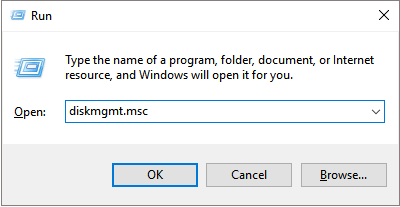
Step 1. To open Windows Disk Management, press the Windows key + R to bring up the Run box, type "diskmgmt.msc" and click OK. This will open the Windows Disk Management utility.
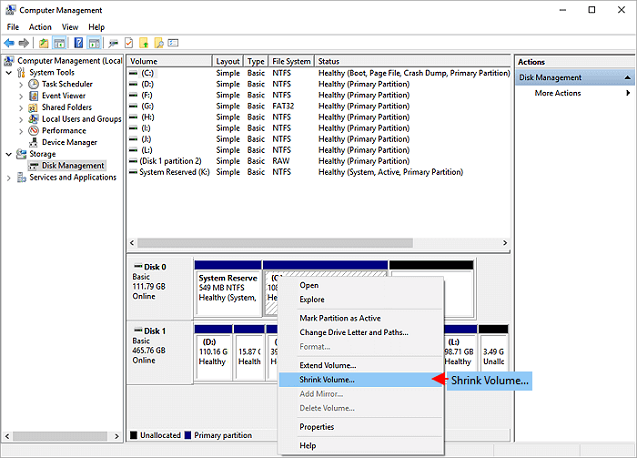
Step 2.To decrease the size of a partition, right-click on it and select Shrink Volume.
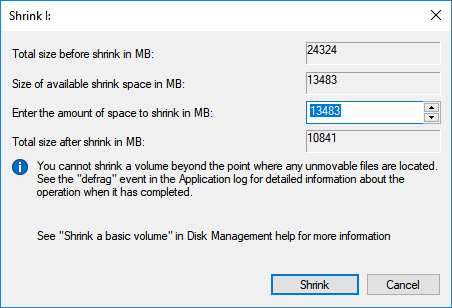
Step 3.To shrink a volume on the Shrink volume window, you enter the exact amount of space to shrink and click Shrink, which will complete the process in seconds.
The disk space has been decreased, and there is unallocated space available now. Go back to the Disk Management interface.
To extend a volume without losing data, you need to do it carefully:
If there is unallocated space on the right side of the partition you want to resize, you can directly extend a volume, otherwise the "Extend Volume" option is grayed out and becomes invalid in Disk Management.
If you need to make unallocated space next to a partition, you may have to delete the adjacent partition, which will result in data loss, so it's essential to back up your files first.
If you don't want to delete a partition but need to extend it, you can use the "Allocate Space" function in Qiling Partition Master to add free space to the target partition, allowing you to move space from one drive to another, such as from D drive to C drive on Windows 11/10.
Solution 2. Resize Partition Without Losing Data Using a Free Partition Manager
Qiling Partition Master allows you to resize, move, create, and merge partitions with ease, without losing data. It supports both NTFS and FAT file systems, making it possible to resize both NTFS and FAT32 partitions. The program also includes a "Create partition" utility to create an NTFS/FAT partition, and a "Convert to NTFS" function to convert FAT (FAT12/FAT16/FAT32) to NTFS. Additionally, the "Merge partition" function enables you to merge a FAT/NTFS partition to another NTFS partition.
Now, download Qiling Partition Master and follow the steps below to resize a partition without data loss with ease.
How to shrink a partition in Windows 11/10/8/7 without losing data
Step 1: Locate and select target partition to shrink
On the main window, click on the partition that you want to shrink and select "Resize/Move".
Step 2: Adjust to shrink partition
To resize a partition, use your mouse to select one of its ends and drag it to the desired position, effectively shrinking the partition space.
You can also adjust the partition size box to shrink the target partition. Once done, click "Proceed" to keep all changes.
How to extend a partition in Windows 11/10/8/7 without losing data
Step 1. Locate the Target Partition.
To extend a partition, first locate the target partition and select "Resize/Move".
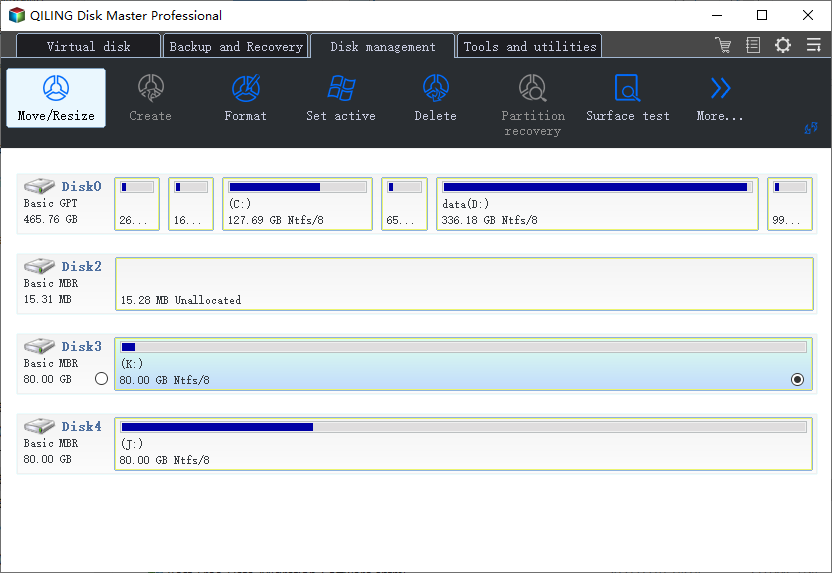
Step 2. Extend the Target Partition.
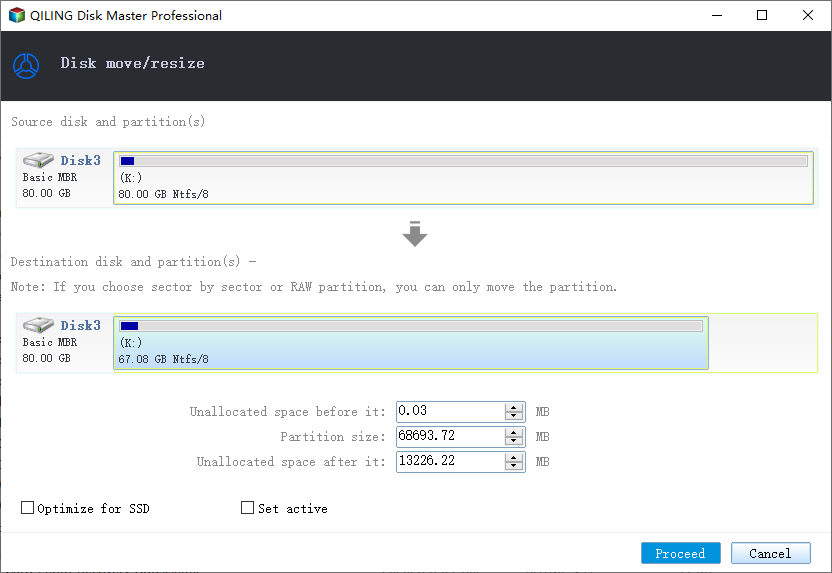
To add unallocated space to your current partition, drag the partition panel to the right or left, and then click "Proceed" to confirm the action.
Extra Option: Get Space from Another Drive
If there's not enough unallocated space on your disk, you can resize a big partition with sufficient free space by selecting the "Resize/Move" option.
Select the target partition that you want to extend at the allocate space to column.
Step 3. Execute Operations to Extend Partition.
To resize the partition, drag the dots of the target partition into the unallocated space and click "Proceed".
Which Way Will You Choose to Resize A Partition?
To summarize, shrinking partitions is safe with either Ease Partition Master or Windows Disk Management, but expanding a partition requires more consideration, and Ease Partition Master is a safer option if you need to expand a partition without deleting other partitions or generating unallocated space.
Related Articles
- [New] How to Add Unallocated Space to C Drive in Windows 11/10
- Top 10 Best Free Partition Manager Tools for Windows 11/10 (2022 Guide)
- [Easy to Go] How to Change Partition Type ID in Windows 10/8/7 Computer and Laptop
- Top Partition Magic Freeware/Best Partition Software
- How to Move Recovery Partition Windows 10 (Easy & Safe)
When trying to extend the system partition via Disk Management, you may encounter a frustrating obstacle: the recovery partition is in the way. - How to Make MSI Boot From USB | Best Tutorial🔥
Additionally, if you're trying to install MSI, you may need to use a third-party tool or software to create a bootable USB drive specifically designed for MSI, as the process can vary depending on the specific model and version of MSI you're trying to install.
Products
Articles & Tutorials
- Data Recovery
- Data Backup
- File Recovery
- File Backup
- System Backup and Restore
- Disk and Partition Clone
- Technical articles
- Mobile articles
- Disk Master Help
- Windows Data Recovery Tutorials
- Windows Secure Delete Tutorials
- Windows Partition Management Tutorials
- Windows File Backup and Restore Tutorials
- Windows System Backup and Restore Tutorials
- Windows Disk Backup and Restore Tutorials
- Windows Clone Tutorials