How to Fix USB won't format to FAT32, Check Three Easy Ways
To fix the issue of a USB drive not formatting to FAT32, try the following:
| Workable Solutions | Step-by-step Troubleshooting |
|---|---|
| Fix 1. Format USB Drive with Qiling Partition Master |
Free download software > Connect the USB drive...Full steps |
| Fix 2. Use PowerShell to Format Drive | Open PowerShell as an administrator...Full steps |
| Fix 3. Remove Write Protection by Diskpart | Open the Command Prompt as an administrator....Full steps |
If you're having trouble formatting your USB drive to FAT32, - you're not alone. Many people have struggled with this issue, but it's easily solvable. This blog post will guide you through the simple steps to format your USB drive to FAT32, so you can get started today.
Why Does "USB Won't Format to FAT32" Happen?
There are a few reasons why your USB drive might not be formatting to FAT32.
- Your USB drive might be too large to be formatted to FAT32, which is a common file system used by Windows. This is because FAT32 has a 32 GB file size limit, and if your USB drive exceeds this size, it can't be formatted to this file system.
- The USB drive may have been formatted with a different file system, such as NTFS, which requires it to be reformatted using the correct file system to work properly.
- If the USB drive is not recognized, it may be due to a corrupted file system, which can occur if the drive is damaged or formatted with an incompatible file system. In this case, a data recovery tool can be used to extract data before formatting the drive correctly.
How to Fix "Can't format to FAT32" on Windows 10/11?
If you're having trouble formatting your USB drive to FAT32, you can try using a program like Qiling Partition Master to fix common format issues. Alternatively, you can use Powershell to format your drive. If these solutions don't work, you can also try changing a setting in the Diskpart to resolve the problem. These three methods should help you format your USB drive to FAT32.
Solution 1. How to Format USB to FAT32 with Qiling Partition Master
When trying to format a USB drive to FAT32 in Windows 10, you may encounter the error "The volume is too big for FAT32." This issue arises because Windows defaults to formatting drives with the NTFS file system. However, several devices can only read drives formatted with FAT32. Fortunately, the problem can be easily resolved with Qiling Partition Master, which allows you to quickly and easily format your USB drive to FAT32.
Download and install Qiling Partition Master on your PC:
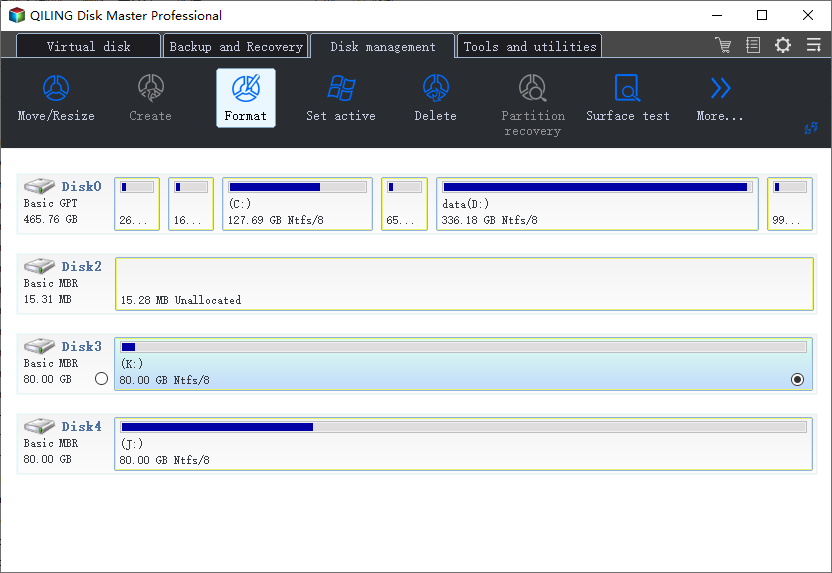
Step 1. Select the USB drive to format.
To format a USB drive, connect it to your computer and download the Qiling partition software. Once installed, launch the software and right-click on the USB drive you want to format, then select the "Format" option.
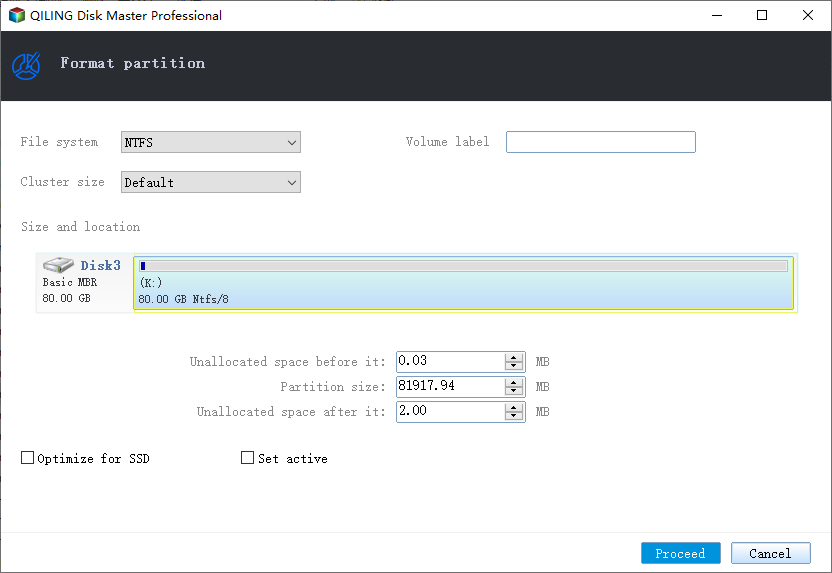
Step 2. Set the drive letter and file system on USB.
Assign a new partition label, file system, and cluster size to the selected partition, then click Proceed.
Step 3. Check "OK" to confirm formatting USB.
Click "OK" if you see the Warning window. If you have important data on it, back up the data in advance.
More worthy features:
You can use a tool like Qiling Partition Master to extend partition storage space, convert to another file system, or clone a hard drive. These tools allow you to resize partitions, convert file systems, and clone entire hard drives, making it easy to manage and maintain your disk and partition structure.
Manage Windows 10/11 disk space: Resize, Move, Shrink, Extend partition.
The Disk Converter feature supports various conversion operations, including converting the disk from Master Boot Record (MBR) to GUID Partition Table (GPT) or vice versa, converting a primary partition to a logical one or vice versa, and other similar operations.
Disk Cloner is a tool that safely copies all data and OS to another drive, including the ability to clone a hard drive (HDD) to a solid-state drive (SSD) in Windows 11.
Solution 2. Format USB Drives (Larger Than 32GB) to FAT32 Using PowerShell
Windows 10 does not have a built-in way to format USB drives to FAT32, which can be a problem for compatibility reasons.
Fortunately, you can format a USB drive to FAT32 using PowerShell, providing a convenient solution for managing file systems.
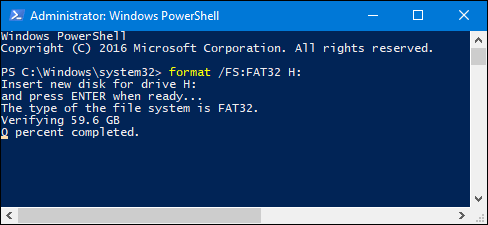
Step 1. To do this, open PowerShell as an administrator.
To run PowerShell as administrator, open the start menu and search for PowerShell, then right-click on the result and select "Run as administrator".
Step 2. Run the following command: Format- /FS:FAT32 + drive letter
e.g. format /FS:FAT32 D:
To format a USB drive to FAT32, you can use the command `format` in the Windows Command Prompt, specifying the drive letter of the USB drive. For example, if your USB drive is assigned the drive letter D:, you can type `format D: /FS:32` and press Enter. This will format the USB drive to FAT32 file system.
Solution 3. Remove Read-only Using Diskpart
If your USB drive shows read-To resolve the issue, you can use the Diskpart command to remove the write protection, and then attempt to format the device again. This should allow you to access and utilize the device as needed.
To clear the read-The only attributes of a USB drive that can be modified using Diskpart are the read-only attribute and the hidden attribute. To modify these attributes, you can use the following commands: `attributes disk clear readonly` and `attributes disk set hidden`, respectively.
1. Open the Command Prompt as an administrator.
2. Type in "diskpart" and press Enter.
3. To list all of the disks connected to the computer, type "list disk" and press Enter. This command will display a list of available disks, including their disk number, disk size, and free space.
4. Type in "select disk 1" and press Enter. Replace "1" with the number of the USB drive you want to modify.
5. To clear the readonly attribute from a disk, type "attributes disk clear readonly" and press Enter. This will make the drive writable again.
6. To resolve the issue where your USB drive is not writable, type "exit" and press Enter in Diskpart to exit the program, then your USB drive should be writable again. If you continue to experience issues, you may need to format the drive or try a different USB port.
Final Thoughts
If you're having trouble formatting your USB to FAT32, you can try using a different USB port or a different computer to see if the issue is specific to your current setup. Additionally, you can try formatting the USB drive in a different operating system, such as Windows or macOS, to see if the issue is specific to your current OS.
1. To format a USB drive to FAT32 using Qiling Partition Master and PowerShell, follow these steps: First, download and install Qiling Partition Master. Next, launch the software and select the USB drive from the list of available drives.
2. Run Diskpart to remove write protection.
If ordinary FAT32 formatting still fails, first identify the USB controller and protect any needed files; the URescue format-tool guide explains when a controller-specific utility is appropriate.
Related Articles
- SSD Slow Boot Windows 11 | Boot Windows 11 from SSD
- How to Corrupt A Flash Drive on Purpose
- Fixed: The Disk Is Write Protected Windows 11
- Setup SSD/HDD and Change System/OS Disk for Windows 11/10
- Diskpart: Delete Partition Force in Windows 11,10, 8, 7
You can use Diskpart to delete partition force when need to delete a hidden or system-protected partition on Windows 11, 10, 8, and 7. - Diskpart: Fix RAW Partition in Windows 10/8/7
This page focuses on how RAW drive comes and how to use Diskpart to fix RAW partition. If you want to fix RAW partition without formatting, please try Qiling Disk Master Standard.
Products
Articles & Tutorials
- Data Recovery
- Data Backup
- File Recovery
- File Backup
- System Backup and Restore
- Disk and Partition Clone
- Technical articles
- Mobile articles
- Disk Master Help
- Windows Data Recovery Tutorials
- Windows Secure Delete Tutorials
- Windows Partition Management Tutorials
- Windows File Backup and Restore Tutorials
- Windows System Backup and Restore Tutorials
- Windows Disk Backup and Restore Tutorials
- Windows Clone Tutorials