How to Encrypt an External Hard Drive on Windows
An external hard drive holds backups, photo archives, and work files, and because it is portable it is also the easiest storage to lose or have stolen. Encryption turns the drive into a locked vault that no one can open without the password.
This guide explains when to encrypt an external drive, how container encryption works on a large disk, and how to set it up with Qiling Safe Disk.
PAGE CONTENT
- Why Encrypt an External Hard Drive?
- Container Encryption vs Full-Drive Encryption
- What You Need Before You Start
- Encrypt an External Drive with Qiling Safe Disk
- Use the Encrypted Drive on Another PC
- FAQs About External Drive Encryption
- Back Up Windows Before You Change Settings
Why Encrypt an External Hard Drive?
External drives are designed to be carried, which is exactly what makes them a security risk.
- Loss and theft. A drive left in a car or office is an open book to anyone who plugs it in.
- Backups contain everything. A full backup image holds your documents, photos, browser data, and saved passwords.
- Shared computers. If you plug the drive into a public PC, unencrypted files can be copied without your knowledge.
- Compliance. Many industries require portable media to be encrypted before it leaves the office.
- Peace of mind. If the drive is encrypted, losing it is a minor inconvenience, not a data breach.
Encryption means the files on the drive are unreadable without the password, regardless of who finds the disk.
Container Encryption vs Full-Drive Encryption
There are two ways to encrypt an external drive, and each has trade-offs.
- Container encryption. A single encrypted file on the drive mounts as a virtual disk. Only the files inside the container are protected; the rest of the drive is normal. This is what Qiling Safe Disk does.
- Full-drive encryption. The entire external disk is encrypted, so every file on it is protected. This usually requires the same software on every PC that opens it.
Container encryption is more flexible for most users. The rest of the drive stays usable for ordinary files, the container is easy to back up, and you only need Safe Disk installed to open it. Full-drive encryption is stronger but less convenient, especially if you move between computers.
What You Need Before You Start
- Free space on the external drive. The container file needs room equal to the size of the encrypted volume you want, up to 2048 GB in Safe Disk.
- A strong password. At least 12 characters with a mix of letters, numbers, and symbols. There is no recovery without it.
- Qiling Safe Disk installed. Download it from the official site and install it on Windows 11, 10, 8, 8.1, 7, Vista, or XP.
- A backup of existing data. If the drive already has files, back them up elsewhere before creating a large container, in case something goes wrong.
You do not need to format the external drive. The container is created as a file inside the existing file system, so your current partitions are untouched.
Encrypt an External Drive with Qiling Safe Disk
Qiling Safe Disk creates an encrypted container file directly on the external drive. Download and install it on your PC first.
Step 1. Plug the external hard drive into your PC and note its drive letter, for example D: or E:.
Step 2. Open Qiling Safe Disk and click Create to make a new encrypted container.
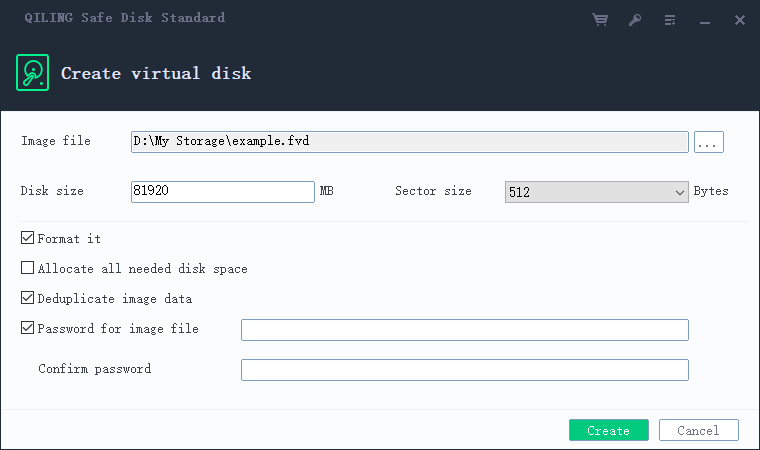
Step 3. Save the container file directly on the external drive. Set the size to fit the files you plan to protect, up to 2048 GB.
Step 4. Choose AES-256 encryption, set and confirm the password, then click Create. Safe Disk builds the encrypted file on the external drive.
Step 5. Select the container and click Mount. Enter the password and choose a drive letter.
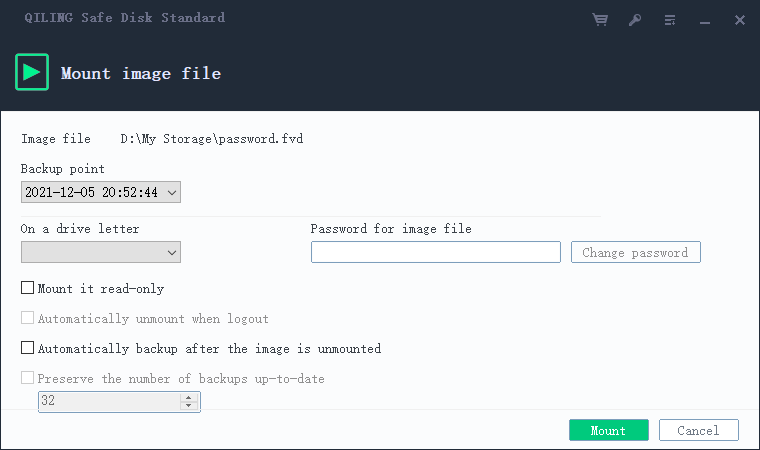
Step 6. Copy the files you want to protect into the mounted drive. When finished, click Unmount to lock them.
Use the Encrypted Drive on Another PC
The container travels with the external drive, so you can open it on any Windows PC that has Qiling Safe Disk.
- Install Safe Disk on the host PC. It is a small download and takes a minute.
- Plug in the external drive. The container file appears in Explorer, but its contents are not readable directly.
- Open Safe Disk and add the image. Click Add Old Image and select the container on the external drive.
- Mount with the password. Enter the same password you used when creating the container.
- Work normally. The drive appears, and you can open and edit files. Unmount when done.
If you cannot install software on the host PC, run the portable version of Safe Disk from the external drive itself, so the encrypted volume opens without leaving traces on the computer.
FAQs About External Drive Encryption
Will encryption slow down file transfers?
Modern CPUs accelerate AES in hardware, so the speed loss is usually under a few percent. On an older PC, you may notice slower large-file copies.
Can I encrypt the whole external drive instead of a container?
Yes, but a container is more flexible. You can still store normal files on the same drive, and the container is easy to back up.
What if the external drive fails?
Keep a backup copy of the container file on another drive. If the disk fails, you restore the backup and mount it with the same password.
Can I move the container to a new external drive later?
Yes. The container is a single file, so copy it to any new drive and mount it with Safe Disk.
Does the password change if I copy the container?
No. The password is stored inside the container file, so the same password works on any copy.
Back Up Windows Before You Change Settings
Before installing encryption software or changing storage settings, create a full Windows backup. Qiling Disk Master creates a system image you can restore from.
Step 1. Open Qiling Disk Master and choose "System Backup" to capture Windows and the boot partitions.
Step 2. Save the image to a drive other than the Windows disk, then start the backup.
Step 3. If a change causes problems, restore from this image to return Windows to its working state.
Conclusion
Encrypting an external hard drive is the single most effective step you can take to protect portable data. Qiling Safe Disk creates an encrypted container file directly on the external drive, and everything inside it is protected by AES-256. You mount it with a password, work with files normally, and unmount to lock the data away. If the drive is lost or stolen, the files are unreadable without the password. Keep a backup copy of the container on another drive and remember the password, and your portable data stays safe wherever you take it.
For more on protecting your data, see How to Encrypt a USB Flash Drive, How to Create an Encrypted Virtual Drive, Does Encryption Slow Down a Disk?, and How to Use Qiling Safe Disk.
Related Articles
- BitLocker Encryption: The Guard of Your Data
See how Windows' built-in full-disk encryption compares with Safe Disk's container method for external drives. - How to Mount an Encrypted Drive on Another Computer
Plug the external drive into another PC and mount the container with the same password. - Encrypt Backup Drive to Protect Your Data
Encrypt the external drive that holds your backup images for an extra layer of protection. - What is Disk Imaging
Back up the encrypted container file itself with a disk image so you never lose access. - Should You Encrypt Backups to Protect Against Ransomware?
Learn why encrypting the backups on your external drive matters as much as encrypting the originals.
Products
Articles & Tutorials
- Data Recovery
- Data Backup
- File Recovery
- File Backup
- System Backup and Restore
- Disk and Partition Clone
- Technical articles
- Mobile articles
- Disk Master Help
- Windows Data Recovery Tutorials
- Windows Secure Delete Tutorials
- Windows Partition Management Tutorials
- Windows File Backup and Restore Tutorials
- Windows System Backup and Restore Tutorials
- Windows Disk Backup and Restore Tutorials
- Windows Clone Tutorials