Is Google Drive Going Away? Get Clear Ideas Here!🥇
Google Drive, one of the most popular cloud storage services with over one billion active users, has been booming in recent years. However, it has been reported that Google Drive will no longer be available, leaving many computer users who store their data on the service in a bind.
Is Google Drive going away? This article from Qiling explores the possibility of Google Drive disappearing and provides a better data protection solution. It's worth checking out to learn more.
Google Drive Will Stop Working on Windows 8.1/8
Google Drive was first introduced on April 24, 2012, and is available for Windows, macOS, Android, and iOS, with an online version and a desktop app called Google Drive for Desktop.

Google Drive for Desktop allows users to store, share, and manage files on their computer, combining the features of Backup and Sync and Drive File Stream.
Google Drive will no longer support some platforms after August 2023, according to an announcement on Google's official website.
As of August 2023, Google Drive for Desktop will no longer support Windows 8/8.1 and 32-bit operating systems. To avoid service interruption, Windows users should upgrade to Windows 10 (64-bit) or higher by then.
Google Drive will not go away in 2023, but it will no longer be available on Windows 32-bit, Windows 8/8.1, and Windows Server 2012 operating systems.
The article explains that Google Drive for Desktop and Backup and Sync are two different applications that serve different purposes. Google Drive for Desktop is designed to sync your Google Drive files with your computer, allowing you to access and edit your files directly from your computer.
Google Drive for Desktop VS Backup and Sync
Google Drive for Desktop and Backup and Sync are two different applications that serve related but distinct purposes. Google Drive for Desktop is a more comprehensive app that allows users to sync files across devices, access Google Drive from the desktop, and also backup and sync files. Backup and Sync, on the other hand, is a more basic app that focuses solely on syncing files and backing them up. Ultimately, the choice between the two depends on the user's specific needs and preferences.
Advantages and Disadvantages of Google Drive
Google Drive for Desktop will stop supporting Windows 8/8.1, 32-bit operating system, and Windows Server 2012, but the online version will remain unaffected. This change does not impact Windows 10 (64-bit) or above users, who can continue to use Google Drive to store their data.
Google Drive is a cloud storage service provided by Google that offers a range of features, including file sharing, collaboration, and backup. However, it also has some drawbacks, such as limited free storage space, potential security risks, and compatibility issues with certain file types. Despite these limitations, Google Drive remains a popular choice for individuals and businesses alike, thanks to its user-friendly interface and seamless integration with other Google services.
👍Pros of Google Drive
- Easy File Access and Storage. You can quickly store or access your data in Google Drive from any device with an internet connection, including Android, iPad, Mac, iPhone, or PC.
- Automatic Backup and Syncing. Google Drive provides automatic backup and syncing functions to securely store and easily retrieve your files.
- Integration with Other Google Services. Google Drive integrates with Google Docs, Sheets, and Slides, making it easy to access and share files across these services.
- Powerful Search and Organization Features. The search functionality allows for searching files by name, content, owner, or keywords, and also enables organizing files into folders, applying labels, and using color coding.
👎Cons of Google Drive
- Privacy and Data Security Concerns. Google Drive data may be used for targeted advertising, despite robust security measures to secure user information, leaving a risk of data breaches or unauthorized access.
- Storage Limitations. Google Drive offers 15GB of free cloud storage, and you may need to purchase a storage plan if you need additional space.
- Internet Connection Required. Google Drive data can't be accessed without an internet connection, allowing offline work, but changes and comments are only synced when connected to the internet.
- File Size Limits. Embedded pictures in a document should not exceed 2 gigabytes, and alphanumeric and text documents should not have more than 1,024,000 characters.
Google Drive is a reliable cloud storage platform, but sometimes, you might experience issues like Google Drive not working or syncing errors, making it an unreliable way to protect your data.
Get a personalized enterprise backup solution tailored to your specific needs by starting a live chat with a Qiling Expert. They can assist with various aspects, including:
- Commence a free trial
- Obtain a quotation
- Arrange a free demonstration
Better Way to Protect Data: Using Cloud Backup Software🔥
The 3-2-1 backup rule states that three copies of data should be kept on different platforms, ensuring that if one platform fails, the data remains safe. Additionally, one copy of the data should be stored offline, separate from the other two platforms, to provide an extra layer of protection against data loss.
To ensure the safety of your data, using cloud storage services alone, such as Google Drive, is insufficient. Instead, consider utilizing professional cloud backup software, like Qiling Disk Master, to provide enhanced protection for your data.
Qiling Disk Master Pro is a useful and versatile backup and recovery utility for Windows 7/8/8.1/10/11 that enables automatic backups of files, disks, systems, and computer apps, with diverse backup modes including full, incremental, and differential backups.
Qiling Disk Master Pro
- Transfer an operating system from one computer to another
- Store backups in a local or external drive, NAS, Security Zone, or Cloud for safekeeping.
- Clone a hard drive and migrate your operating system from an HDD to an SSD with ease and speed. This process involves using specialized software to create an exact copy of the HDD's contents, including the OS, onto the SSD.
- Mount/unmount your backup images and split or edit backups
- Get 250G free Cloud storage to back up your files to Cloud.
Qiling Disk Master is a versatile backup tool that can meet all your backup needs, whether you want to back up your data to any location. It allows compression of backups and saves them in different locations to keep data safe, and also has an Enterprise Version for Windows Server users.
Here is how to back up your files to Cloud with Qiling Disk Master.
Step 1. Click the Backup and recovery tab page to start the backup process.
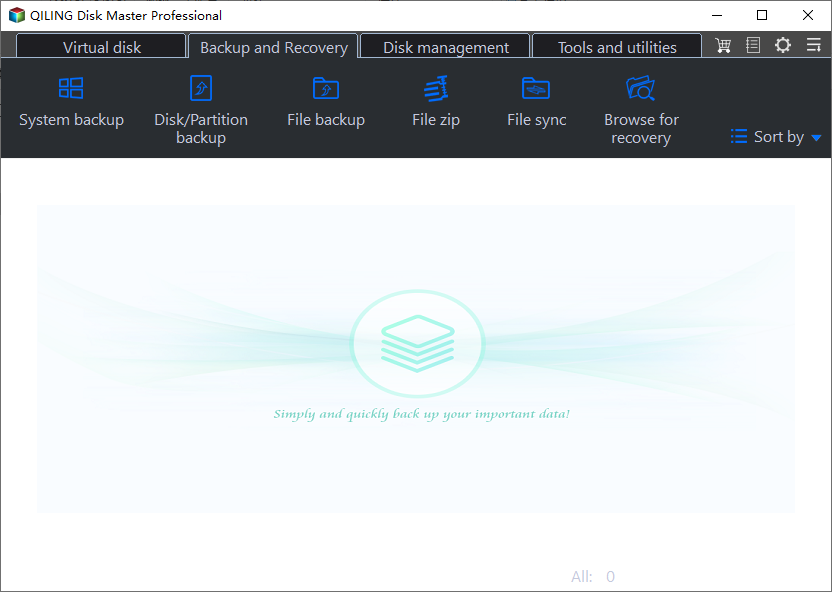
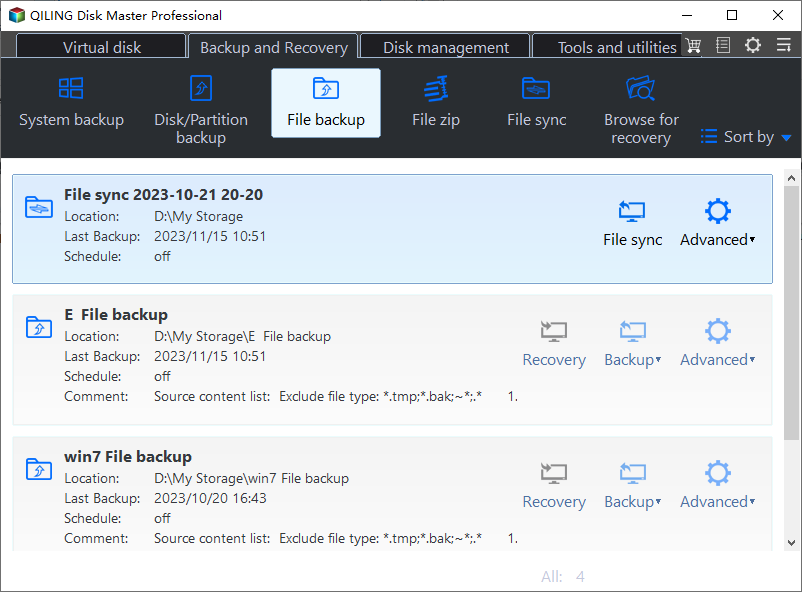
Step 2. There are four categories of data backup: File, Disk, OS, and Mail. These categories ensure that different types of data are protected, including important files, the operating system, and email accounts.
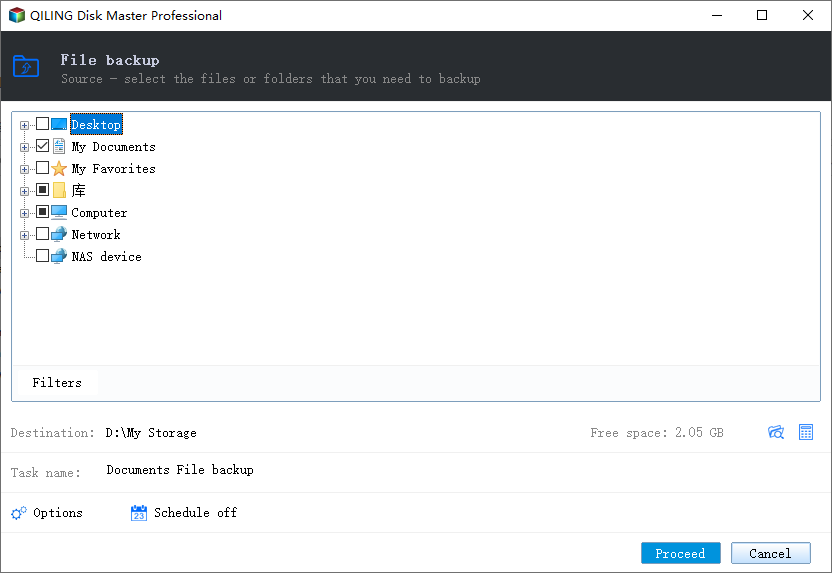
Step 3. The left-hand side of the screen displays lists of both local and network files. Users can expand the directory to select the files they want to back up.
Step 4. The guidance on the screen is to follow the instructions on how to store the backup, and choose the place where you want to store the backup.
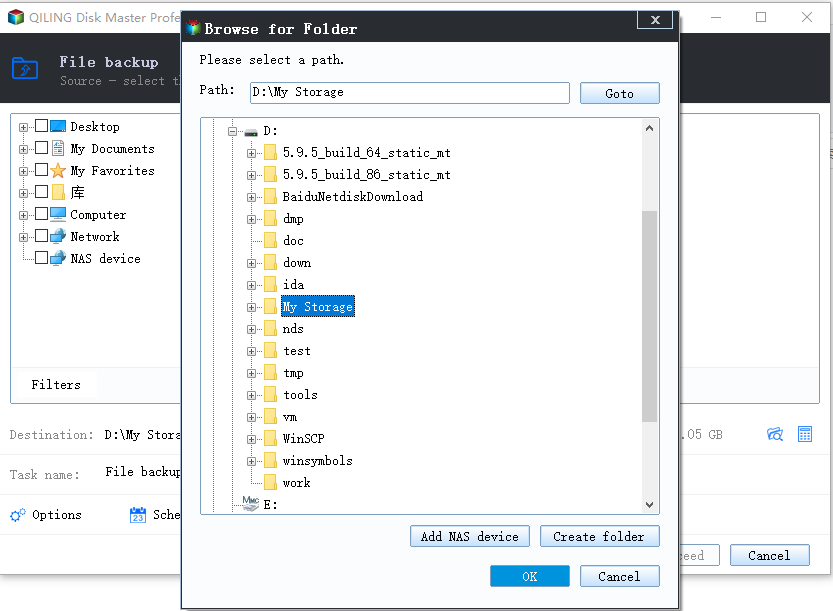
To ensure a secure backup, encrypt the backup and set a schedule by clicking on "Options" in the "Backup Options" section. You can also customize the backup start time in the "Backup Scheme" by clicking on "Options". Additionally, explore various other customizable options available.
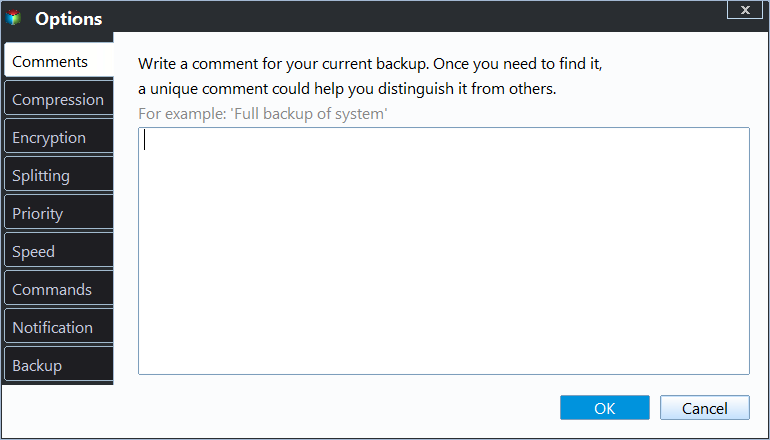
Step 5. You can store the backup file on your computer, in Qiling's cloud service, or on a network-attached storage device (NAS).
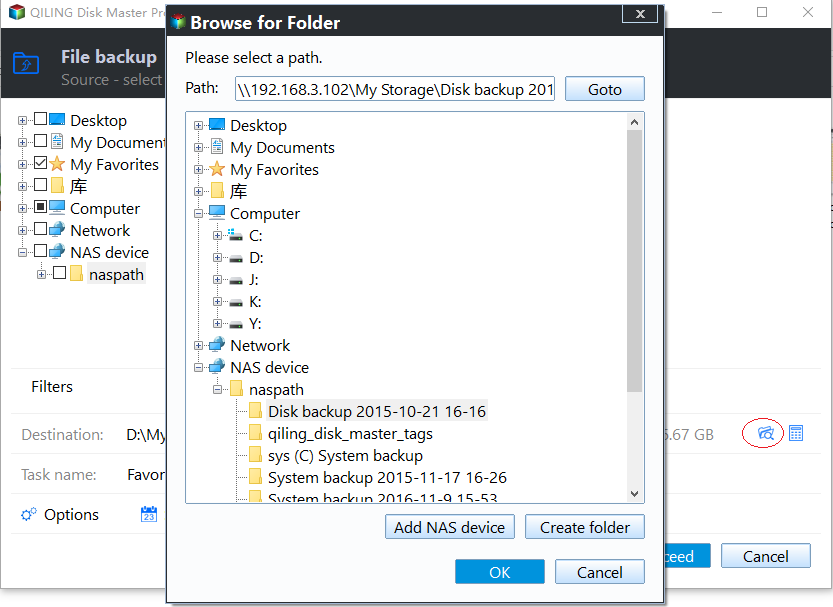
Step 6. Qiling Disk Master allows customers to store backup copies of their files on either a third-party cloud drive or the company's own cloud storage.
To back up your data on a third-party cloud drive, select Local Drive and scroll down to add Cloud Device, then fill in your account information.
Step 7. To start a backup, click on the "Proceed" button. Once the backup process is complete, the backup job will be displayed as a card on the left-hand side of the screen. You can right-click on the card to view more details about the backup job and learn how to manage it further.
If you like this article, you can post it on your social platforms.
To Wrap Things Up
Is Google Drive going away? Google Drive is not going away, but it will stop supporting Windows 8/8.1, 32-bit Windows, and Windows Server 2012, so users in these situations should upgrade to Windows 10 or higher to continue using Google Drive.
Cloud storage, such as Google Drive, is not a reliable backup plan on its own. To ensure comprehensive data protection, consider using professional backup software like Qiling Disk Master as a more reliable and secure option.
Qiling Disk Master is a tool that can back up data in various locations, not just the cloud, and also allows for scheduled backups and management of created backups, offering additional valuable functions.
FAQs on Is Google Drive Going Away
1. What happened to Google Drive 2023?
Google Drive will stop supporting Windows 32-bit operating systems, Windows 8/8.1, and Windows Server in August 2023, requiring users to upgrade to Windows 10 (64-bit) or higher to continue using the service.
2. Why is Google Drive shutting down?
Google Drive is not shutting down, it will continue to serve for many years to come.
3. How do I increase Google Drive storage for free 2023?
Google Drive offers 15GB of free cloud storage, including Google Photos, Drive files, and Gmail content, but requires paid upgrades if exceeded. In contrast, Qiling Disk Master provides 250GB of free cloud storage and allows data backup to various locations, including local disks, external disks, NAS, and cloud services.
Related Articles
- Can You Backup C Drive to OneDrive in Windows 10/11
- 2024: How to Install Windows 11 on M.2 SSD (with Pictures)
- Windows 10 Keeps Freezing on Startup – Causes & Solutions Are Here
- Can I Use a USB Flash Drive to Backup My Computer? [Answered with Details]
- Create System Image on USB Drive in Windows 10/8/7
- How to Backup Windows XP to USB Drive? 2 Ways Recommended
To back up Windows XP to a USB drive, you can either use Qiling Disk Master to create a backup or utilize the Windows Backup Utility, which can be accessed through the Control Panel.
Products
Articles & Tutorials
- Data Recovery
- Data Backup
- File Recovery
- File Backup
- System Backup and Restore
- Disk and Partition Clone
- Technical articles
- Mobile articles
- Disk Master Help
- Windows Data Recovery Tutorials
- Windows Secure Delete Tutorials
- Windows Partition Management Tutorials
- Windows File Backup and Restore Tutorials
- Windows System Backup and Restore Tutorials
- Windows Disk Backup and Restore Tutorials
- Windows Clone Tutorials