Five Ways to Backup Your Data on Windows
Losing all your data in a moment due to a system failure is a devastating situation, resulting in the loss of important documents, photos, videos, memories, and vital projects. To avoid this, relying on a backup is essential. Fortunately, we have got you covered with our guide on Five Ways to Backup Your Data on Windows, which provides you with the necessary solutions to safeguard your valuable data.
Five Ways to Backup Your Data
There are various ways to back up your data on Windows OS, each with its own strengths and weaknesses. Storage devices, backup modes, reliability, and efficiency differ across methods, making some more suitable than others. The five most suitable methods for backup and restore will be highlighted, providing a comprehensive overview of the options available.
- Method 1. Backup Your Data in the Cloud
- Method 2. Backup Your Data with An External Hard Drive
- Method 3. Backup Your Data with USB
- Method 4. Backup Your Data with NAS
- Method 5. Backup Your Data with a CD/SSD
Method 1. Backup Your Data in the Cloud
Cloud storage is the trendiest and most user-friendly way to back up your data, allowing you to store everything on another computer's server without needing secondary storage devices. You can connect with services like Google Drive, Microsoft OneDrive, and Google Photos to backup your data daily without using a physical storage device.
In 2022, backing up your data on Windows is a breeze. Even if you don't want to create a traditional backup, you can simply upload your data to cloud drives and delete it from your PC. This not only saves storage space but also money and effort, allowing your computer to run smoothly and efficiently.
Cloud backup is not limited to personal use, it can also be used for enterprise-level businesses, regardless of their size. Accessing files from cloud storage requires an active internet connection and a device to access the data.
You might consider it less secure, but having files backed up on a cloud computer doesn't pose a security breach. Since the data is encrypted, no third party can access it, eliminating the risk of data theft or other security issues.
To keep your cloud drive account safe, create a strong password and consider using a reputable cloud drive like Google Drive, iCloud, OneDrive, or Dropbox, which often offer free storage space. If your data exceeds the free limit, you can upgrade to paid storage.
Backing up to the cloud has its pros and cons, just like every coin has two sides. While it offers convenience, accessibility, and security, it also raises concerns about data ownership, privacy, and potential hacking risks.
Pros
- Free Space Available
- Cheaper storage upgrade plans
- Protects your data in case of disasters at your home or office
- Access your data anytime, anywhere with an internet connection
- Safe data transfer
Cons
- Limited free storage
- You risk losing data if the cloud server stops operating
- Requires an internet connection for backup and retrieval
Dropbox is a popular cloud storage service that allows users to store and share files online. It offers a user-friendly interface, automatic backup, and collaboration features, making it a reliable alternative to Cloud Storage.
Method 2. Backup Your Data with An External Hard Drive
An external hard drive is a hardware drive that connects externally to your PC, with some being as simple as Plug and Play and others requiring software installation for backup and retrieval. However, it's not ideal for daily backups, but rather for occasional use to safeguard confidential or important data.
External Hard Drives have their advantages and disadvantages!
Pros
- Cheaper than replacing your desktop computer's hard disk
- Ample storage space ensures no data loss
- Quick and straightforward to use
- Scheduling backups is optional
Cons
- The system is susceptible to damage from external accidents, malicious activities, or power fluctuations, making it vulnerable to disruptions.
- Susceptible to failures
To ensure data safety, it's recommended to save your data on an external drive and follow the 3-2-1 backup rule, which involves having three backup drives, one primary backup file, and two copies, with one copy stored off-site for added security.
Method 3. Backup Your Data with USB
With their smaller size, USB drives are a convenient and portable way to store data, but their safety can be compromised if not handled properly. If a USB drive is not encrypted, anyone who gains physical access to it can read or copy the data. This is why it's essential to use a password or encryption software to protect your data on a USB drive. Additionally, using a reputable and trusted USB drive manufacturer can also help ensure the safety of your data.
USB drives are not a secure option for backing up important data. They were once expensive and used for multiple purposes, but their design makes them vulnerable to data corruption. Additionally, USB sticks have limited read or write cycles, which can further compromise their reliability.
Portable storage devices like USB drives are convenient and affordable, but they're not a reliable way to secure your data. They can fail at any moment, so it's essential to have another copy of your data as a backup.
Carefully weigh the pros and cons before making a decision!
Pros
- Budget-friendly
- Small, portable, pocket-friendly
- Different ports available like USB 3.0/2.0 or similar
- Easy Data Transmission
Cons
- Easy to misplace
- Prone to data corruption and failures
- Low storage capacities
So if you're engaged in USB drive cloning, keep reading this article below:

How to Clone USB Drive on Mac?
To clone a USB flash drive on Mac Sierra or El Capitan without Disk Utility, you can use a third-party cloning software.

Method 4. Backup Your Data with NAS
Firms and enterprises often have shared data needs, especially those using LAN or similar networks. A NAS (Network-Attached Storage) is ideal for backing up data from multiple computers on the network and making it accessible to all.
The wireless backup method is a reliable way to proceed, allowing you to back up data from multiple computers simultaneously if you're running an educational institution on a LAN. It's also easy to access and restore data on different computers. While a wireless method is available, a wired option is also possible depending on your IT infrastructure and needs. Contrary to what you might think, you don't need to have advanced technical skills to set up a backup on a NAS - once it's set up, the data will appear as another hard drive on your computer.
NAS supports automatic and scheduled backup processes, but is relatively expensive due to setup, configuration, and maintenance needs.
Consider the pros and cons before deciding!
Pros
- Backup multiple PCs simultaneously
- Schedule and automate backup processes
Cons
- Costly
- Vulnerable to hard drive failures
If you have limited data, prefer SD cards and compact discs, and value a storage device with zero failure rate, this method might be suitable for you.
Method 5. Backup Your Data with a CD/SSD
When considering an alternative to prevent drive failures, backing up data to a CD/SSD may seem like a viable option. However, it's not a reliable method, and understanding its pros and cons is essential. While it may have some benefits, it also has significant drawbacks that make it an unreliable solution for data safety.
Pros
- No drive failure
Cons
- Not a safe long-term storage option
- It takes more time to backup
- Limited storage
- Prone to data corruption
You may want to consider an alternative method that is more effective, efficient, and affordable, as its disadvantages seem to outweigh its advantages.
Here's a summary of the five methods:
| Service | Pros | Cons |
|---|---|---|
| Cloud Drive | Free Storage, Cheaper plans, Effective against Disasters, Anytime, anywhere access | Free Storage is limited Requires internet to access data |
| External Drive | Cheaper than upgrading a hard disk More Storage | Need to follow the 3-2-1 backup rule Costly hardware |
| USB | Budget Friendly, Pocket-friendly, Various ports available, Simple data transmission | Easy to misplace Prone to data corruption Low storage |
| NAS | Can backup multiple PCs simultaneously Schedule and automate backup | Costly, High maintenance |
| CD/SSD | No drive failure | Time-consuming |
[Recommend] Backup Your Data with Qiling Backup
Qiling Backup is the ultimate solution for Windows Backup and Recovery, allowing you to save your data to a Cloud, External Hard Drive, USB, or CD/SD. With its scheduling and automation features, you can overcome the limitations of other backup options and ensure your data is protected.
Here are the reasons why Qiling Backup is better than others:
- Lossless backup
- Backs up apps, photos, videos, documents, software, and configurations
- This tool allows you to create backups of your data in various formats, including zip files and system images, giving you flexibility and control over how you store your backups.
- You have the option to backup your data using cloud storage, which allows you to access your files from anywhere, or go for a full-offline backup, which ensures your data is completely disconnected from the internet and can't be accessed remotely.
- Creates a backup in a few clicks
- The interface is as easy as Windows OS
- A subscription plan provides users with free cloud storage, allowing them to store and access their files from anywhere.
- Ideal for personal and enterprise reasons
- Reliable, secure, and fast
- Suitable for novices and even tech enthusiasts
The following steps can help you to use it better:
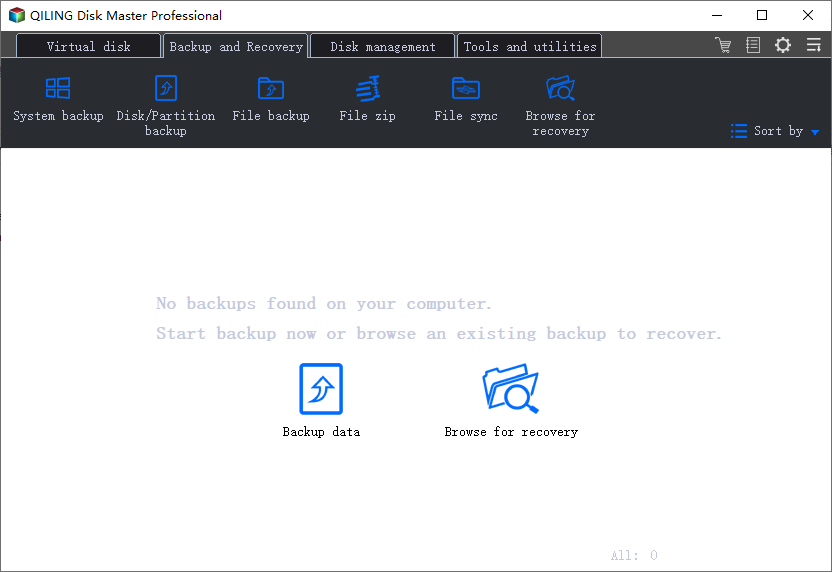
Step 1. Launch Qiling Backup on your computer, click System Backup on the home screen to start the backup process.
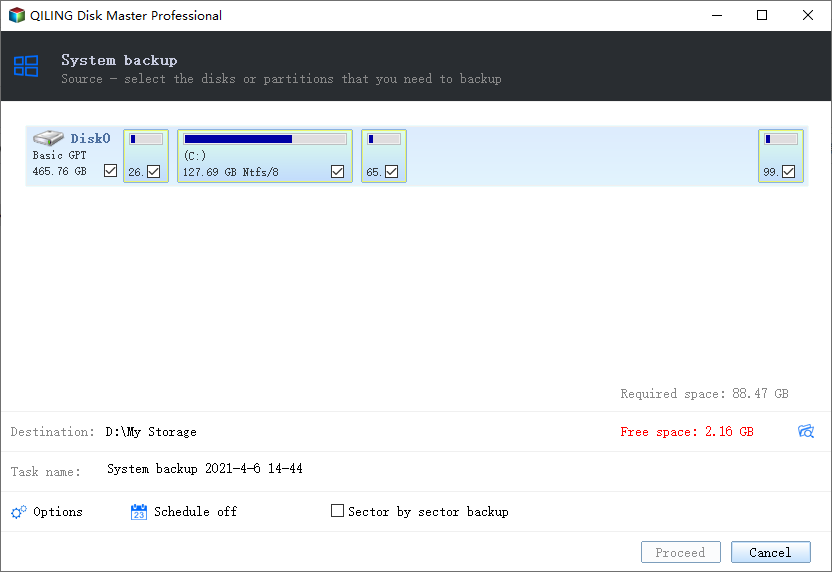
Step 2. On Windows, the operating system information and all system-related files and partitions will be automatically selected, so no manual selection is required. Next, choose a location to save the system image backup by clicking on the illustrated area.
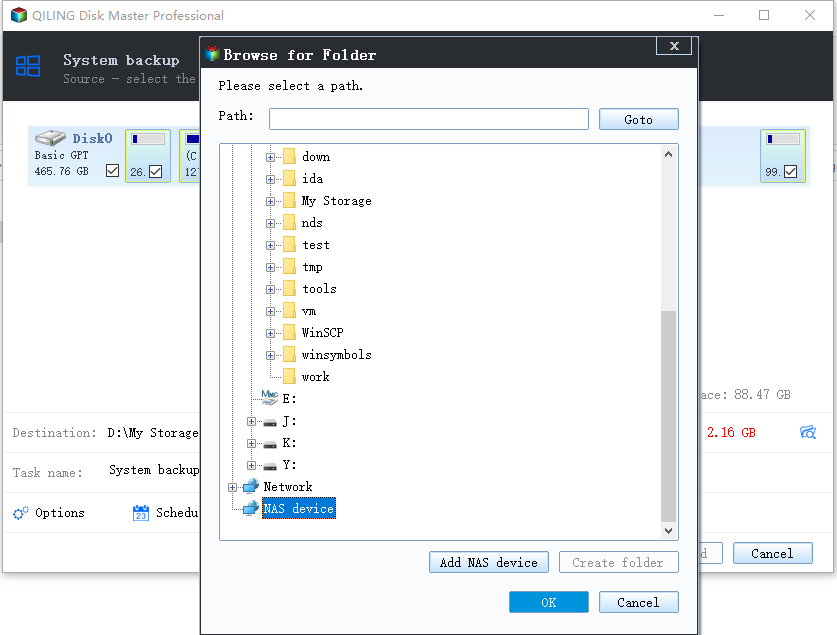
Step 3. The recommended backup location is an external physical drive or cloud, where system backup files can be safely stored.
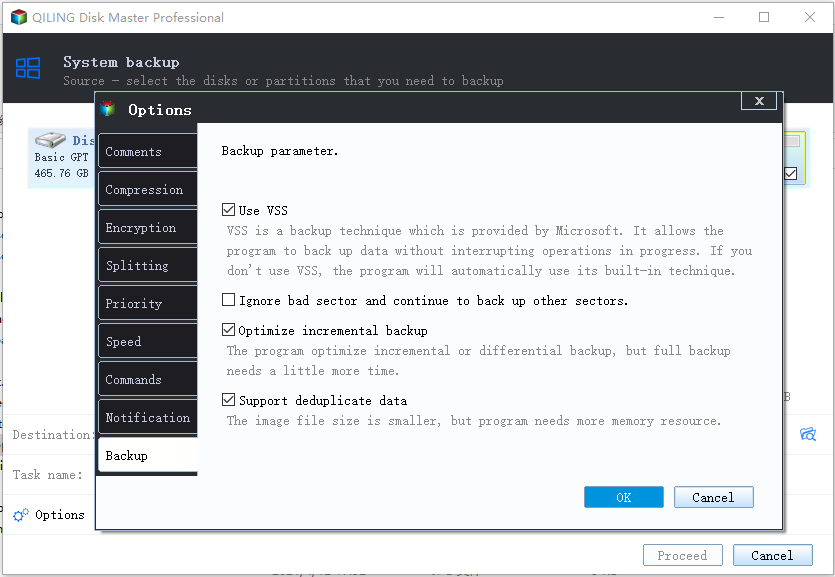
Step 4. Customization settings like enabling an automatic backup schedule in daily, weekly, monthly, or upon an event, and making a differential and incremental backup are available in the Options button. The Windows system backup process can be initiated by clicking "Proceed", and the completed backup task will be displayed on the left side in a card style.
Qiling is the best backup process I've tried, offering partitioned backups, app backups, and configuration backups to meet all your needs. With years of user trust and reliability, it's the perfect solution for creating a backup. So, download the software now and get started with your customized backup needs!
The Final Verdict
To backup your data on Windows, you can choose from various methods, including cloud drives, external hard drives, USB drives, NAS, or CDs/SD cards, each with its pros and cons. Regardless of the method you choose, using Qiling Backup software can help make it a foolproof plan, allowing you to backup data to the cloud, external hard drives, USB drives, CDs/SD cards, or similar.
Backup Your Data FAQs
Here are some frequently asked questions and answers to help you with your concerns:
1. What are the 3 types of backups?
There are three backups available: full, incremental, and differential.
2. Why do I need to back up data?
Backing up your data is crucial to safeguard against various primary failures, including system crashes, Windows malfunctions, malicious software, and disastrous situations. It also protects you from accidental deletions, ensuring your important files and information remain safe and accessible.
3. How to choose the best way to back up my data?
The best way to back up data depends on your needs. If you're looking to save costs and keep your data in a remote location, a cloud drive is a good option. Alternatively, if you prefer an offline backup, consider using an external hard drive and follow the 3-2-1 backup rule.
Related Articles
- Boot Drive vs Recovery Drive: Are They the Same Thing?
- [How-to] Windows 10 Automatic Backup Creating Guide
- Windows Backup Failed While Trying To Read From the Shadow Copy [New Fixes in 2022]
- How to Backup to OneDrive Without Sync? Step-by-step Guide
- 6 Ways to Fix OneDrive Error Code 0x8004de40 in Windows
Are you facing OneDrive Error Code 0x8004de40 in Windows? Are you unable to sync files? Then follow this easy guide to fix the error on Windows PC. - Fix Windows 11 Update Error with Efficient Ways
How to fix Windows 11 updates error? This article will guide you through each one of them, providing a comprehensive solution to resolve the issue.
Products
Articles & Tutorials
- Data Recovery
- Data Backup
- File Recovery
- File Backup
- System Backup and Restore
- Disk and Partition Clone
- Technical articles
- Mobile articles
- Disk Master Help
- Windows Data Recovery Tutorials
- Windows Secure Delete Tutorials
- Windows Partition Management Tutorials
- Windows File Backup and Restore Tutorials
- Windows System Backup and Restore Tutorials
- Windows Disk Backup and Restore Tutorials
- Windows Clone Tutorials