Intel Optane Memory vs SSD Caching Software: What's the Difference?
Both Intel Optane Memory and SSD caching software aim at the same goal: make a slow hard drive feel like a fast one by keeping your most-used data on faster storage. The difference is where that fast storage lives and how the caching is done. Optane uses dedicated hardware and a chipset feature; software caching uses a normal SSD, or even spare RAM, and works on almost any PC.
This guide explains how each approach works, compares them side by side, lists the hardware requirements, and shows how to set up a software SSD cache with Qiling Fast Cache on Windows 11.
PAGE CONTENT
- What Intel Optane Memory Is
- How Software SSD Caching Works
- Side-by-Side Comparison
- Hardware and Compatibility Requirements
- How to Set Up a Software SSD Cache
- Which Should You Choose Today?
- FAQs About Caching an HDD
- Back Up Windows Before You Change Settings
What Intel Optane Memory Is
Intel Optane Memory is a small module, usually in an M.2 slot, built on 3D XPoint memory rather than standard NAND flash. Paired with a mechanical hard drive and Intel Rapid Storage Technology, it acts as a cache: the driver learns which blocks you read and write most, stores them on the Optane module, and serves them from there.
Optane was interesting for two reasons. First, its random read performance at low queue depths was far ahead of the NAND SSDs of its era, which is exactly the pattern a desktop workload produces. Second, it was designed as a drop-in accelerator for systems that shipped with an HDD, letting a 16 GB or 32 GB module make a 1 TB hard drive feel much quicker.
The catch is that Optane is tied to Intel platforms and specific generations of chipsets and processors. Intel stopped developing new Optane products in 2022, so today it is mostly relevant on existing machines that already have a module installed.
How Software SSD Caching Works
Software caching does the same job in the operating system instead of in hardware. A tool such as Qiling Fast Cache watches the read and write patterns on a drive you choose, keeps copies of the hot blocks on faster storage, and redirects future requests for those blocks to the fast device.
Two details make software caching flexible:
- It can use two cache levels. Spare RAM can act as a first-level cache for the hottest blocks, while a spare SSD acts as a second-level cache that is large enough to hold a real working set and persists across reboots.
- It is storage-agnostic. The cache does not care whether the accelerated drive is an HDD or a slow SSD, and it does not need a specific CPU, chipset, or M.2 slot. Any spare SSD, including an older SATA model, can be put to work.
Because the cache sits below the file system, applications need no changes. Boot files, program files, and game data all benefit without being moved.
Side-by-Side Comparison
| Factor | Intel Optane Memory | Software SSD Cache |
|---|---|---|
| Cache hardware | Dedicated 3D XPoint module | Any spare SSD, plus optional RAM |
| Platform support | Specific Intel CPUs, chipsets, and UEFI settings | Any CPU and chipset |
| Typical cache size | 16-32 GB, up to 64 GB on some models | Limited only by the SSD you dedicate |
| Random reads | Excellent at low queue depth | Excellent on modern NVMe, good on SATA |
| RAM tier | No | Yes, as a first-level cache |
| Availability | Discontinued, hard to buy new | Installed in minutes, no hardware purchase if you have a spare SSD |
| Best for | Existing PCs that already have a module | Any PC that still runs on an HDD or a slow SSD |
In raw random-read latency, Optane had an edge over the SATA SSDs of its time. Against a current NVMe SSD used as a software cache, the gap largely disappears, and the software option wins on capacity, flexibility, and availability.
Hardware and Compatibility Requirements
Intel Optane Memory needs all of the following:
- A supported Intel processor and chipset generation, plus a UEFI setting that enables the caching feature.
- A free M.2 slot that supports the module, and a hard drive to accelerate.
- The Intel Rapid Storage Technology driver, and a system disk that is set up the way the tool expects.
Software caching needs only a spare drive and a Windows installation:
- Any spare SSD, internal or external, with enough free space for the cache.
- Optionally, spare RAM to add a first-level cache for the hottest data.
- Windows 11, 10, 8, or 7, on 32-bit or 64-bit editions.
How to Set Up a Software SSD Cache
Step 1. Download and install Qiling Fast Cache.
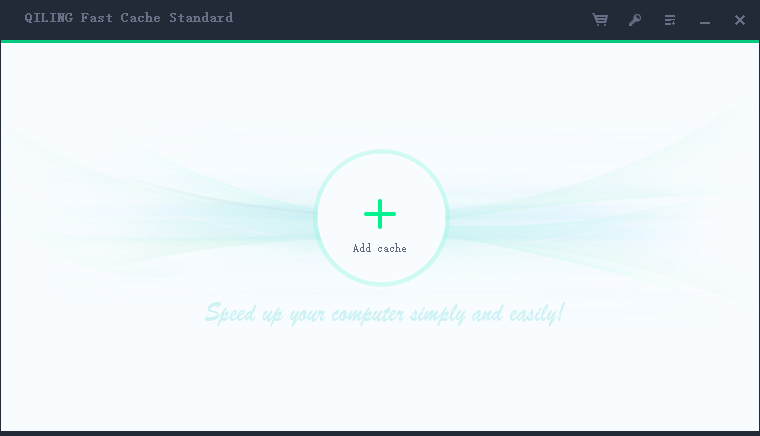
Step 2. Open the program and click the + button to create a new cache task.
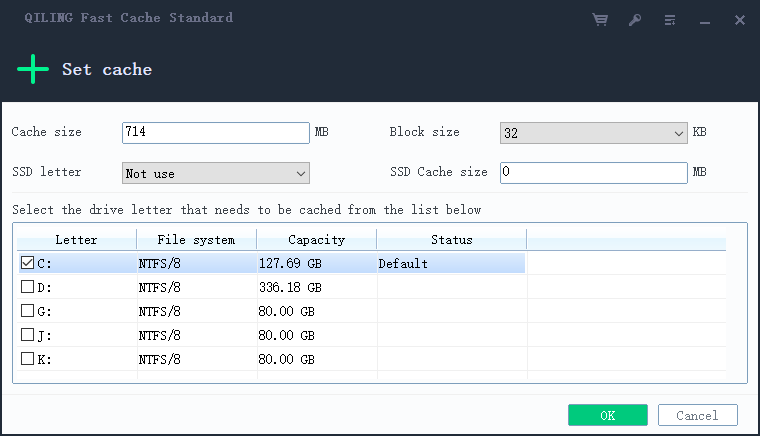
Step 3. Select the drive you want to accelerate, then set the cache size. Use spare RAM for the first level if you have it, and choose your spare SSD for the second level so the cache survives reboots.
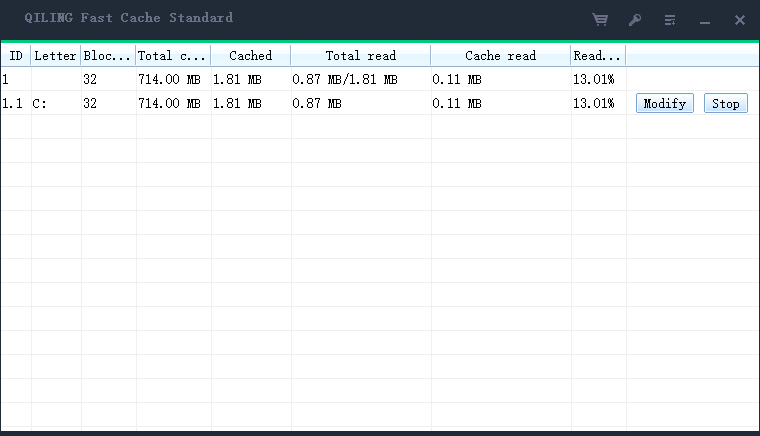
Step 4. Click OK to start caching. The main window shows the hit rate and read statistics as the cache learns your workload.
Which Should You Choose Today?
If your PC already has an Optane module installed and the Intel driver is working, there is no reason to change anything. It does its job, and the acceleration is transparent.
For everyone else, a software SSD cache is the practical choice:
- You probably already own the hardware. An older SATA SSD that is too small for Windows still makes an excellent cache.
- You are not locked to a platform. It works on AMD and Intel systems, on desktops and laptops, and on any drive you choose.
- You can add a RAM tier. Spare memory becomes a first-level cache, which software caching can do and Optane cannot.
- It is flexible. Change the cache size, switch the accelerated drive, or stop caching at any time without touching the hardware.
FAQs About Caching an HDD
Is Intel Optane Memory still worth buying?
New modules are no longer produced, and they require a supported Intel platform, so buying into it today is rarely practical. A software cache using a spare SSD gives comparable results on almost any PC.
Does a software cache work with an SSD as the source drive?
Yes. It is most dramatic with an HDD, but it can also speed up a slow SATA SSD or an external drive by caching its hot blocks on faster storage.
How much SSD space should I dedicate to the cache?
For a system drive, 60-120 GB is usually plenty to hold the working set of Windows and your common apps. The cache only needs to cover the data you actually reuse.
Will caching damage my SSD?
Caching adds writes, but the amount is modest compared with the benefit, and a cache means the HDD does less work. See How to Extend Your SSD Lifespan for context on endurance.
Can I cache a drive that is already an SSD?
Yes, though the gain is smaller. It still helps when the drive is an older or lower-end model, or when it is connected over a slower interface than the cache device.
Do I need to move my files to the cache?
No. The cache is transparent. Files stay on the original drive, and the caching layer decides which blocks to keep in the fast tier.
Back Up Windows Before You Change Settings
Setting up a cache is safe, but changing storage drivers or partitioning always carries some risk. Qiling Disk Master creates a full Windows image you can restore from if anything goes wrong.
Part 1: Create a Full System Backup
Step 1. Install and open Qiling Disk Master. On the home screen, open "Backup and Recovery" and choose "System Backup". This option automatically includes Windows and the hidden boot partitions, so you do not have to select them one by one.
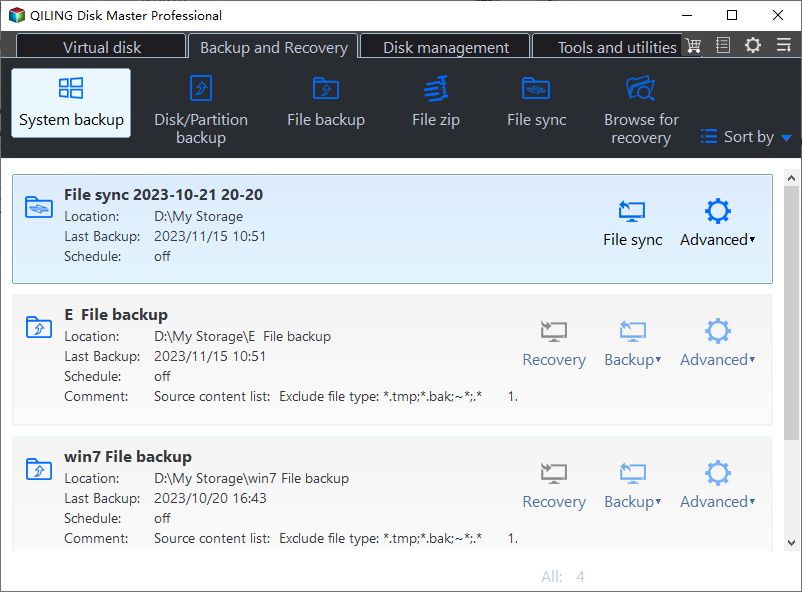
Step 2. Check the source. The disk where Windows is installed and its system partitions are already ticked for you. If you only need your personal documents, run a separate "File Backup" task instead.

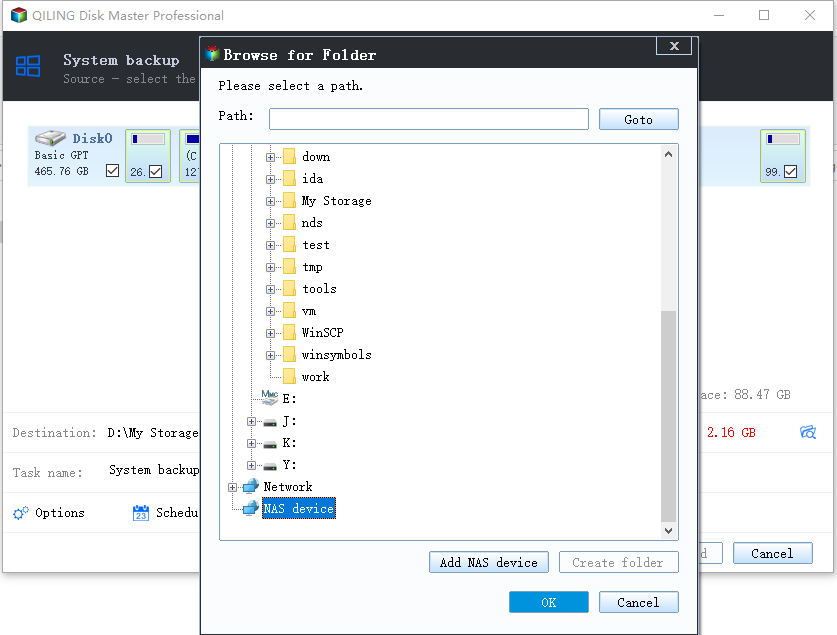
Step 3. Click the destination box and choose where the image should be saved. Use an external HDD or SSD, a NAS, or any drive other than the one Windows is installed on, and make sure it has enough free space.
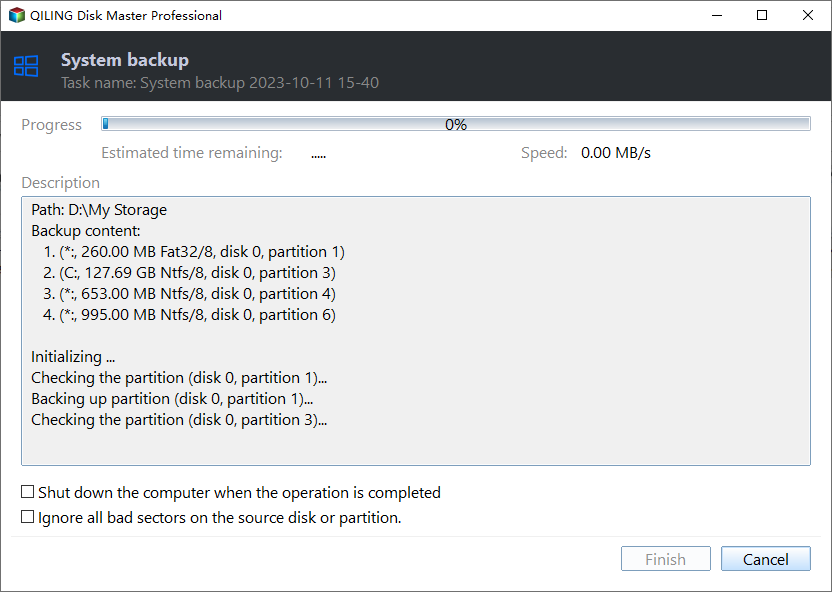
Step 4. Review the task summary and click "Proceed". Wait until the progress bar reaches 100%. Do not unplug the drive or turn off the PC while the backup is running.
Part 2: Restore Windows from the Backup
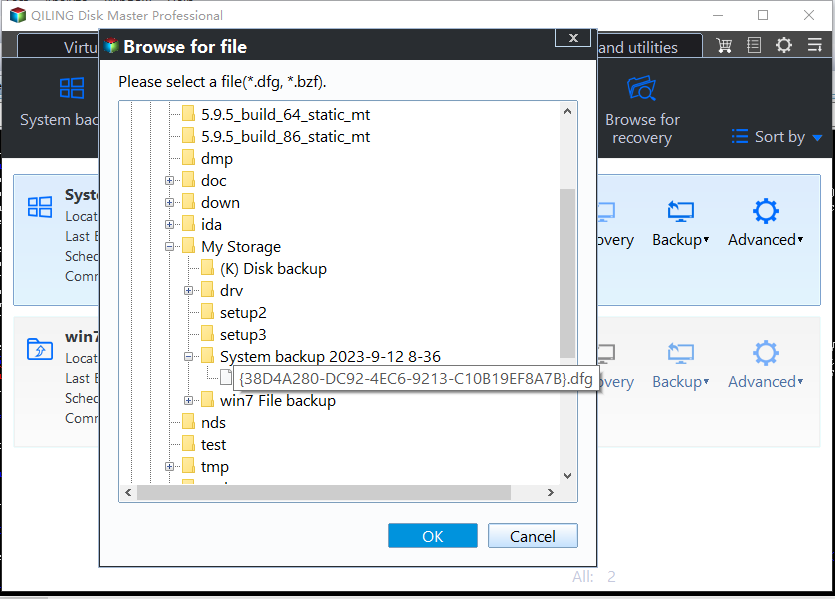
Step 1. Open Qiling Disk Master again, go to "Backup and Recovery", and select the recovery option. Your backup images are listed, so pick the one you created before the changes began.
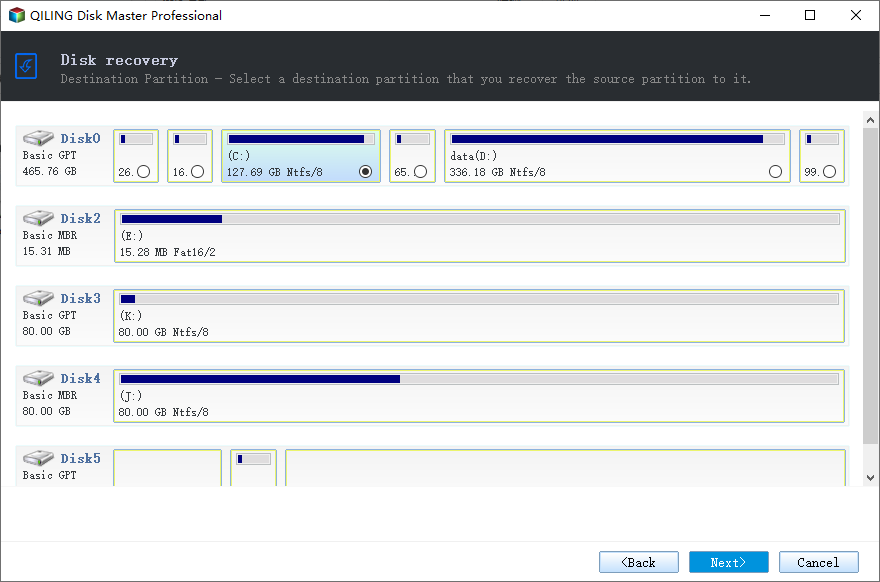
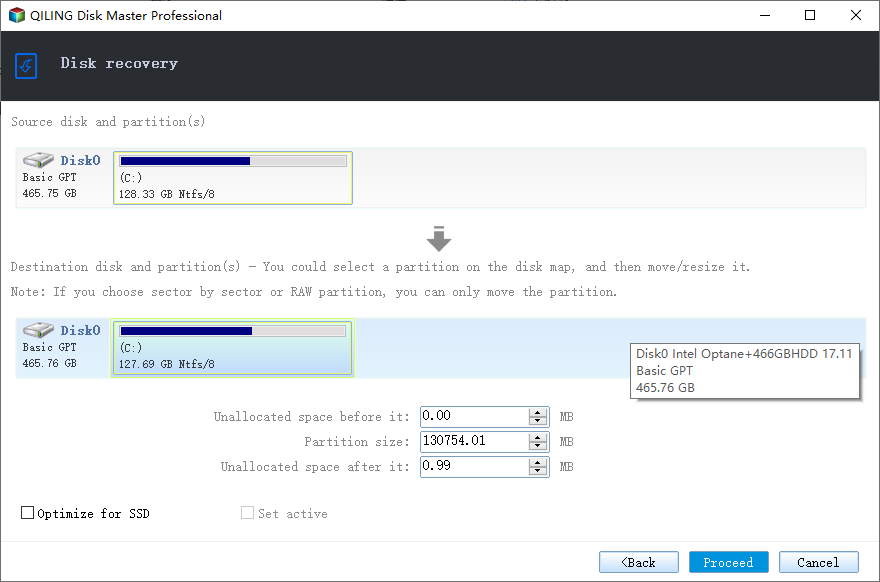
Step 2. Choose the target disk or partition. Normally you restore to the original system disk. If the drive was replaced, select the new disk instead, and the restore rebuilds Windows together with its boot partitions.
Step 3. Preview the restore plan, click "Proceed", and confirm the warning. The PC restarts to finish the job, and Windows comes back exactly as it was on the day the image was created, with your files and programs intact.
- Note
- Keep the backup image on a separate drive, and refresh it before changing storage drivers or cache settings.
Conclusion
Intel Optane Memory and software SSD caching solve the same problem in different layers. Optane works in hardware, needs a supported Intel platform, and is no longer produced; a software cache such as Qiling Fast Cache works on any PC, can combine spare RAM and a spare SSD, and needs no special hardware beyond a drive you may already own. If you have an Optane module that is already set up, keep using it. Otherwise, install Fast Cache, point it at the drive you want to accelerate, and let the cache warm up — a hit rate above 50 percent is a good sign that your HDD is no longer the bottleneck.
Protect your PC with Qiling Backup—create a system image before your next round of settings changes.
For more Windows 11 performance guides, see Windows 11 Fast Cache, How to Use an M.2 Drive for Cache, SSD Cache vs RAM Disk, How to Check Cache Hit Rate, and ReadyBoost vs RAM Disk vs SSD Cache.
Related Articles
- Windows 11 Fast Cache: Speed Up HDD with RAM and SSD Cache
Step-by-step setup for the software cache described here. - How to Use an M.2 Drive for Cache Data
Put a spare M.2 SSD to work as a second-level cache. - ReadyBoost vs RAM Disk vs SSD Cache: Which to Use?
- PrimoCache vs Qiling Fast Cache
- SSD Cache vs RAM Disk: Which Speeds Up Windows 11 More?
Products
Articles & Tutorials
- Data Recovery
- Data Backup
- File Recovery
- File Backup
- System Backup and Restore
- Disk and Partition Clone
- Technical articles
- Mobile articles
- Disk Master Help
- Windows Data Recovery Tutorials
- Windows Secure Delete Tutorials
- Windows Partition Management Tutorials
- Windows File Backup and Restore Tutorials
- Windows System Backup and Restore Tutorials
- Windows Disk Backup and Restore Tutorials
- Windows Clone Tutorials