How to Fix and Recover Data from Uninitialized Disk on Mac [macOS 13/12/11]
If you've encountered an "uninitialized disk" on your Mac after connecting an external hard drive you've used before, you may be facing system errors and an inability to access the data saved on the drive. This article aims to help you recover data from an uninitialized disk on your Mac.
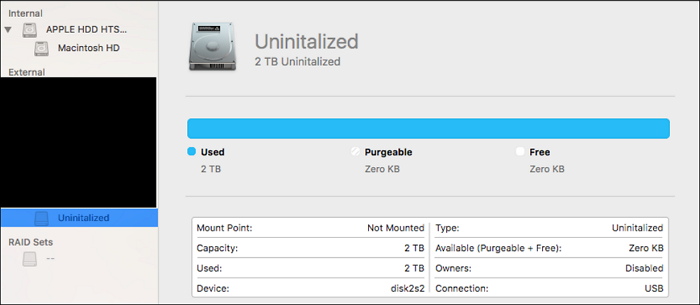
Why Does Mac Uninitialized Disk Issue Occur
The disk is uninitialized on Mac because macOS needs to activate and assign a variable in its own language when the drive is connected for the first time, causing it to malfunction and not be accessible or readable.
Mac's disk may become uninitialized due to a hardware failure, such as a faulty hard drive or a malfunctioning solid-state drive, which can cause the disk to become inaccessible. Additionally, software issues like a corrupted operating system or a failing disk driver can also lead to this problem. Furthermore, user errors like accidentally deleting important system files or formatting the wrong drive can also result in an uninitialized disk.
- Malware or virus infection: The drive will be harmed and become uninitialized due to virus infection.
- Defective partition or disk: The external hard disk's partition is lost, and the drive is unknown and not initialized, making it inaccessible and unusable.
- System errors: The Mac Finder may not recognize an attached USB flash drive, or display the message "The disk you inserted is not readable by Mac." This issue can be caused by a faulty USB port, a corrupted flash drive, or outdated Mac software.
- Damaged or bad sectorIf certain problematic sectors exist, it will lead to an unexpected problem.
- Physical harm: The problems relating to the improper connection, sudden loss of electricity, or hard disk crack can be considered as physical issues.
If the hard disk has physical damage, send it to the seller for replacement or repair. For other causes of an uninitialized hard disk on a Mac, refer to additional resources for possible fixes.
How to Recover Data from Uninitialized Disk on your Mac
A Mac cannot access files on an uninitialized disk, but those files are still present and recoverable using professional data recovery software like Deep Data Recovery for Mac, which can even uninitialized the internal disk if the data hasn't been overwritten, allowing you to preview and select only the required data for accelerated recovery.
Data recovery software can significantly improve the chances of retrieving lost data, even if Disk Utility shows a greyed-out drive partition.
Deep Data Recovery for Mac
- To recover data from an uninitialized disk on a Mac, you can use the built-in Disk Utility or third-party software like Disk Drill, Deep Data Recovery Wizard, or Stellar Data Recovery. These tools can help identify and recover data from a disk that won't initialize due to various reasons such as corruption, formatting, or physical damage.
- Recover lost partitions on a Mac can be done on a PC or the original internal hard drive of the Mac in multiple file systems, allowing users to retrieve their lost data. This process involves using software designed for partition recovery, such as Qiling Partition Recovery or Disk Drill, to scan and rebuild the lost partition, making it accessible again.
- You can recover permanently deleted files on a Mac, even if the hard drive is unmountable, by using a data recovery software that can scan the drive for recoverable files. These software can bypass the operating system's file system and recover files that were deleted or corrupted due to various reasons.
To recover data from uninitialized external disks, follow these steps:
Step 1. Search for lost files
Connect your external hard drive to your Mac, launch Deep Data Recovery for Mac, select the external hard drive, and click "Search for lost files" to find lost/deleted files on your external device.
Step 2. Filter and find lost files
After scanning, all file types will be displayed in the left panel. Select the file type to search for the desired files on your external devices.
Step 3. Preview and recover
To recover data from a corrupted file, click on the file to preview it, select the desired files to recover, and then click the "Recover" button to save the data to a local drive or cloud storage.
You can also follow this video tutorial:
How to Fix Uninitialized Disk Issues on Mac
If your external hard drive isn't initialized, you can try a few methods to resolve the issue and get it working again. Before attempting to fix the drive, consider performing data recovery to safeguard your files from potential loss. This involves using software to scan the drive and retrieve any accessible data.
- Method 1. Reconnect the Disk to Check the Disk Again
- Method 2. Restart Your Mac
- Method 3. Use First Aid in Disk Utility
- Method 4. Reinstall or Upgrade macOS
- Method 5. Initialize or Format the Uninitialized Disk
- Method 6. Scan and Remove Virus
Method 1. Reconnect the Disk to Check the Disk Again
Before initializing the external hard drive on your Mac, it's a good idea to check the connection first. To do this, simply unplug the external hard drive, wait a few seconds, and then plug it back in. If that doesn't work, you can try using a different USB cable or plugging it into a different USB port. This can sometimes resolve any issues with the connection.
Method 2. Restart Your Mac
To restore your Mac to normal, simply unplug all peripherals, and then reboot your Mac by shutting it down and turning it back on. This is an effective way to resolve any issues and get your Mac running smoothly again.
- Choose Apple - Restart
- Or you can press Command+Control+Power
- If your Mac won't boot, try to reboot in macOS Recovery (Command + R) or Mac Safe Mode (Shift + Power button).
Method 3. Use First Aid in Disk Utility
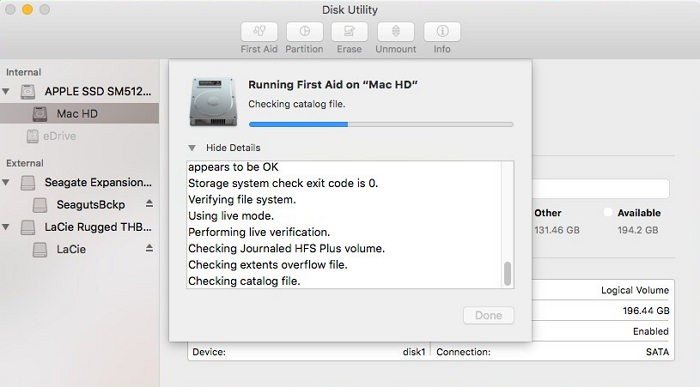
Disk Utility is the standard diagnostic program for Mac, used to handle various disk problems. It allows booting into the program and initializing the disk if there are additional issues, such as file system crashes.
- You can select Disk Utility under Go - Utilities.
- The uninitialized external hard disk will thereafter be visible.
- You can select the drive and click the First Aid button at the top of the Disk Utility window.
- Or you can right-click the drive and select First Aid.
- It will automatically begin to fix the problems.
Method 4. Reinstall or Upgrade macOS
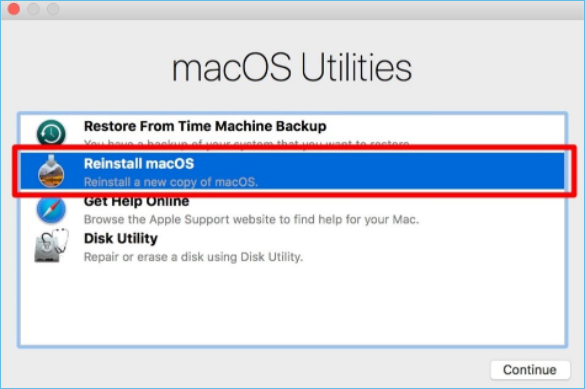
If your Mac's hard disk becomes uninitialized after upgrading the operating system, you can reinstall macOS to fix the error. This will allow you to install your preferred operating system and restore any important files to the disk.
To reinstall macOS:
- Turn off your Mac.
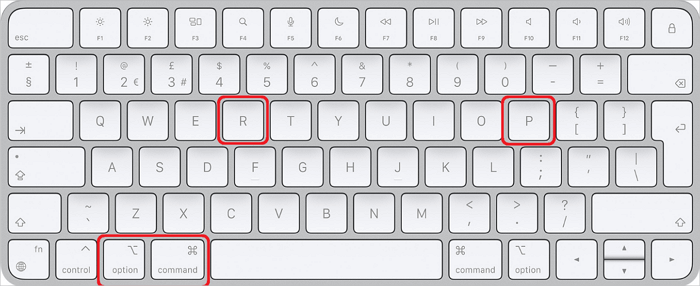
- Pressing and holding Command+R on your keyboard while booting your Mac will put it into Recovery Mode, allowing you to access various tools and options for troubleshooting and repairing your system.
- Select "Reinstall macOS" under the macOS Utilities window.
- Choose Install to start the process.
Method 5. Initialize or Format the Uninitialized Disk
If none of the above fixes for your uninitialized external hard disk on a Mac work, the formatting might be necessary. It is an effective technique to cure your uninitialized disk. To format the disk on Mac, you can go to Disk Utility, select the external hard disk, click on the "Erase" button, choose the desired format, and confirm the action. This will erase all data on the disk, so make sure to back up any important files before proceeding.
- Select Disk Utility under Applications - Utilities.
- From the left sidebar, select the uninitialized drive.
- Click Erase at the top.
- If you've previously fixed the issue, reconnecting the drive should resolve the problem. If the problem persists, it's likely that the drive's firmware is corrupted.
Notice: Formatting a disk will erase all data on it, making it impossible to recover without specialized software. Formatting the disk will delete all data on it, and a data recovery program will be needed to recover the files. Formatting the disk will remove all data.

Top 5 Completely Free Data Recovery Software for macOS
The top five completely free data recovery software for Mac include various options that differ in features, functions, and performance. These free data recovery software for Mac offer a range of capabilities, from recovering deleted files to retrieving data from corrupted or formatted hard drives, and can be a cost-effective solution for users who need to recover lost data without breaking the bank.
Method 6. Scan and Remove Virus
The process of acquiring a disk infected with a virus is relatively straightforward if the disk has previously been connected to a different computer or device. To resolve this issue, launch security software on your Mac to scan and remove viruses from the drive.
To Wrap It Up
Your hard drive will lose its initialization, making the data inaccessible, but not necessarily erasing it. You can use Qiling Data Recovery for Mac to easily recover data from uninitialized disks and then follow the instructions above to fix the uninitialized disk issues.
Recover Data from Uninitialized Disk Mac FAQs
Here are 4 additional questions about recovering data from an uninitialized disk on Mac. Check here for the answers.
1. How can I recover data from an uninitialized disk?
Using Mac data recovery software is the most efficient and reliable approach to recovering files from a Mac hard drive. A smart choice is Deep Data Recovery for Mac.
You can follow the steps:
Step 1. Search for lost files.
Step 2. Go through the scanning results.
Step 3. Select the file(s) and recover.
2. How do I access my uninitialized hard drive?
It's not possible to open an uninitialized drive on a Mac as the operating system can't access or read its contents. However, you can initialize the disk to access its data. If that's not feasible, you can still recover files from the uninitialized disk using data recovery software.
3. Does initializing a disk erase data on Mac?
If you discover that your hard drive has become uninitialized, you can try some methods before fixing it. These methods may make the disk usable again, so it's worth a shot. However, keep in mind that initializing the disk will completely erase its data, so be prepared for that possibility. If none of these methods work, you may need to take further action to repair your hard drive.
4. How to initialize an external hard drive on Mac?
When you first connect a new hard drive to your Mac, macOS will attempt to automatically initialize it. If this doesn't happen, you can manually start the process by clicking "Initialize" or use Disk Utility to create a partition on the drive.
Related Articles
- Mac Desktop Empty: How to Restore Missing/Disappeared Mac Desktop Files and Icons
- How to Recover Deleted Files with Mac Terminal & Alternative Ways
- Does Updating macOS Delete Everything? No...but Yes!
- Recover Deleted Files Mac Terminal and Better Alternatives
- 4 Ways to Fix the Parameter is Incorrect in External Hard Drive
Here are 4 ways to fix the problem of the parameter is incorrect in an external hard drive, solve the problem and recover data in external hard drive: Check the connection, update the drive's firmware, run a disk check and repair, and recover data using data recovery software. - How to Fix USB Drive Not Formatted Error [2023]
The 'USB drive not formatted' error can be frustrating, but there are solutions available. Fortunately, there are ways to resolve this issue, and one can try three methods to fix the problem.
Products
Articles & Tutorials
- Data Recovery
- Data Backup
- File Recovery
- File Backup
- System Backup and Restore
- Disk and Partition Clone
- Technical articles
- Mobile articles
- Disk Master Help
- Windows Data Recovery Tutorials
- Windows Secure Delete Tutorials
- Windows Partition Management Tutorials
- Windows File Backup and Restore Tutorials
- Windows System Backup and Restore Tutorials
- Windows Disk Backup and Restore Tutorials
- Windows Clone Tutorials