How to Repair Bad Sectors on External Hard Drive Mac Without Losing Data
| Fix Bad Sectors on Mac | Full Guide |
|---|---|
| 1. Repair Bad Sector with First Aid | Connect your external hard drive to Mac Go to the macOS Utilities window...Full steps |
| 2. Replace Failing Hard Drive | Connect both HDDs to Mac to get started Navigate to Applications > Utilities > Disk Utility...Full steps |
The concept of bad sectors can be unsettling, and the consequences of having them can be severe. However, the goal should be to minimize their presence. If you're experiencing issues with bad sectors on an external hard drive on your Mac and want to repair them without losing important data, this information can be helpful to you.

What Are Bad Sectors?
Wiki - A bad sector is a permanently damaged disk sector that loses all information stored on it, and the operating system skips it in the future after being marked.
A drive is in danger of failing and losing data permanently when it develops bad sectors, according to the definition.
Since the operating system can skip bad sectors, there's no immediate need to worry if they're found. However, if the bad sectors continue to grow and start to freeze the operating system, it's time to take action to correct them. Accumulating bad sectors is inevitable for any hard drive, so it's essential to minimize their formation and maintain the hard drive's health through daily use.
Two types of bad sectors you should know...
- Physically damaged bad sectors, caused by factors such as scratches on a drive's surface, heavy dust ruining core components, or a hard drive collapse damaging rotating parts, cannot be repaired.
- Most bad sectors on a hard drive are caused by logical errors that can be fixed. These errors often occur when there's a sudden power outage while data is being written to the disk, or when a virus or malware attack damages the drive. In contrast, physical bad sectors are caused by actual physical damage to the drive's surface and are often irreversible.
How to Identify Bad Sectors on Mac?
First, you can judge by the symptoms.
Unless the drive is showing signs of malfunction, such as being unable to read or write to certain sectors, or the operating system freezing frequently, there is no need to check for bad sectors.
Second, use professional software for an automatic check.
If you're concerned about the health of your Mac's hard drive, including identifying bad sectors, you can use third-party software like Setapp, which is a reliable option.
How to Recover Data from Bad Sectors on Mac
As bad sectors accumulate, the most direct impact will be on the data, making it high time to begin data recovery. Since no real-time backup is available, recovering data from an external HDD with too many bad sectors is crucial. Luckily, Deep Data Recovery for Mac can recover data from inaccessible HDD, USB flash drive, or memory cards, making it possible to access data that would otherwise be inaccessible.
Download Qiling hard drive recovery software for Mac, and follow a 3-step guide to rescue data from an external hard drive with bad sectors.
Step 1. Launch Deep Data Recovery. Choose file types and click "Fast Scan" to start the recovery process.
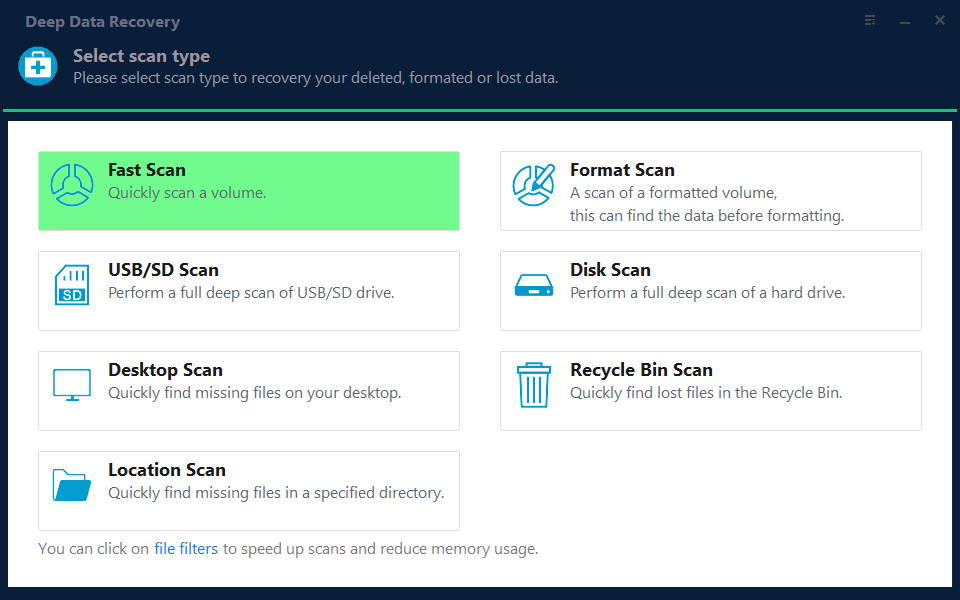
Note: You can choose different search modes based on where and why the data was lost.
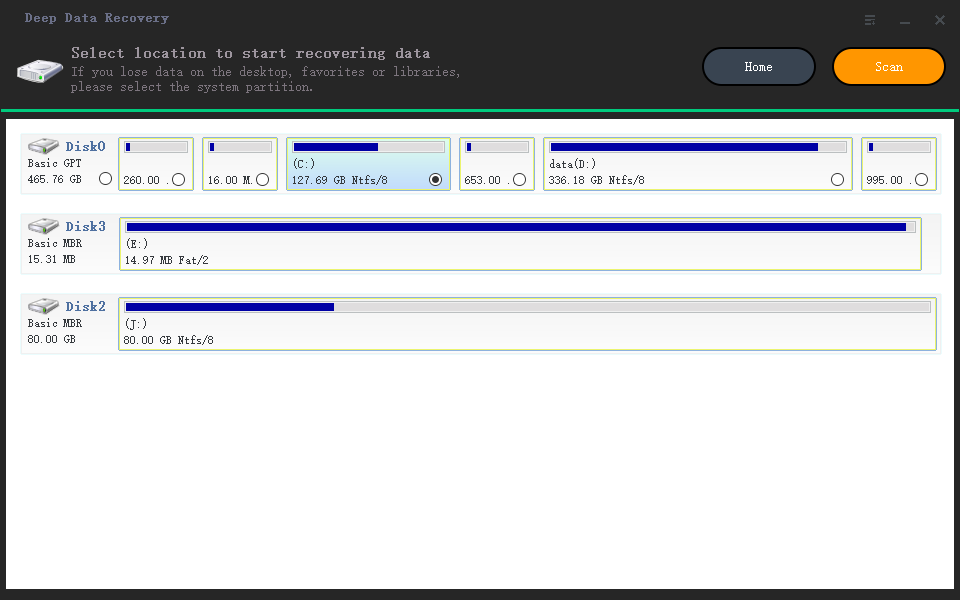
Step 2. Select the disk location where you lost data and files, then click the "Scan" button.
Step 3. Deep Data Recovery for Mac scans the selected disk volume and displays the results on the left pane.
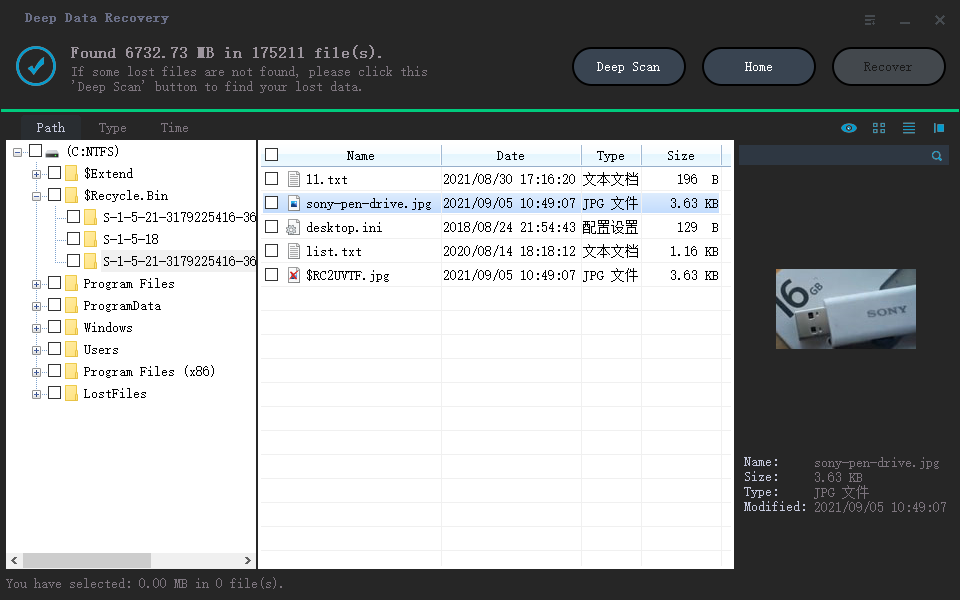
Step 4. In the scan results, select the file(s) and click the "Recover" button to have them back.
If your Mac's internal HDD fails to boot due to bad sectors, you can recover data using Deep Data Recovery for Mac bootable edition, which allows access to the drive without needing to boot the operating system.
To create a USB bootable media of Deep Data Recovery for Mac, follow the instructions on the linked page.
How to Use Disk Utility to Fix Bad Sectors from External Hard Drive on Mac (Two Ways to Go)
The hard bad sectors on a disk are usually unrecoverable, but soft bad sectors can often be restored by deallocating the storage space they occupy, which Disk Utility can do.
Fix 1. Repair Bad sectors via Disk Utility's First Aid
- Connect your external hard drive to your Mac using the proper cable or enclosure, such as a USB cable or a Thunderbolt 3 cable, to ensure a stable and secure connection.
- Press and hold the Command (⌘) + R keys to awake the Apple logo.
- To start, go to the macOS Utilities window, select Disk Utility, and then click Continue.
- From the Disk Utility sidebar, select the connected external hard drive and click First Aid.
- Click Run to repair the drive.
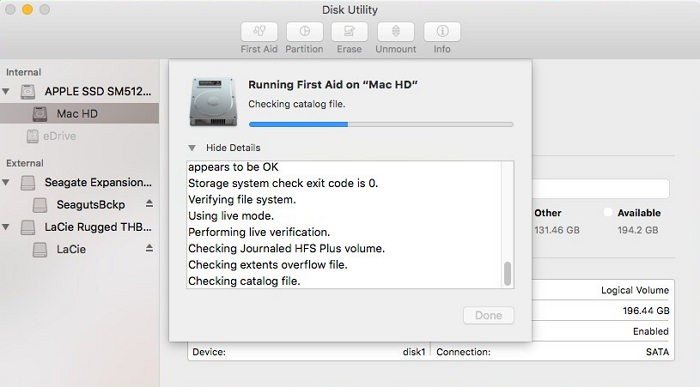
Fix 2. Replace failing external hard drive via Disk Utility's Restore
Before the external hard drive completely dies, you can try to clone the drive and all its contents to a new drive, which can help avoid permanent data loss.
- To clone the external hard drive, the target HDD should be of equal or larger size than the original external hard drive. First, connect both HDDs to your Mac to get started.
- Navigate to Applications > Utilities > Disk Utility.
- Select the new hard drive from the sidebar and click Restore on it.
- To restore your files from a bad external hard drive, go to the Disk Drill Restore from option, select the problematic external hard drive, and click Restore.
- Wait for Disk Utility cloning. After completion, click Done.
What's Next...?
Bad sectors on a hard drive can be unpredictable and may occur suddenly. To mitigate this, investing in reliable security software or a UPS (Uninterruptible Power Supply) device can help prevent data loss due to sudden power outages. While Deep Data Recovery for Mac may be able to recover data from bad sectors on an external hard drive, it's essential to regularly back up important files on your Mac hard drive to ensure their safety.
Related Articles
- Mac Cache Recovery: How to Recover Deleted Cache Files on Mac
- Recover Unsaved Word/Excel Files in Crashed Office 2016 on Mac
- Screenshots Management - How to Crop a Screenshot on Mac
- Time Machine Restore Button Greyed Out, How to Fix?
- Recover Deleted LINE Attachments on iPhone/Android
If you've accidentally lost LINE attachments, they can be recovered. Qiling MobiSaver is a reliable tool that can help you retrieve deleted or lost LINE attachments from your iPhone or Android device. - Ext3/EXT2 Recovery | How to Recover Linux Partition in Windows
To repair a Linux partition from Windows, you can use Qiling data recovery software, which supports recovering lost, deleted, and formatted data from ext2 or ext3 Linux partitions. You can download the software to recover data from a Linux partition in Windows.
Products
Articles & Tutorials
- Data Recovery
- Data Backup
- File Recovery
- File Backup
- System Backup and Restore
- Disk and Partition Clone
- Technical articles
- Mobile articles
- Disk Master Help
- Windows Data Recovery Tutorials
- Windows Secure Delete Tutorials
- Windows Partition Management Tutorials
- Windows File Backup and Restore Tutorials
- Windows System Backup and Restore Tutorials
- Windows Disk Backup and Restore Tutorials
- Windows Clone Tutorials