Can't Install Windows 7 on Dynamic Disk - 3 Fixes 🔥
Key Takeaways:
- If you're experiencing the "Can't Install Windows 7 on Dynamic Disk" error, there are three possible solutions. First, you can try to convert the dynamic disk to a basic disk using the Disk Management tool.
- Reasons why Windows cannot be installed on a dynamic disk.
When installing Windows 7 on a dynamic disk, users may encounter an error message stating that the operating system cannot be installed on the hard disk space due to the presence of one or more dynamic volumes that are not supported.
The sum of the interior angles of a triangle is 180 degrees. So, the sum of the interior angles of a hexagon is 720 degrees. The sum of the interior angles of a hexagon is 720 degrees. The sum of the interior angles of a hexagon is 720 degrees.
Microsoft notes that dynamic disks are only supported in Windows 7 Enterprise/Professional/Ultimate editions, but not in Home Basic, Premium, or Starter versions. To resolve this issue, the dynamic disk must be converted to a basic disk, and we offer three methods to facilitate this conversion.
| Comparison | Data Loss | Target User | Difficulty |
|---|---|---|---|
| 🥇Qiling Disk Master | No data loss | Beginners and Advanced Users | Easy |
| 🥈Disk Management | Yes, deleting all partitions | Beginners | Medium |
| 🏅Diskpart | Yes, deleting all partitions | Advanced Users | Difficult, requires typing commands |
From the table, it's clear that Qiling Disk Master is the safest and easiest way to fix the error we're focusing on. This tool can help convert a dynamic disk to a basic one, making it a reliable solution for this specific issue.
Use Qiling Disk Master Professional
If you're not a pro, consider using Qiling Disk Master Professional to convert a dynamic disk to a basic disk without losing data. Unlike Disk Management and CMD, which delete all partitions before conversion, this tool allows for a safe and data-preserving process. To get started, install Qiling Disk Master Professional and follow the instructions provided.
Step 1. To get started, install and open Qiling Disk Master, then navigate to the Disk Converter section.
Step 2. Select the disk conversion mode that suits your need:
- Convert Basic to Dynamic: change a Basic disk to Dynamic.
- Convert Dynamic to Basic: change a Dynamic disk to Basic.
Step 3. Select the target disk - Basic or Dynamic, confirm you've selected the correct disk and click "Convert" to start the process.
0:00 - Converting a disk from Basic to Dynamic format takes place from 0:18, while the reverse process of converting a Dynamic disk to Basic format occurs between 0:19 and 0:36.
This tool enables users to effortlessly convert between basic disks and dynamic disks, providing a convenient solution for managing disk types.
After changing the disk into a basic one, you can start to install Windows 7 from USB or other media sources.
Use Disk Management
Using the built-In Windows, you can resolve the Windows 7 installation failed error by converting the disk to a basic disk in the Disk Management program. However, this method requires deleting all partitions on the dynamic disk, so it's essential to back up any important data beforehand.
Just open this tool, right-Click on the target volume, and select "Delete Volume." When you see the warning below, click yes to continue.
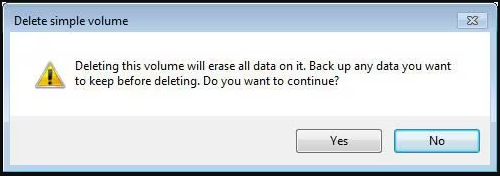
After deleting all volumes on a disk, it automatically becomes a basic disk, allowing you to install Windows 7 on it.
You May Also Like:
Use CMD
To convert a basic disk to a dynamic disk, you can use the Command Prompt to perform the conversion. This method is more complex and is not recommended for beginners, who should instead use a third-party tool like Qiling Disk Master.
Follow the steps to try:
- To launch the Diskpart utility, press the Windows key + R to open the Run window, and then type "diskpart" into the text field and press Enter. This will open the Diskpart command-line interface.
- Enter "list disk": all disks can be listed.
- Enter "select disk 1": 1 represents the disk number. Please select the target disk to convert to a basic disk.
- Then enter "Detail Disk."
- Enter "select volume 0": n represents the number of the dynamic volume.
- Then, enter "delete volume."
- After running the command, enter "convert basic" and you will see that diskpart successfully converts the selected disk to the basic format.
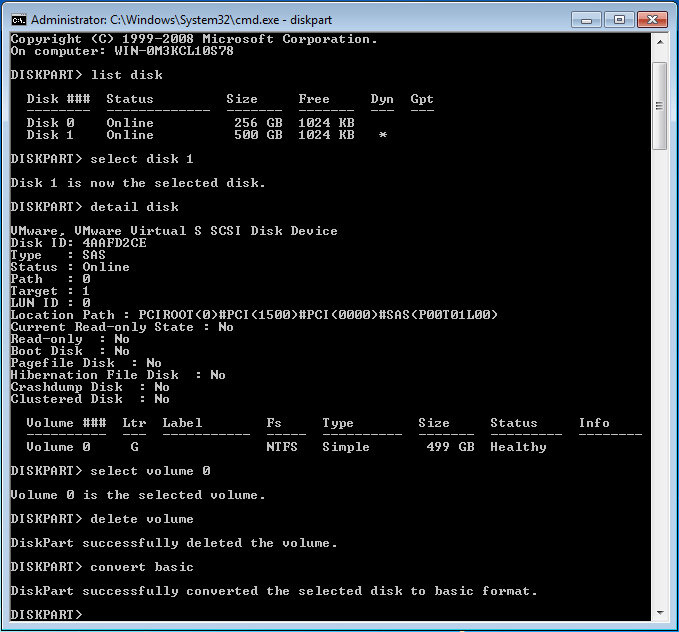
If there are multiple volumes, repeat steps 5 and 6 to delete all volumes.
Using the Disk Management utility or diskpart commands to convert a dynamic disk to a basic disk has a significant limitation: all volumes must be deleted first, resulting in data loss. To avoid this inconvenience, it is recommended to use a trustworthy third-party software, such as Qiling Disk Master, which can convert dynamic disks to basic disks without deleting volumes.
Why Can I Install Windows 7 on Dynamic Disk
Dynamic disks are only supported in Windows 7 Enterprise, Professional, and Ultimate editions, but not in Home Basic, Premium, or Starter editions. They are also not supported in Windows Home editions or older operating systems like MS-DOS, Windows 95/98, Windows Me, and Windows NT.
🚩Read Also: Should I Convert to Dynamic Disk?
The dynamic disk can only be used to create a new Windows installation if it was converted from a basic partition with a remaining partition table entry. Otherwise, simple volumes created from basic partitions without a partition table entry cannot be used for a new Windows installation.
Windows 7 can only be installed on dynamic disk's boot volumes or the current system to protect data, which can cause issues with dual-booting. When trying to install Windows on a dynamic disk, the error "Windows cannot be installed on dynamic disk" often appears. To resolve this, it's recommended to convert the dynamic disk to a simple disk. This will allow you to proceed with the installation without any further issues.
Share the fixes with users who want to install Windows 7 on dynamic disks.
Conclusion
Windows 7 can only be installed on a basic disk, not a dynamic disk, which can cause the error "Windows cannot be installed on a dynamic disk" when trying to make a dual boot. To resolve this, convert the dynamic disk to a basic disk.
If you're having trouble installing Windows 7 on a dynamic disk, don't worry! We've got three methods to help you solve the problem and understand the underlying reasons. Once you've completed the conversion, you can install the operating system on the target disk. If you're a beginner, it's recommended to use Qiling Disk Master for a hassle-free experience. For more information on the difference between dynamic disks and basic disks, check out the link below.
Unable to Install Windows 7 on Dynamic Disk FAQs
You may encounter errors when installing Windows 7/8/10/11 on a dynamic disk. To troubleshoot, check the following details. By doing so, you'll gain a better understanding of the issue and be able to resolve it.
1. Can I install Windows 7 on a dynamic disk?
When installing Windows 7 on a dynamic disk, you'll encounter an error stating, "Windows cannot be installed to this hard disk space. The partition contains one or more dynamic volumes..." The quickest fix is to convert the dynamic disk to a basic disk.
2. How do I convert the dynamic disk to a basic disk in Windows 7?
Windows built-To convert a dynamic disk to a basic disk, you need to delete all volumes on the dynamic disk one by one, using a disk management tool. This involves launching the tool, right-clicking on each volume, and selecting "Delete Volume". Once all volumes are deleted, the dynamic disk will automatically convert to a basic disk, allowing you to install Windows 7 on it.
3. What happens if I convert to a dynamic disk?
If you've converted a disk to dynamic, you can't easily revert it to a basic disk without deleting all volumes.
Related Articles
- How to Wipe Unallocated Space in Windows 10/8/7 [2 Efficient Ways]
- Change File Extension One-by-One or in Bulk [2024 Tutorial]
- How to Fix USB Flash Drive Not Showing Up in Windows 11🔥
- How to Format Micro SD Card? [Windows/Mac/Android]
Formatting a micro SD card before use is a simple process. This article provides methods to format micro SD cards to FAT32 or other file systems on Windows, Mac, and Android, offering a solution for users who need to get their cards up and running. - Windows 10 Boot Repair Tool: 2023 Best Pickes🔥
If you're experiencing issues with Windows Boot, you can try using one of the best Windows 10 Boot Repair Tools to fix the problem. These tools can help resolve boot issues when your PC is stuck or data related to boot is corrupt, ensuring you can access your PC without losing any data. - How to Apply Windows 10 Boot Repair [6 Promoted Ways]🔥
This article will cover six valuable methods to help users fix Windows 10 startup errors. Read on and learn how to apply Windows 10 boot repair efficiently.
Products
Articles & Tutorials
- Data Recovery
- Data Backup
- File Recovery
- File Backup
- System Backup and Restore
- Disk and Partition Clone
- Technical articles
- Mobile articles
- Disk Master Help
- Windows Data Recovery Tutorials
- Windows Secure Delete Tutorials
- Windows Partition Management Tutorials
- Windows File Backup and Restore Tutorials
- Windows System Backup and Restore Tutorials
- Windows Disk Backup and Restore Tutorials
- Windows Clone Tutorials