Guide on Checking Disk Speed in Windows 10 Using CMD [2024 Tutorial]
Quick Navigation on Checking Disk Speed Windows 10:
| 🎯Goal: | To check disk speed in Windows 10 and analyze internal hard drive read and write speed, you can use the built-in tool called "Disk Speed Test" or the Command Prompt. Open the Command Prompt as administrator and type "fsutil" followed by the drive letter (e. |
| 👔Who Need It: | All levels of Windows users |
| 🧰Tools: | Windows 10, hard drive |
| 🛠Applicable Methods: |
1. CMD - Free & Preinstalled 2. Disk Health Check Software 🏆- Efficient and Professional |
If you're concerned about keeping your data safe, it's essential to monitor the health of your Solid-State Drive (SSD). To check disk speed on Windows 10 using the Command Prompt, you can follow detailed instructions found in this article.
How to Check Disk Speed in Windows 10 Using CMD
- ⏲Duration: 3-5 minutes or longer
- 🚩Applied for: advanced Windows users
- 💽Supported Devices: HDDs, SSDs, and external hard drives, etc.
For Windows users, the Command Prompt (CMD) is a command line interface for running programs, while WinSAT, short for "Windows System Assessment Tool," is a command line utility that debuted in Windows Vista and has been included in subsequent versions, including Windows 10, to perform benchmarks on the operating system and its components.
Guide to Check Disk Speed via CMD Windows 10
To examine the condition of your SSD (Solid-State Drive) using the Command Prompt (CMD), follow these specific procedures. You can use the built-in tools and commands in CMD to assess the health and performance of your SSD, and identify any potential issues.
Step 1. To open the Command Prompt, press the Windows key + R, type "cmd" in the Run window, and press Enter. This will open the Command Prompt window, where you can enter commands to interact with your computer.
Step 2. The command "wmic" is a command-line utility that allows you to manage Windows systems remotely or locally. It can be used to perform various tasks such as starting and stopping services, managing disk quotas, and executing scripts.
Step 3. Enter "winsat disk -drive c", and press Enter again.
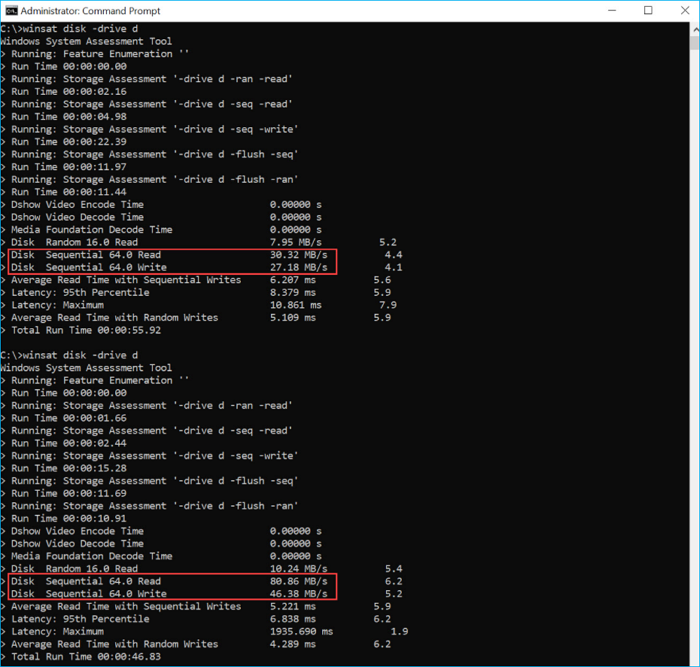
Step 4. The Command Prompt will list the drives and their current speed:
- Disk Sequential 64.0 Read meants its reading speed
- Disk Sequential 64.0 Wirte means its writing speed
CMD is also helpful in detecting other types of disk speed, a method that can also be used to assist with.
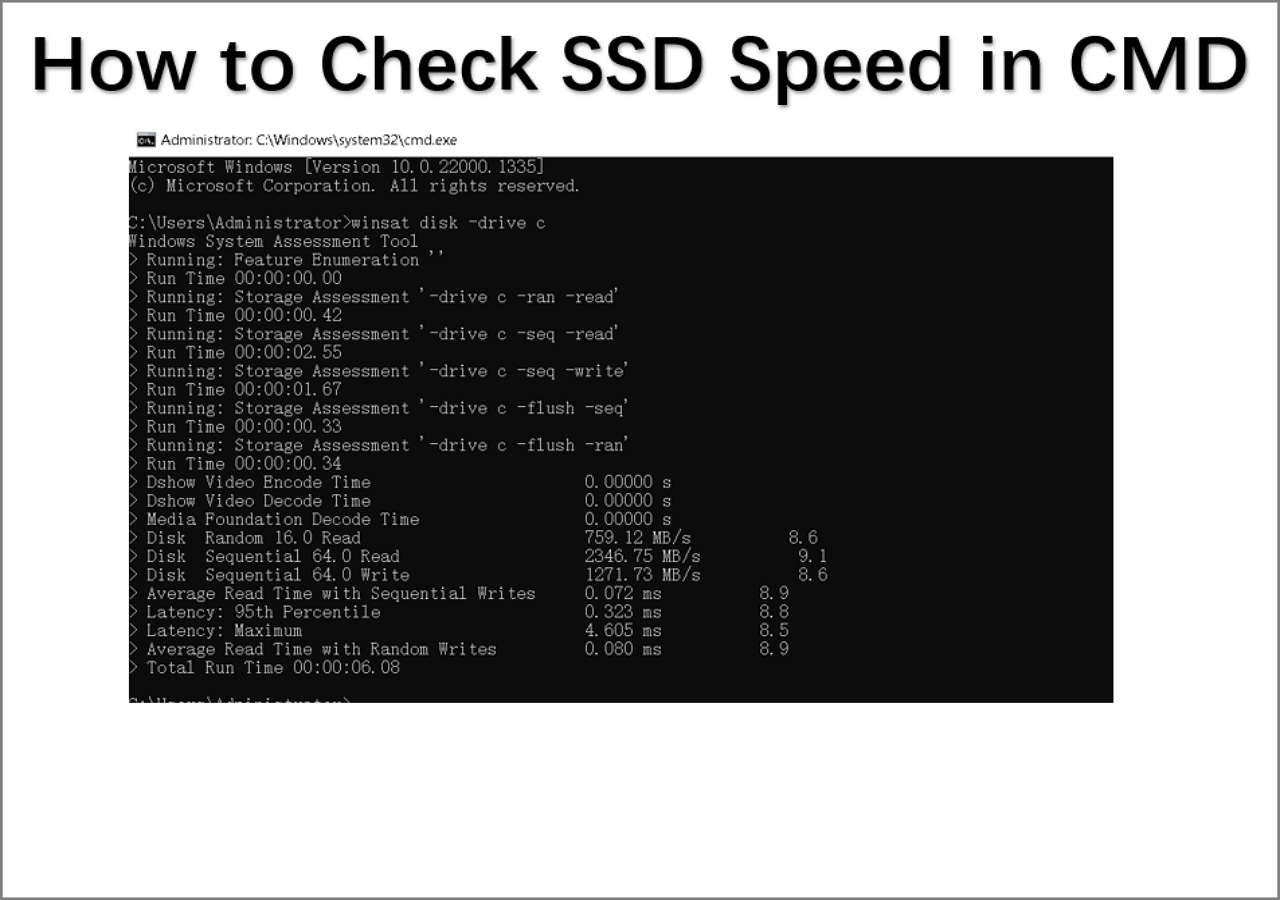
To check the SSD speed in CMD on Windows 11/10, open the Command Prompt as an administrator, type `wmic diskdrive get name, size, status` and press Enter. This will display the name, size, and status of all drives, including the SSD.
To check SSD speed on Windows 11/10, you can use the Command Prompt (CMD) to run a few simple commands. Alternatively, you can use a reliable tool to make the process even easier.
While the Command Prompt (CMD) can check an SSD's disc, it doesn't display all the features related to its health state. For a quicker and more thorough assessment, consider using Qiling Disk Master, which is a user-friendly alternative that requires no computer knowledge.
Pros and Cons of Using CMD to Check Disk Speed in Windows 10
Checking disk speed in Windows 10 using CMD can have its advantages and disadvantages. On the plus side, using CMD allows for a quick and easy way to check disk speed, which can be particularly useful for troubleshooting purposes or when trying to identify bottlenecks in system performance.
| Pros✅ | Cons❎ |
|---|---|
|
|
According to the Pros and Cons, it's clear that the CMD measuring solution has some drawbacks that can't fulfill most hard drive owners' needs in specific situations. For an all-in-one, free, and professional disk speed test tool, we suggest finding a CMD alternative software, such as Qiling Disk Master, which can help test and increase your drive's speed.
CMD Alternative Software to Check Disk Speed in Windows 10
- 📝Software Define: perfect CMD alternative software in checking disk speed.
- 💽Supported Devices: HDDs, SSDs, USB flash drives, SD cards, and hybrid-HDDSSDs, etc.
- 🖥Compatible Systems: Windows 10/11, older Windows 8/7/XP/Vista, an Sever systems.
- 👩💻Best For: All Windows beginners, geeks, hard drive manufacturers, and gaming lovers.
Qiling Disk Master is a reliable tool for assessing the state of a hard drive and SSD, working smoothly with various Windows versions, and featuring a free DiskMark tool for detecting and checking disc speed.
This tool allows users to check the speed status of their Solid-State Drive (SSD) with ease, making it a convenient resource for those who want to monitor their SSD's performance.
Step 1. Launch Qiling Disk Master, click the download button to activate the "Surface test" feature under the "Disk management" section.
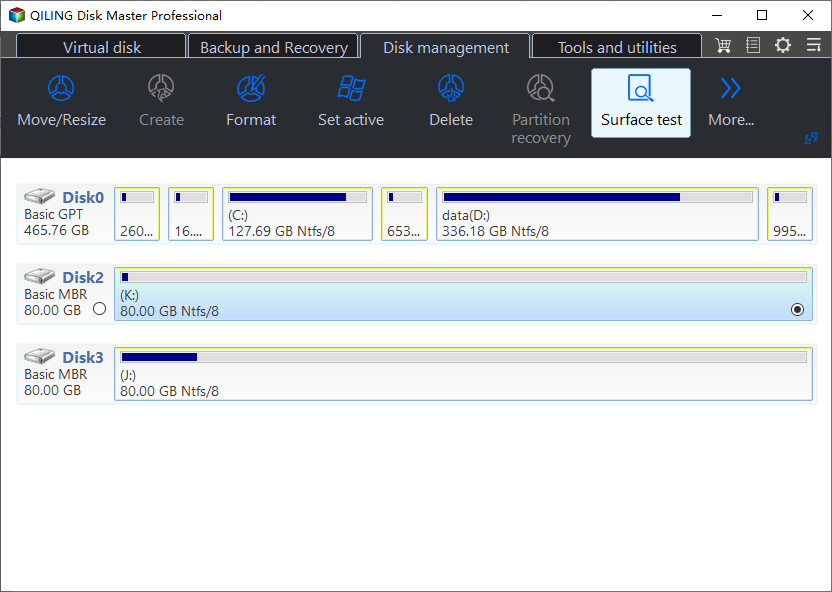
Step 2. Select the target drive, test data, and block size from the drop-down options to proceed.
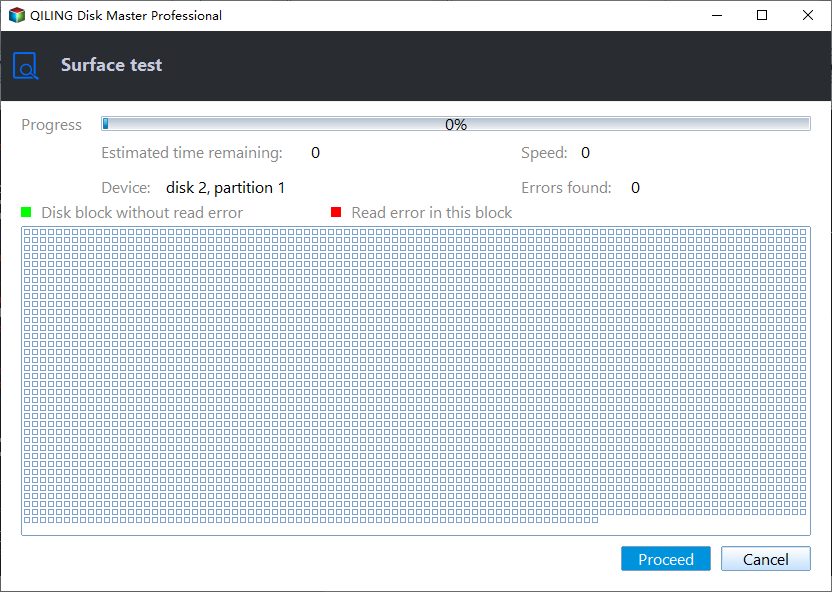
Step 3. Once everything is configured, click "Proceed" to begin the disk test, which will display the Sequential read speed, I/O, and Delay data.
Video Tutorial in Check SSD Speed
If your hard drive speed is slower than its average speed, stay calm and follow this tutorial guide for help.
How to Speed Up Hard Drive in Windows 11/10/8/7
To speed up your hard drive in Windows, consider upgrading to a solid-state drive (SSD), which can significantly improve performance. Alternatively, you can defragment your hard drive, disable unnecessary startup programs, and close resource-intensive applications.
Why Choose Qiling Disk Master Over CMD
Selecting Qiling Disk Master over CMD in Windows 10 offers several advantages. A comparison table highlights the reasons, including the features listed below.
| Comparison | Qiling Disk Master | CMD |
|---|---|---|
| Check Disk Read/Write Speed | ✔ | ✔ |
| Display Disk Speed Test Report | ✔ | ✔ |
| Free to Use | ✔ | ✔ |
| Optimize Disk Speed | ✔ | ✖ |
| Who to Use It | Professionals, Geeks & Beginners | Professionals |
Qiling Disk Master not only checks disk speed but also offers a Disk Health feature, allowing you to monitor your HDD and SSD's status, temperature, powered-on hours, and total host writes and reads, all from your PC.
The software includes some excellent features that you may also like for better managing partitions and optimizing disk performance, such as.
- Improve SSD performance by 4k alignment.
- Check and fix hard drive or SSD file system errors.
- Erase all data to reset HDD or SSD.
- Combined partitions.
- Migrate OS from HDD to SSD.
- Allocate hard drive space
Qiling Partition Manager offers various HDD and SSD management options, so you can try out the trial version to see its features for yourself.
When Do I Need to Check Disk Speed in Windows 10?
To ensure your Windows computer runs smoothly, it's a good idea to periodically check the read and write speeds of your hard drive, as these speeds can significantly impact overall performance.
In Windows 10, you can check if your hard drive is failing by running a disc performance test. This is essential as broken or corrupted sectors on a hard disk can cause performance and operating system boot issues. To do so, go to the "This PC" or "Computer" section, right-click on the hard drive you want to test, and select "Properties." From there, click on the "Tools" tab and then on "Check" to run a quick test.
- The computer is slow to transfer files.
- The computer becomes slow to boot up or shut down.
- C drive full or low disk space.
- Windows 10 warns of high RAM CPU usage issue
- The computer gets slow or stuck while playing games.
To determine the disc speed in Windows 10, access the command prompt or an alternative software, and follow the provided instructions to obtain the disc speed information.
Conclusion
On Windows 10, it's essential to regularly check the status of your SSD (Solid-State Drive) using the Check Disk (chkdsk) command to ensure the integrity of your data, privacy, and games.
While Qiling Disk Master can evaluate an SSD's health, we recommend Qiling Command Prompt for its more user-friendly interface and additional features.
FAQs About Checking Disk Speed in Windows 10 Using CMD
Read these answers to avoid confusions.
1. How do I run SSD speed test in Windows 10 using CMD?
Monitoring your SSD's health regularly can help identify potential issues before they become major problems, ensuring the security and longevity of your device.
To access the command prompt on Windows 10, you can press the Windows key + R to open the Run dialog box, type "cmd" and press Enter, or search for "Command Prompt" in the Start menu. Once you have the command prompt open, you can run the SSD speed test using the command "CrystalDiskMark" or "HD Tune" if you have those tools installed. If you don't have them, you can download and install them from their respective websites.
- Launch the command line interface (as an Administrator, please!)
- The WinSAT disc was in Drive C:.
2. Can I run Blackmagic Disk Speed Test in Windows 10?
BlackMagic Disk Speed Test is a free and open-source app that checks hard drive integrity, supported on Windows 11/10/8.1/8/7/Vista. However, finding its genuine version online can be challenging, prompting users to seek alternative software for help.
3. How can I check my hard drive health in CMD?
To check if a disk drive is enabled, enter "cmd" into the search bar, right-click on "Command Prompt" and choose "Run as Administrator", then type "wmic diskdrive get status" and press enter.
Related Articles
- Fix Windows PC Won't Boot After Enabling Secure Boot
- Recover/Create EFI Partition Windows 11/10 When EFI Boot Partition Missing
- How Can I Fix Windows 11 NVMe Slow Error 2024
- How to Format 2TB Hard Drive to FAT32? Here Is A Quick Guide - Qiling
- Windows Install Stuck on Windows Logo: 100% Working Fixes
If your Windows installation process gets stuck on the Windows logo. This guide will walk you through the steps to fix the issue and get your Windows installation back on track. - How to Fix Windows Stuck on Diagnosing Your PC -10 Ways👍
If your PC is stuck on the 'Diagnosing Your PC' screen, there are fixes for this issue on Windows 10/11. You can try restarting your PC, checking for updates, or running the Windows Update troubleshooter to resolve the problem.
Products
Articles & Tutorials
- Data Recovery
- Data Backup
- File Recovery
- File Backup
- System Backup and Restore
- Disk and Partition Clone
- Technical articles
- Mobile articles
- Disk Master Help
- Windows Data Recovery Tutorials
- Windows Secure Delete Tutorials
- Windows Partition Management Tutorials
- Windows File Backup and Restore Tutorials
- Windows System Backup and Restore Tutorials
- Windows Disk Backup and Restore Tutorials
- Windows Clone Tutorials