Download and Use Partition Magic for Windows Server 2016 [Step-by-Step Guide]
Key Takeaways of Partition Magic Server 2016:
- 1. Partition Magic Server 2016 is available for free download on this page.
- 2. Partition Magic Server 2016 software allows for efficient management of disk partition space, enabling users to switch between MBR and GPT disk types, clone, and successfully migrate their OS drive.
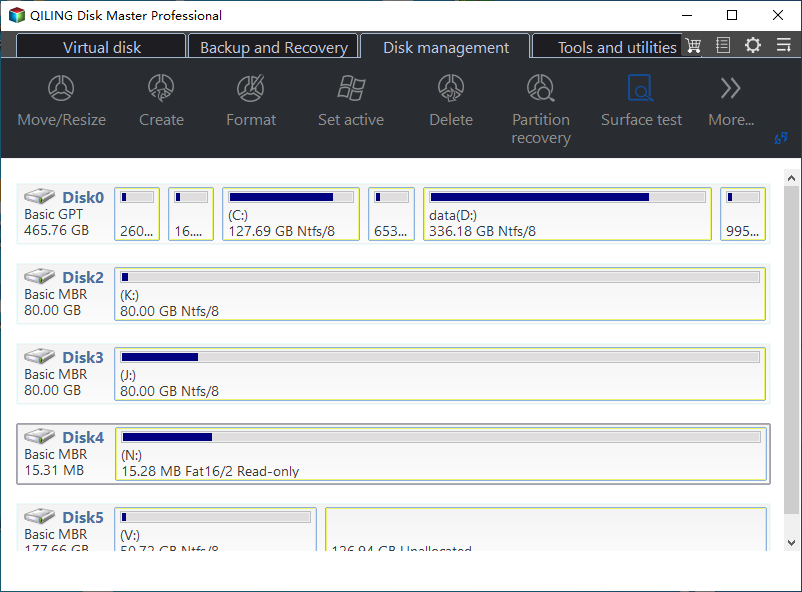
For Windows Server 2016 users, the best disk tools or partition magic server software can be found on this page, providing instant execution of basic and advanced disk managing operations.
What Is the Best Partition Magic Server Software for Windows Server 2016
Partition Magic is a software that allows users to manage and create partitions on their hard drives, making it easy for old Windows users to do so successfully.
What Does Partition Magic Do for Windows Server 2016
There are server software alternatives to Partition Magic that can help Windows Server users manage and control their disk drive spaces, such as Qiling Disk Master, among others. These tools offer features like disk partition management, disk cloning, and disk wiping, allowing users to optimize their disk usage and ensure data safety.
Partition Magic can work on Windows Server systems, but a server-specific partition magic software is required to execute disk partitioning operations.
| Basic Disk Management | Advanced Disk Optimization |
|---|---|
|
|
Can Partition Magic Server Software Be Free for Windows Server 2016?
Windows Server users can use partition magic software to allocate disk space on their own.
As a Windows personal user, you can find free partition magic software to help with partition management.
Free Partition Magic Server software is available for Windows Server systems, but it often comes with limited features.
Looking for the best Windows Partition Magic Server Software? This page is your go-to resource for finding top-notch solutions that meet your needs.

The top best partition magic server software include Qiling Partition Master. These software tools offer pros such as user-friendly interfaces, advanced partition management features, and system recovery capabilities.
You can find the top 5 best partition magic server software on this page, which can be downloaded and applied to successfully partition Windows Server disks and manage internal or external hard drive space.
Download Best Partition Magic for Windows Server 2016
To get the best partition magic servers software for Windows Server 2016, 2019, or 2022, look for software that supports your server's operating system and meets your specific needs. Consider factors such as disk partitioning, resizing, merging, and cloning, as well as features like disk wiping, formatting, and recovery. Ensure the software is compatible with your server's hardware and has a user-friendly interface.
- Risk-free & 100% secure.
- Powerful tech support team.
- Regular software updates with sophisticated algorithms.
- Stable and designed with powerful disk management features.
- Reasonable price for partitioning disk drives on Windows Servers.
To save time and energy, consider using Qiling Disk Master Enterprise to help with disk management and optimization on Server computers, as it offers all the necessary features.
Qiling Partition Magic software for Windows Server 2016 offers several benefits, including resizing and reconfiguring partitions without data loss, creating, deleting, and formatting partitions, and backing up and recovering partitions. However, it also has some drawbacks, such as potential data corruption or loss if not used properly, compatibility issues with certain hardware or software configurations, and the risk of overwriting existing data if not handled carefully.
| Benefits | Drawbacks |
|---|---|
|
|
Editors' Reviews on Qiling Disk Master:
If you're using a newer or older Windows Server system, you can refer to the next two pages to download the correct edition of Partition Magic software for disk management.
How Do I Partition Server 2016 with Qiling Partition Magic Software
You can download this software, activate it, and then follow the tutorials provided to learn how to easily manage disks on your Server systems.
Akin to Partition Magic, this software enables you to manage disks on Windows Server 2016, and also serves as a reliable Partition Magic Server Software for Windows Server 2022/2019. It allows you to partition a hard drive, convert a Server disk, and migrate a Windows Server 2016 system to an SSD without reinstallation, making it a handy tool for system administrators.
# Guide 1: Partition Hard Drive in Windows Server 2016
Step 1. Launch Qiling Disk Master to check for free space at the Partition Manager section.
- If your hard drive has unallocated space, you can skip Step 1 and Step 2, and go straight to Step 3 to create a partition.
- If the hard drive has no unallocated space, you can't install the operating system on a separate partition, so you'll need to delete some data to free up some space or purchase an external hard drive to expand your storage capacity.
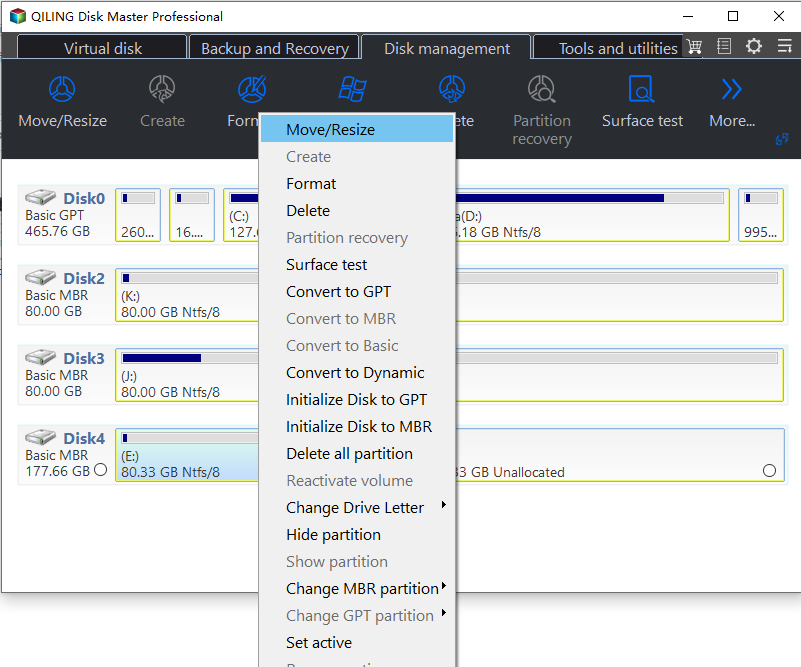
Step 2. Shrink a disk partition to create unallocated space.
Right-Select the target drive partition with ample free space and choose the "Resize/Move" option.
To create more unallocated space, drag the partition to the left or right, reducing its size, and monitor the "Partition size" area for the updated space reduction. This provides you a clear visual of the space decrease. (Note: This response is a rewritten version of the original text in a concise and straightforward manner, as requested.
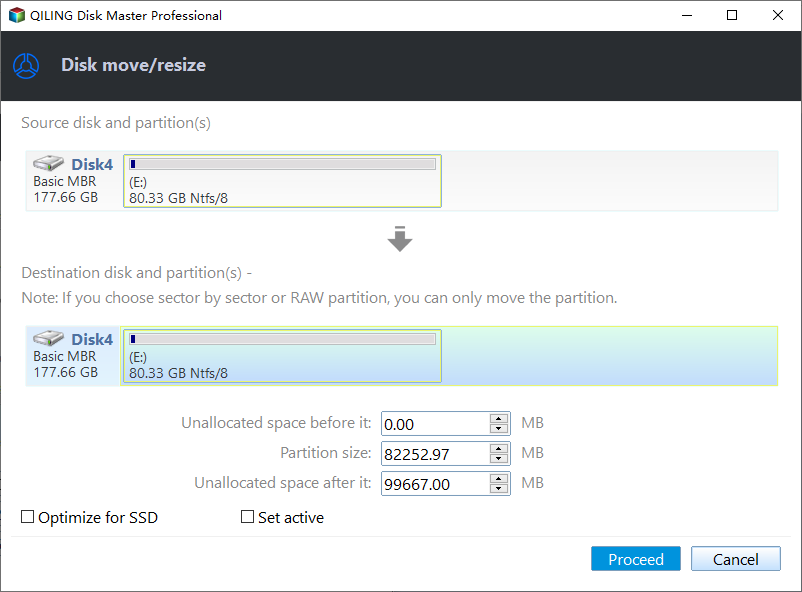
Click "Proceed" to save all the changes.
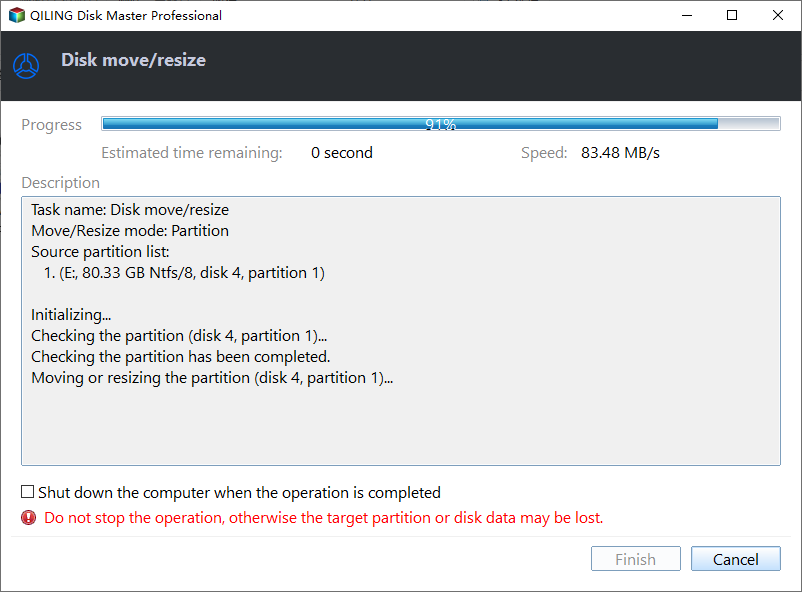
Go back to Partition Manager, there should be unallocated space appearing on the same disk and you can continue with the next step to create a new partition on your hard drive.
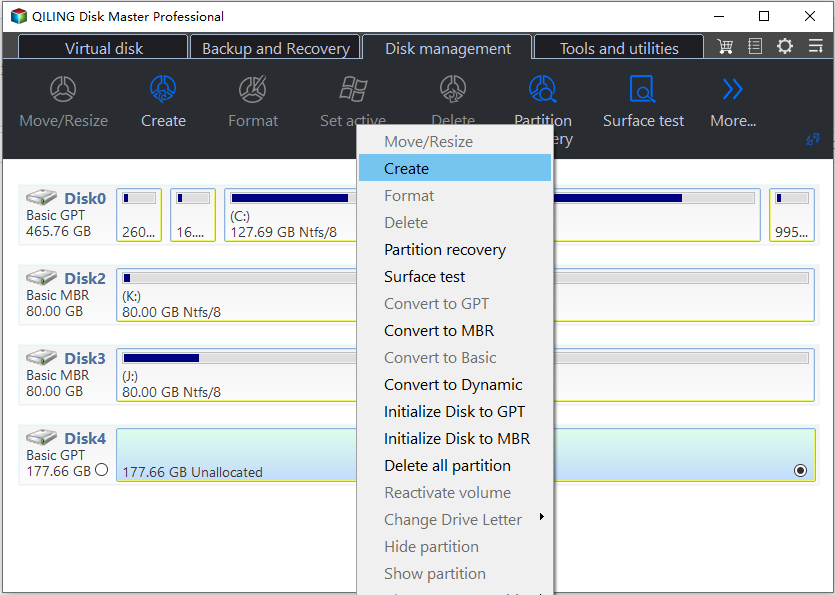
Step 3. To create a new partition with unallocated space on the target hard drive, you can follow these steps: First, ensure the target hard drive is selected in the disk management tool. Then, click on the 'New' button to initiate the partition creation process.
Right-click on the unallocated space and choose "Create".
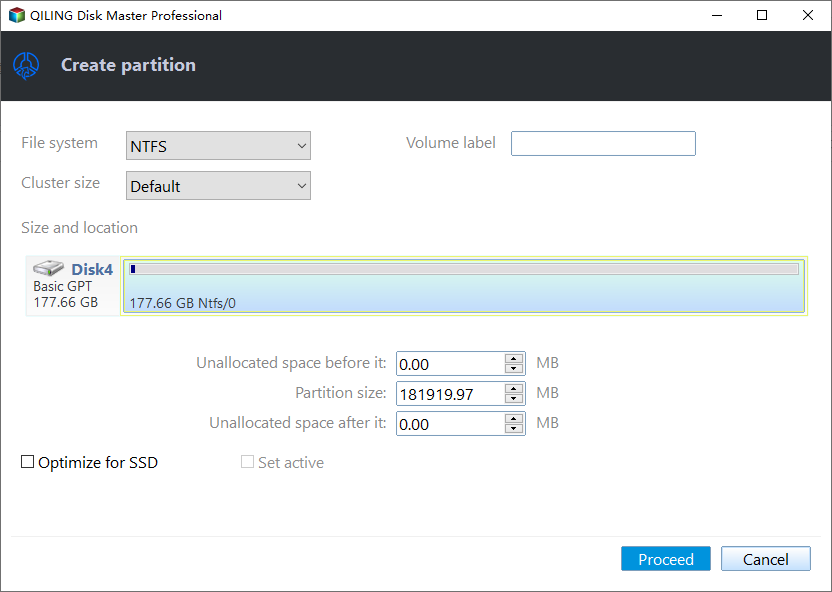
In the Advanced Settings, you can customize various partition settings such as partition size, drive letter, label, file system (including NTFS, FAT32, EXT2/3/4, and exFAT), and more.
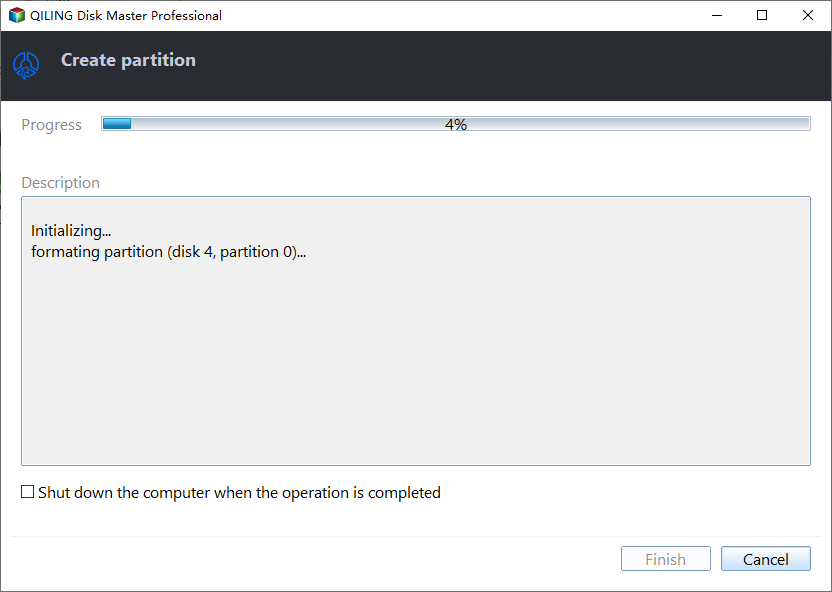
To create multiple partitions on a hard drive, first, open the Disk Management tool. Then, select the unallocated space on the disk and click "New Simple Volume." Assign a drive letter and file system type, and click "Next.
# Guide 2: Convert Disk to MBR/GPT in Windows Server 2016
Step 1. Download and launch Qiling Disk Master on your computer.
Step 2. Go to Disk Converter, select the "Disk management" tab to proceed.
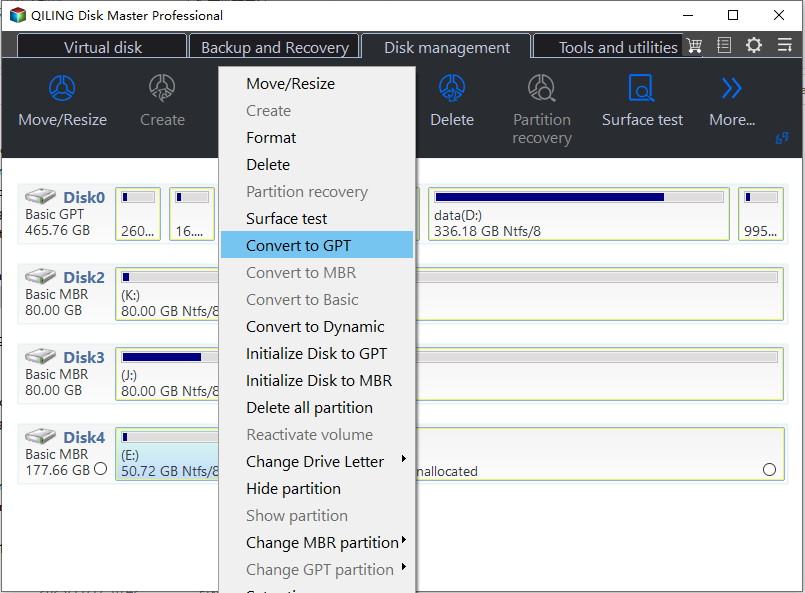
Step 3. Select the target MBR disk that you tend to convert to GPT, and click "Convert to GPT" to start the conversion.
# Guide 3: Migrate Windows Server 2016 to New SSD without Reinstallation
To successfully migrate the Windows Server 2016 OS to the new SSD, you'll need to install the SSD first and initialize it as the system disk in advance, mirroring the setup of the original Windows Server 2016 system disk. This step is crucial for a seamless OS migration.
To migrate Server 2016 OS, start by learning how to initialize an SSD, and then follow the steps outlined in this guide.
Steps to migrate OS to HDD/SSD:
- Run Qiling Disk Master, and select "Toos" tab page.
- Check "Migrate OS" and click "Next".
- To continue, select the SSD or HDD as the destination disk and click the "Next" button.
- Be aware that the data and partitions on the target disk will be completely erased, so it's essential to back up any important data before proceeding. If you haven't already, do so now to avoid any potential loss.
- Then click "Yes".
- Preview the layout of your target disk. Then click "Proceed" to start migrating your OS to a new disk.
- After this, click "Reboot Now" or "Done" to reboot the computer from the new disk immediately.
"Reboot Now" means to apply the changes immediately, whereas "Done" means the changes will be applied after a manual restart of the computer.
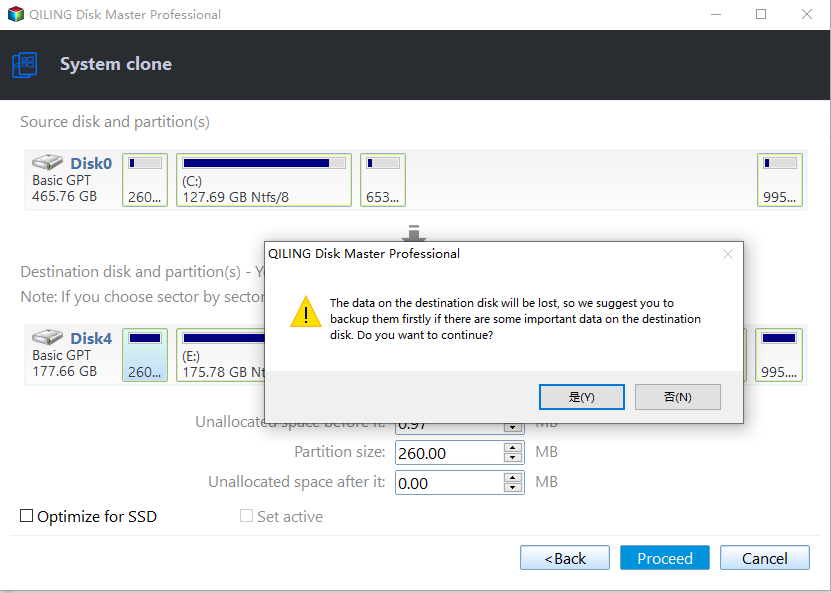
Note: When migrating an operating system to an SSD or HDD, be aware that if there's not enough unallocated space on the target disk, the existing partitions and data will be deleted and removed. It's essential to back up any important data from the target disk to an external hard drive beforehand to prevent data loss.
After the system migration process is complete, restart Windows Server 2016, then enter the BIOS settings by pressing F2 or Del. Set the new SSD as the boot drive and save the changes to ensure the server boots normally on the new disk.
To Master Windows Server 2016 Disk Drives, Take Qiling Partition Magic Software for Help
Qiling Disk Master Enterprise is the best partition magic server software for Windows Server 2016, offering a range of features and functionalities.
The correct editions in Qiling partition magic server software should be selected to fully master and make use of your disk drive space.
- The Qiling Disk Master Server is designed for personal use by Windows Server 2016 users.
- Qiling Disk Master Unlimited is for Business owners.
- Qiling Disk Master Technician is for MSP and Service Providers.
Regardless of the edition you choose, Qiling Disk Master offers instant tech support to help resolve any disk management issues that may arise.
FAQs about Partition Magic Server 2016
In the last, we collected 3 top questions, and if you have the same or a similar doubt, follow and find answers here:
1. Does Windows Server 2016 has a Disk Management tool?
Windows Server 2016, like its Windows counterparts, features disk management tools for managing disk drive space. These tools allow users to manage disk drive space, similar to how they would on a personal computer.
- Disk Management
- Diskpart or Command Prompt
- PowerShell
2. How to extend Windows Server 2016 with Partition Magic Server Software
To extend a partition in Windows Server 2016 using Partition Master, follow these steps:
- Launch Qiling Disk Master on Windows Server 2016.
- Check if the target disk has unallocated space.
- If yes, right-To extend a target drive, click on it and select "Resize/Move". Then, drag the end of the target partition into the unallocated space.
- If no, right-To extend a partition, click on a partition with enough free unused space and select "allocate space". Then, select the partition you want to extend as the target, and drag the end of the target volume into the unallocated space.
3. Can I use Partition Magic on Windows Server 2012?
While PartitionMagic is no longer available, you can use alternative software like Qiling Partition Master to manage disk partitions on Windows Server 2012. These tools offer similar features to PartitionMagic, such as resizing, merging, and splitting partitions, as well as creating and deleting partitions.
Qiling Disk Master Enterprise is a powerful tool that can meet various needs for managing and optimizing disk performance on Windows Server systems, including 2016, 2019, 2022, and older versions.
Related Articles
- 3 Ways to Fix Convert to Dynamic Disk Greyed Out
- How to Format NVMe SSD in Windows 10/11 [Full Guide]
- How to Resize Virtual Hard Disk in 2024 [Efficient & Safe Solutions]
- Freeware: Reformat Hard Drive to FAT32 from NTFS or exFAT
If you need to reformat a hard drive from NTFS to FAT32 or exFAT, you can use various tools such as Disk Management, Diskpart, or a free partition manager to complete the task. - Step-by-Step: Use DiskPart Convert MBR in Windows 11, 10, 8, 7
To use Diskpart to convert MBR in Windows 11, 10, 8, 7, you can follow the instructions in this article to learn how to do it. - How to Convert RAW to FAT32 Using CMD with Ease?
Here we show how to convert RAW to FAT32 using CMD for your reference. Then you can easily change RAW micro SD card, memory card, pen drive or USB flash drive to FAT32 file system when necessary.
Products
Articles & Tutorials
- Data Recovery
- Data Backup
- File Recovery
- File Backup
- System Backup and Restore
- Disk and Partition Clone
- Technical articles
- Mobile articles
- Disk Master Help
- Windows Data Recovery Tutorials
- Windows Secure Delete Tutorials
- Windows Partition Management Tutorials
- Windows File Backup and Restore Tutorials
- Windows System Backup and Restore Tutorials
- Windows Disk Backup and Restore Tutorials
- Windows Clone Tutorials