Windows Server 2003 Extend C Drive: Two Ways to Extend System Partition
This solution applies to various Windows operating systems, including Windows Server 2003, 2008 (R2), 2012 (R2), 2011, 2016, and 2019, as well as Windows 10, 8, 7, XP, and Vista. It also works for older operating systems like Windows Server 2000 and Windows NT before 2003, although these are less commonly used today.
How to Solve Windows Server 2003 Extend C Drive
Windows Server operating systems, from 2003 to 2019, are considered enterprise-level with enhanced management solutions and robust configurations. However, to maintain stable performance, it's essential to avoid running out of space on the system partition, which can lead to lag in boot time, loading files, and running applications. Regular disk cleanup may still result in "low disk space" warnings on the system C partition, making it crucial to monitor and manage disk space to ensure optimal system performance.
To extend the system partition on Windows Server 2003, you can use Qiling Partition Master Server Edition or the Diskpart command. With Qiling Partition Master Server Edition, you can easily extend the C drive by following the software's step-by-step guide. Alternatively, you can also use the Diskpart command to extend the system partition, allowing you to increase the size of the C drive and make more space available for your operating system and applications.
| Workable Solutions | Step-by-step Troubleshooting |
|---|---|
| To safely extend the C drive in Windows Server 2003 using Qiling Partition Master, follow these steps. First, you need to download and install Qiling Partition Master on your computer. Once installed, launch the software and select the disk where the C drive is located. | Resize/Move partitions; Merge partitions; Allocation Space...Full steps |
| #2. Utilizing Diskpart for Windows 2003 Extend C Drive | Solve common errors and extend C drive...Full steps |
Qiling Partition Master is a third-party partition manager software that allows users to extend the C drive space without data loss, offering three options to do so. In contrast, Windows has a built-in disk management solution, Diskpart.exe, but it requires unallocated space, which can be obtained by shrinking or deleting an existing partition drive, a process that may be unfamiliar to some users.
#1. (Safe Method) Using Qiling Partition Master in Windows Server 2003 Extend C Drive
To extend system partition on Windows Server 2003, we recommend using Qiling Partition Master Server Edition, which is a leading server partition software that quickly and safely manages Windows server hard drives.
You can perform various partition operations on your Server without losing data, including resizing, moving, copying, creating, deleting, formatting, converting, splitting, merging, and more. These operations can be previewed before being applied to the hard disk, ensuring all data remains protected.
Qiling Partition Master Enterprise
Your trustworthy Windows Server disk manager.
- Extend System drive, combine/split partitions.
- Clone disk, migrate OS to HDD/SSD.
- Convert MBR to GPT, GPT to MBR, no data loss.
- 1-click adjust disk layout, create volumes at one time.
The process of extending the system partition on Windows Server 2003 using Qiling Partition Master Server Edition is notable for its zero data loss guarantee, along with a user-friendly interface. Three options are available to increase the space in the system C drive partition, all of which ensure data safety.
- Notice:
- Although safer than using the Diskpart command, it's still recommended to back up your server before extending the system partition on Windows Server 2003 to prevent potential issues in case of unexpected shutdown or hardware failure.
Option 1. Resize/move partition without losing data
Step 1. Locate the Target Partition.
To extend a partition, locate the target partition and select "Resize/Move" to start the process.
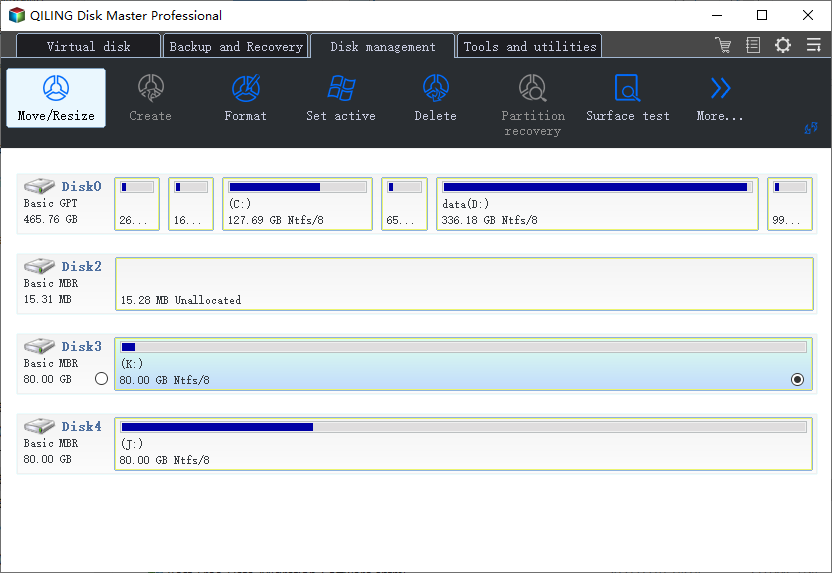
Step 2. Extend the Target Partition.
To add unallocated space to your current partition, drag the partition panel to the right or left, adding the unallocated space to your current partition, and then click "Proceed" to confirm the action.
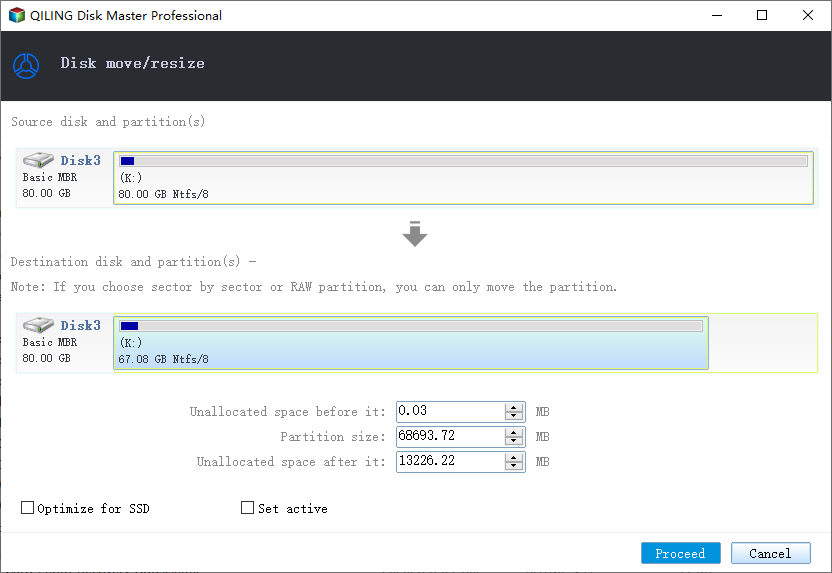
Extra Option: Get Space from Another Drive
If there's not enough free space on your disk, you can resize a larger partition to free up space. To do this, click on a larger partition with enough free space, select "Resize/Move", and then adjust the partition size to allocate the desired amount of space.
Drag the dots of the big partition to shrink it for the unallocated space and click "Proceed".
Option 2. Merge C drive with D drive without losing data
Step 1: Select the target partition
Right-To add space to a partition, click on the partition where you want to add space and select "Merge" from the options.
Step 2: Select a neighbor partition to merge
Select one partition next to the former selected partition.
Step 3: Execute operation to merge partitions
The program will merge the space and add files from the second partition to the first partition after clicking the "Proceed".
Option 3. Allocate space to C Drive without losing data
Step 1. To resize or move the D: partition, click on the D: partition with sufficient free space available and select the "Resize/Move" option.
Step 2. Drag the D: partition panel rightward to shrink it for the free space from D: drive, then click "Proceed" to confirm.
Step 3. Select the target partition - C: drive and select "Resize/Move".
Step 4. To combine the free space from the D: drive with the C: drive, drag the partition panel to the right, adding the free space to C:. After making the desired adjustment, click "Proceed" to confirm the changes.
#2. Utilizing Diskpart for Windows 2003 Extend C Drive
To extend the C drive on Windows Server 2003 using Diskpart commands, you must have a continuous unallocated space next to the C drive, which is a prerequisite for the Diskpart command to work. Without this, you'll encounter an error message that prevents you from executing the next command.
Error: The volume you have selected may not be extended
The volume you have selected may not be extended.
Please select another volume and try again.
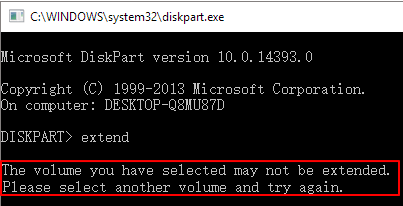
The error message is caused by a lack of unallocated space, which prevents the system volume from being extended. This can be resolved by running Diskpart.exe from a command line on a bootable CD.

How to solve common errors and extend C drive in Diskpart
Step 1. Open Diskpart Command Prompt in Windows Server 2003
To access the Diskpart Utility, open the search bar on your computer and type "Diskpart". Click "OK" to enter the utility, where you can manage your disk partitions and perform various disk-related tasks.
Step 2. Extend C drive with continuous unallocated space
The user can specify the number of a hard disk or partition, denoted as "x", to be excluded from the backup process. The examples provided show how to exclude specific disks or partitions, such as excluding the entire hard disk "x" or excluding a specific partition within the hard disk "x".
- To list all the disks on your system, simply type the command "list disk" and press Enter. This will display a list of all the disks currently connected to your system.
- To select the target disk, type the command "select disk x" (where x is the number of the disk you want to select) and press Enter.
- To list the partitions, enter the command "list partition" and press Enter. This will display a list of all the partitions available.
- Select the number of system partition that needs to be extended by inputting select partition x and pressing Enter.
- Input Extend command, and press Enter.
- Input Exit to leave the Diskpart window.
Step 3. Extend C drive with non-continuous unallocated space (Data backup is required)
When there's no free space next to the system volume, you'll need to delete the adjacent drive to create free space. Then, you can increase the C drive by typing the relevant commands and pressing Enter.
The example shows how to use the `--resizefs` option to resize a filesystem on a hard disk or partition. The command `resize2fs -p /dev/sdb1` resizes the filesystem on `/dev/sdb1` to fill the entire disk.
- list disk
- select disk x
- list partition
- select partition y
- delete partition
- select partition x
- extend
- exit
Bonus Tip: Extend Server System Partition with Disk Management
This video includes a bonus way that you can follow, which is to extend the system partition on Server computers with Disk Management.
Related Articles
- Fixed: Command Prompt Not Working in Windows 11/10
- 2022 Top 3 USB Format Tools For Mac Are Here to Help
- Fixed: We Couldn't Format the Selected Partition | 0x8004242d Error [2022]
- How to Reinstall Windows 11 Without Losing Data [4 Ways]
- How to Fix PC Won't Boot After Installing M2 SSD - Full Guide
If your PC won't boot after installing a new M2 SSD, you can try booting from the BIOS settings, checking the boot order, and ensuring the SSD is properly recognized by the motherboard. You can also try reinstalling the operating system or using a live USB to troubleshoot the issue. - Portable Partition Manager Download Free | With Guide
A portable partition manager is a software tool that allows users to manage and manipulate disk partitions on a computer without the need for installation, making it easy to use on any device.
Products
Articles & Tutorials
- Data Recovery
- Data Backup
- File Recovery
- File Backup
- System Backup and Restore
- Disk and Partition Clone
- Technical articles
- Mobile articles
- Disk Master Help
- Windows Data Recovery Tutorials
- Windows Secure Delete Tutorials
- Windows Partition Management Tutorials
- Windows File Backup and Restore Tutorials
- Windows System Backup and Restore Tutorials
- Windows Disk Backup and Restore Tutorials
- Windows Clone Tutorials