NTFS or exFAT for External Hard Drive: Which Format is Better for External Hard Drive
"ExFAT or NTFS? I'm curious about this, and i can't seem to find a straight-forward answer: Which is better, ExFAT or NTFS? I understand that ExFAT is relatively new. I believe it is geared more towards external devices like flash drive and USB hard drive? What are the advantages and disadvantages for using ExFAT format on such a device?"
Running out of disk space is a common issue, especially with limited internal hard drive space. To address this, many users opt for external hard drives or devices to store large files and transfer important data. However, choosing the right format for your external drive is crucial, as different operating systems require specific formats like exFAT, NTFS, and others. This is because the disk format serves as an organizing principle for storing data, and selecting the correct one ensures compatibility and seamless data transfer.
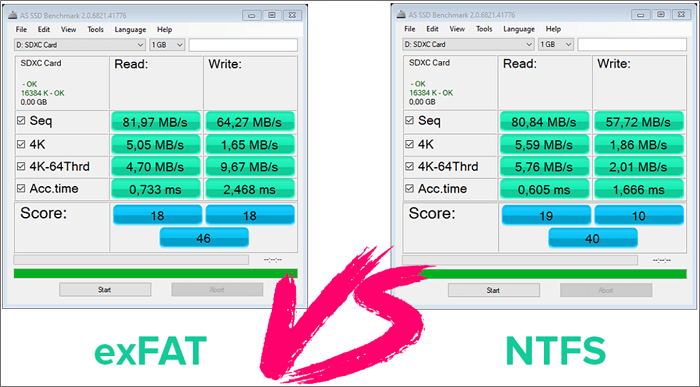
Depending on your needs, you may need to format the external hard drive into NTFS or exFAT.
Quick Navigation:
NTFS for Windows Only
exFAT for Windows and Mac
NTFS or exFAT for External Hard Drive
How to Format External Hard Drive to NTFS or exFAT
NTFS for Windows Only
NTFS (New Technology File System) is the default file system of the Windows NT environment, compatible with Windows 2000, XP, Vista, 7, 8.1, and NT operating systems. It replaced the old FAT file system, offering improvements such as metadata support, advanced data structures, reliability, and efficient disk space utilization. NTFS also supports additional features like file system encryption, hard links, sparse files, and reparse points.
If you only use a Windows computer, it's recommended to use the NTFS format. This is because Mac computers can only read NTFS, not write to it, making it the safer choice. Some devices, like Xbox One, Xbox 360, and media players, also support NTFS.
exFAT for Windows and Mac
exFAT is a file system introduced by Microsoft for use in flash memory, first appearing in Windows Embedded 5.0 and later versions.
The system was launched to address the issue of FAT32 and other file systems not supporting files larger than 4GB. It's more suitable than NTFS for use on flash drives, memory cards, and other small storage devices.
exFAT is a good choice for Windows and Mac computers, Xbox One, and PS4, but it may not work with Xbox 360 and PS3. However, it lacks a journal function.
Read also:
NTFS or exFAT for External Hard Drive
NTFS and exFAT are two file systems commonly used for external hard drives. While NTFS offers advanced features such as compression, encryption, and access control, exFAT is a simpler file system that is widely supported by operating systems.
Compatibility
NTFS is only used for Windows users, so choose this format if you only want to use an external hard drive on Windows. If you have a hard drive set to NTFS, you don't need to reformat it. ExFAT is used for Windows, macOS, Android, smart-TVs, cameras, and other devices, so pick one based on your existing OS.
Data Security
The main drawback of exFAT is its lack of logging, which increases the risk of data corruption, such as file loss, in case of a sudden power outage. In contrast, NTFS has a built-in logging function that prevents file corruption due to power problems.
NTFS can encrypt files by default, whereas exFAT requires manual encryption.
Storage Limit
The exFAT format supports unlimited storage and large files, but is less efficient at managing files than NTFS, which has a 16TB storage limit.
How to Format External Hard Drive to NTFS or exFAT
Have you decided which format to choose? If so, you can pick the two methods here to finish up the format converter.
How to Format HDD Drive to exFAT
You can open Disk Management to format an external hard drive as NTFS. To do this, right-click on the Start menu and select Disk Management. In the Disk Management window, right-click on the external hard drive you want to format and select Format.
- Press Windows + X shortcut key and click Disk Management.
- Right-click the external hard drive that you want to format.
- Select exFAT on the window and click OK.
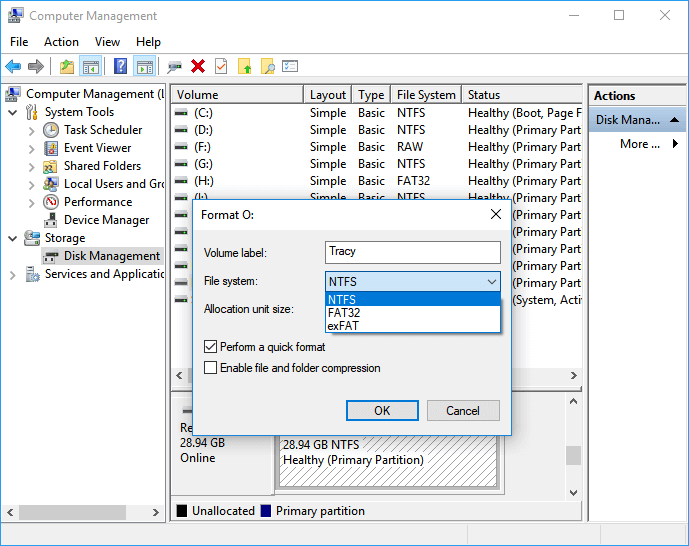
How to External Hard Drive to NTFS
You can download a straightforward format tool called Qiling Partition Master Free, which allows you to format partitions to various file systems, including NTFS, FAT32, EXT2, EXT3, and EXT4. This all-in-one solution supports formatting internal and external hard drives, SD cards, memory, and more.
Download software and do the simple steps:
Step 1. Right-click the hard drive partition and choose the "Format" option.
Step 2. To create a new partition, open a new window and set the Partition label, File system, and Cluster size for the partition. After making these selections, click "Proceed" to continue with the partition creation process.
Step 3. You can see a warning window, click "OK" to start formatting the hard drive partition.
To Sum Up
When deciding between exFAT and NTFS for an external hard disk, it's essential to consider the compatibility and functionality you need. exFAT is a more modern and widely supported format, compatible with both Windows and macOS, making it ideal for cross-platform use. On the other hand, NTFS is a more traditional format that's still widely used, but its compatibility with macOS is limited, and it may require additional setup.
- Applied to multiple operating systems - Choose exFAT.
- Protecting data from unexpected corruption can be achieved by choosing NTFS as the file system, which has a journal function that serves as a checkpoint to recover unsaved data in case of system crashes or power outages.
- Storage capacity - Choose exFAT (But NTFS also performs well.)
Related Articles
- 3 Reliable Ways to Wipe SSD on Windows 11
- How to Create/Recover EFI Partition on Windows 11
- Windows 11 Slow? How to Improve Windows 11 Performance
- What Is The Best Way to Change SSD Cluster Size? Your Guide Is Here
- 5 Methods to Fix Bootrec /Fixboot Access Is Denied Windows 11
If you are trying to fix your computer with Bootrec.exe but only to find out Bootrec /Fixboot access is denied, what should you do? Here, we provide you with 5 solutions to fix 'Bootrec /Fixboot access is denied Windows 11'. - How to Burn ISO to USB on Windows 8 Efficiently
Learn how to efficiently burn an ISO to a USB drive on Windows 8 with our step-by-step guide, making it easy to create bootable USB drives for installation or backup purposes.
Products
Articles & Tutorials
- Data Recovery
- Data Backup
- File Recovery
- File Backup
- System Backup and Restore
- Disk and Partition Clone
- Technical articles
- Mobile articles
- Disk Master Help
- Windows Data Recovery Tutorials
- Windows Secure Delete Tutorials
- Windows Partition Management Tutorials
- Windows File Backup and Restore Tutorials
- Windows System Backup and Restore Tutorials
- Windows Disk Backup and Restore Tutorials
- Windows Clone Tutorials