SSD 4K Alignment: How to Check and Align SSD in Windows
If your SSD feels slower than expected, the issue might not be the drive itself—it could be SSD 4K alignment. When SSD partitions are not aligned to 4KB boundaries, every read and write operation requires the SSD to access two physical blocks instead of one, cutting performance by up to 50% and increasing wear on the flash memory.
This guide explains what 4K alignment is, how to check if your SSD is properly aligned, and how to fix misaligned partitions in Windows 10/11.
PAGE CONTENT
- What Is SSD 4K Alignment?
- Why Is 4K Alignment Important?
- Method 1: Check 4K Alignment with msinfo32
- Method 2: Check 4K Alignment with CrystalDiskInfo
- Method 3: Check 4K Alignment with Command Prompt
- How to Align a Misaligned SSD
- How to Align SSD During Cloning
- FAQs About SSD 4K Alignment
What Is SSD 4K Alignment?
Modern SSDs use 4KB physical sectors (the "4K" in 4K alignment). When you create a partition, Windows needs to align the partition's starting offset to a 4KB boundary. If the partition starts at an offset that is not a multiple of 4096 bytes (4KB), the partition is "misaligned".
Think of it like this: imagine a bookshelf where every book is exactly 4 pages wide. If you start placing books at the wrong position, each book will span two shelves instead of one, making it slower to find and read.
Why Is 4K Alignment Important?
Performance Impact
- Read/write speed: Misalignment causes each 4KB read/write to access two physical blocks instead of one, reducing speed by 20-50%.
- IOPS (Input/Output Operations Per Second): Misaligned SSDs have significantly lower random read/write IOPS.
- Latency: Misalignment increases access latency, making the system feel sluggish.
Lifespan Impact
- Increased write amplification: When a 4KB write spans two blocks, the SSD must read, modify, and erase both blocks, doubling the wear on flash memory.
- Shorter SSD lifespan: Increased write amplification means the SSD's flash cells wear out faster.
- Note
- Windows 7 and later automatically align partitions to 1MB boundaries (which is divisible by 4KB) during installation. Misalignment is usually only a problem if the drive was partitioned by Windows XP, or if it was cloned from an older misaligned drive.
Method 1: Check 4K Alignment with msinfo32
The easiest way to check SSD alignment is using the built-in System Information tool.
Step 1. Press Win + R, type msinfo32, and press Enter.
Step 2. In the left panel, expand "Components" > "Storage" > "Disks".
Step 3. Find your SSD in the list and look for "Partition Starting Offset".
Step 4. The offset is shown in bytes. Divide this number by 4096. If the result is a whole number (no decimal), the partition is properly aligned.
Example: If the offset is 1048576 bytes, divide by 4096 = 256. Since 256 is a whole number, the partition is aligned.
Method 2: Check 4K Alignment with CrystalDiskInfo
CrystalDiskInfo is a free tool that shows SSD health and alignment status.
Step 1. Download CrystalDiskInfo from the official website (crystalmark.info).
Step 2. Extract and run DiskInfo64.exe.
Step 3. Click on your SSD at the top.
Step 4. Look for "Aligned" or "Partition Starting Offset" in the attributes list.
Step 5. If it shows "Aligned: Yes" or the offset is divisible by 4096, your SSD is properly aligned.
Method 3: Check 4K Alignment with Command Prompt
You can also check alignment using the wmic command in Command Prompt.
Step 1. Press Win + R, type cmd, and press Enter.
Step 2. Run the following command:
wmic partition get Name, BlockSize, StartingOffset
Step 3. Find your SSD partition and divide the StartingOffset by BlockSize. If the result is a whole number, the partition is aligned.
Step 4. Alternatively, divide StartingOffset by 4096 and check if it's a whole number.
How to Align a Misaligned SSD
If your SSD partition is misaligned, you need to realign it. The safest way is to use partition management software that supports partition alignment.
We recommend Qiling Partition Master:
Step 1. Download and install Qiling Partition Master. Before changing the partition layout, close running programs and back up important files.
Step 2. Launch the program, open the Disk management page, and select the misaligned SSD partition.
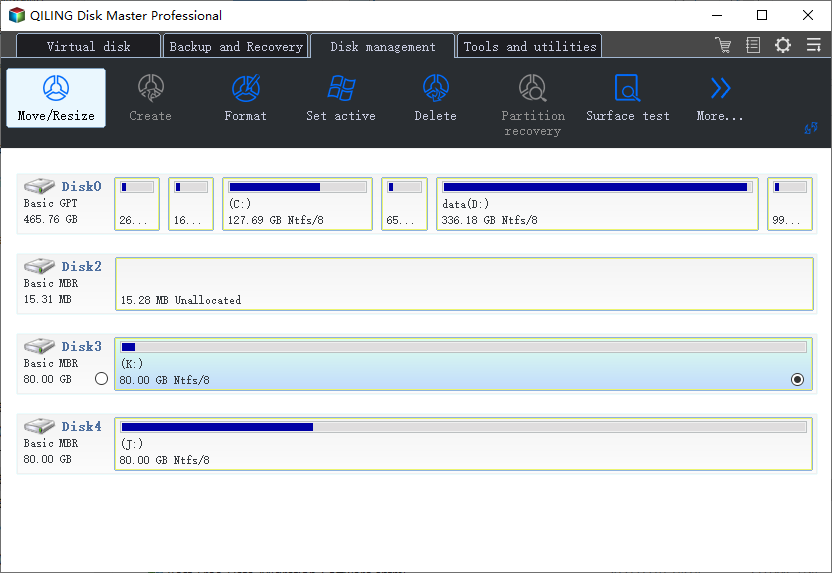
Step 3. Click Move/Resize. In the resize window, keep the partition size unchanged if you only want to optimize alignment.
Step 4. Select Optimize for SSD. This option aligns the partition to a 4K boundary while keeping the partition data in place.
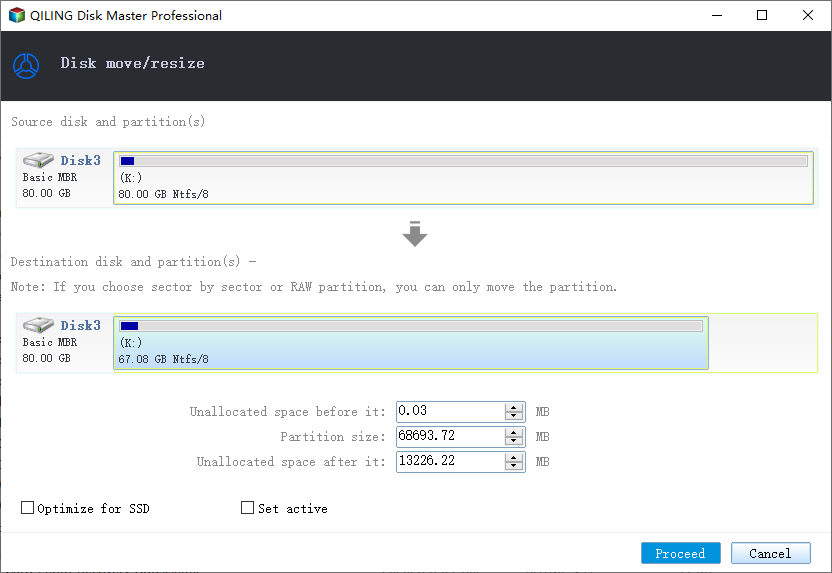
Step 5. Click Proceed to apply the pending operation, and keep the computer powered on until the alignment finishes.
Step 6. After completion, verify the alignment again with msinfo32, Command Prompt, or CrystalDiskInfo.
- Warning
- Before aligning partitions, back up your important data. While Qiling Partition Master is designed to be safe, any partition operation carries a small risk. Use Qiling Backup to create a system image first.
How to Align SSD During Cloning
If you're cloning from an HDD to an SSD, make sure the cloning software aligns the partitions on the destination SSD. Qiling Disk Copy automatically aligns partitions to 4KB boundaries during cloning.
Step 1. Download and install Qiling Disk Copy.
Step 2. Launch the program and select "Disk Clone" or "System Clone".
Step 3. Select the source drive (HDD or old SSD) as the source.
Step 4. Select the new SSD as the destination.
Step 5. Make sure "SSD alignment" or "Optimize for SSD" is enabled (it is by default).
Step 6. Click "Proceed" to start cloning. Qiling Disk Copy will automatically align all partitions to 4KB boundaries.
For more details, see our guides: How to Clone HDD to SSD and How to Clone to NVMe M.2 SSD.
FAQs About SSD 4K Alignment
How do I know if my SSD is 4K aligned?
Use msinfo32 (Win + R > msinfo32 > Components > Storage > Disks), find your SSD, and check "Partition Starting Offset". Divide the offset by 4096. If the result is a whole number, your SSD is aligned.
What happens if SSD is not 4K aligned?
A misaligned SSD suffers from reduced read/write performance (20-50% slower) and increased write amplification, which shortens the SSD's lifespan. Realigning the partition restores full performance.
Does Windows 10/11 automatically align SSD partitions?
Yes. Windows 7 and later automatically align partitions to 1MB boundaries during installation, which is 4K-aligned. Misalignment usually only occurs with drives partitioned by Windows XP or cloned from misaligned drives.
Is 4K alignment the same as 4K sectors?
No. 4K sectors refer to the physical block size of the SSD (4KB). 4K alignment refers to the partition starting offset being a multiple of 4096 bytes. A drive with 4K sectors still needs its partitions to be 4K-aligned for optimal performance.
Can I align an SSD without losing data?
Yes, using partition alignment software like Qiling Partition Master. The software moves the partition's starting position to a 4K boundary without deleting or moving your data (only the partition table is updated). However, always back up first as a precaution.
Does cloning software align partitions automatically?
Most modern cloning software (including Qiling Disk Copy) automatically aligns partitions on SSD destinations. Always check that "SSD optimization" or "4K alignment" is enabled before cloning.
Conclusion
SSD 4K alignment is critical for getting the full performance and lifespan from your SSD. Windows 7+ automatically aligns partitions during installation, but drives partitioned by older systems or cloned from misaligned drives may need manual alignment. Use msinfo32 or CrystalDiskInfo to check your alignment, and use Qiling Partition Master to realign if needed.
For optimal SSD performance, also make sure your SSD has TRIM enabled and run regular health checks with CrystalDiskInfo.
Related Articles
- Best Free Partition Manager Software of 2026: Top 6 Picks
- How to Clone HDD to SSD in Windows 10/11/7
- How to Clone to NVMe M.2 SSD (2026 Guide)
- How to Check Disk Health in Windows 10/11
- AHCI vs RAID Mode: Which Should You Use?
Confused about SATA mode? Learn the differences between AHCI and RAID, and how to change SATA mode without reinstalling Windows. - NTFS vs exFAT vs FAT32: Which Format to Choose (2026)
Compare NTFS, exFAT, and FAT32 file systems and choose the best format for your SSD based on file size limits, compatibility, and security.
Products
Articles & Tutorials
- Data Recovery
- Data Backup
- File Recovery
- File Backup
- System Backup and Restore
- Disk and Partition Clone
- Technical articles
- Mobile articles
- Disk Master Help
- Windows Data Recovery Tutorials
- Windows Secure Delete Tutorials
- Windows Partition Management Tutorials
- Windows File Backup and Restore Tutorials
- Windows System Backup and Restore Tutorials
- Windows Disk Backup and Restore Tutorials
- Windows Clone Tutorials