5 Best EaseUS Data Recovery Alternatives (2026 Free & Paid)
EaseUS Data Recovery Wizard is one of the most popular data recovery tools, but it has drawbacks: the free version only recovers 2GB of data, the paid version is expensive ($69.95/year), and some users report slow scanning speeds on large drives. If you're looking for an EaseUS Data Recovery alternative, this guide compares the 5 best options for recovering deleted files, photos, and documents.
Whether you need a free alternative, a more affordable paid tool, or better performance on large drives, you'll find the right option below.
PAGE CONTENT
- Why Look for an EaseUS Data Recovery Alternative?
- Quick Comparison: EaseUS vs Alternatives
- 1. Qiling Data Recovery (Best Overall Alternative)
- 2. Recuva (Best Free Option)
- 3. Disk Drill (Best for Mac Users)
- 4. R-Studio (Best for Professionals)
- 5. PhotoRec (Best Open-Source Tool)
- How to Recover Files with Qiling Data Recovery
- FAQs About EaseUS Data Recovery Alternatives
Why Look for an EaseUS Data Recovery Alternative?
Common reasons users seek alternatives to EaseUS Data Recovery Wizard:
- Limited free version: The free version only recovers 2GB of data. If you need more, you must pay.
- Expensive pricing: The Pro version costs $69.95/month or $99.95/year—one of the most expensive data recovery tools.
- Slow scanning on large drives: Deep scan on large HDDs (4TB+) can take several hours.
- Recovery quality: Some users report that recovered files are corrupted or incomplete.
- Subscription model: You pay yearly to keep using the software, rather than a one-time purchase.
- Customer support: Response times can be slow, especially for free users.
Quick Comparison: EaseUS vs Alternatives
| Tool | Free Limit | Paid Price | Deep Scan | Best For |
|---|---|---|---|---|
| EaseUS Data Recovery | 2 GB | $69.95/year | Yes | General use |
| Qiling Data Recovery | 2 GB | $49.95 (1-time) | Yes | Best overall value |
| Recuva | Unlimited (free) | $24.95 (Pro) | Yes | Best free option |
| Disk Drill | 500 MB | $89.00/year | Yes | Mac users |
| R-Studio | Files < 64KB | $49.99+ | Yes | Professionals |
| PhotoRec | Unlimited (free) | Free | Yes | Open-source users |
1. Qiling Data Recovery (Best Overall Alternative)
Qiling Data Recovery is our top pick as an EaseUS alternative. It offers the same deep scanning technology and file format support, but with more affordable pricing and faster scan speeds on large drives.
Key Features
- Deep scan technology: Recovers files from formatted, corrupted, and RAW partitions
- File preview: Preview files before recovery to verify they're intact
- Filter by type: Filter results by file type (photos, videos, documents, etc.)
- Supports all file systems: NTFS, FAT32, exFAT, ReFS, HFS+, APFS, ext2/3/4
- Recovers from all devices: Internal/external HDDs, SSDs, USB drives, SD cards, cameras
- One-time purchase: $49.95 for a lifetime license—no yearly subscription
Pros
- More affordable than EaseUS (one-time vs subscription)
- Faster deep scan on large drives
- Clean, easy-to-use interface
- Supports Windows and macOS
Cons
- Free version limited to 2GB
- Mac version has fewer features than Windows version
2. Recuva (Best Free Option)
Recuva by CCleaner (Piriform) is the best free data recovery tool. Unlike EaseUS's 2GB limit, Recuva's free version can recover unlimited data.
Key Features
- Completely free for personal use with no data limit
- Recovers deleted files from HDDs, SSDs, USB drives, and SD cards
- Deep scan mode for thoroughly scanning damaged drives
- Secure overwrite feature to permanently delete sensitive files
- Portable version available (no installation needed)
Pros
- Free with no data recovery limit
- Lightweight and fast
- Portable version available
Cons
- Interface is basic and dated
- No preview for some file types
- Lower recovery success rate on formatted drives compared to paid tools
- No Mac version
3. Disk Drill (Best for Mac Users)
Disk Drill by Cleverfiles is a popular data recovery tool with strong macOS support. If you're a Mac user looking for an EaseUS alternative, Disk Drill is a solid choice.
Key Features
- Supports Windows and macOS (excellent Mac support)
- Recovers 200+ file formats
- Deep scan for damaged and formatted drives
- Recovery Vault feature that protects files from future deletion
- Free version recovers up to 500MB
Pros
- Excellent macOS support
- Clean, modern interface
- Recovery Vault prevents future data loss
Cons
- Expensive ($89/year for Pro)
- Free version limited to 500MB
- Subscription model (no one-time purchase)
4. R-Studio (Best for Professionals)
R-Studio by R-Tools Technology is a professional-grade data recovery tool designed for IT professionals and data recovery services. It's more powerful than EaseUS but also more complex.
Key Features
- Advanced RAID recovery (RAID 0, 1, 5, 6, 10)
- Network recovery (recover files over a network)
- Disk imaging for working with damaged drives
- Supports all major file systems (NTFS, FAT, exFAT, HFS+, APFS, ext, UFS)
- Forensic features for data investigation
Pros
- Most powerful recovery tool on the market
- Supports RAID and network recovery
- Cross-platform (Windows, Mac, Linux)
Cons
- Complex interface—not beginner-friendly
- Expensive ($49.99 for personal, $899 for technician)
- Free demo only recovers files < 64KB
5. PhotoRec (Best Open-Source Tool)
PhotoRec is a free, open-source data recovery tool that focuses on recovering photos, videos, and documents. Despite its name, it recovers many file types, not just photos.
Key Features
- Completely free and open-source
- Recovers 480+ file formats
- Works on damaged and formatted drives
- Cross-platform (Windows, Mac, Linux)
- Companion to TestDisk (partition recovery tool)
Pros
- Free and open-source—no hidden costs
- Recovers 480+ file formats
- Works on severely damaged drives
Cons
- Command-line interface (not user-friendly)
- Cannot recover file names (recovers files as numbered names)
- Slow scan on large drives
- No preview feature
How to Recover Files with Qiling Data Recovery
If you choose Qiling Data Recovery as your EaseUS alternative, stop using the affected drive first. New downloads, copied files, or temporary system data may overwrite lost files. Install the recovery tool on another partition when possible, and prepare a separate drive to save the recovered data.
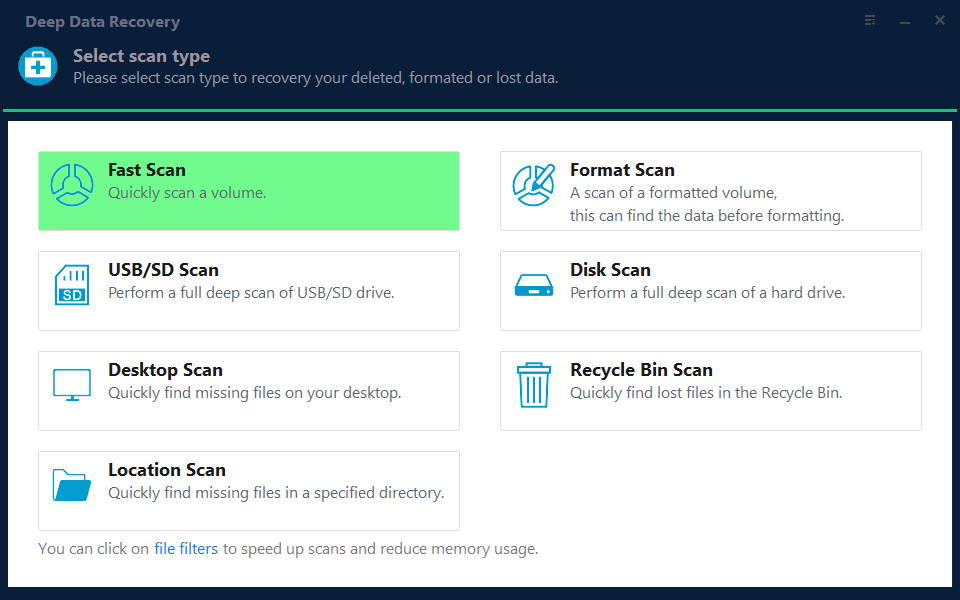
Step 1. Open Qiling Deep Data Recovery and choose the scan mode that matches your data loss case. Use Fast Scan for recently deleted files, Recycle Bin Scan after emptying the Recycle Bin, Format Scan after formatting a partition, USB/SD Scan for removable devices, or Disk Scan for a full drive search.
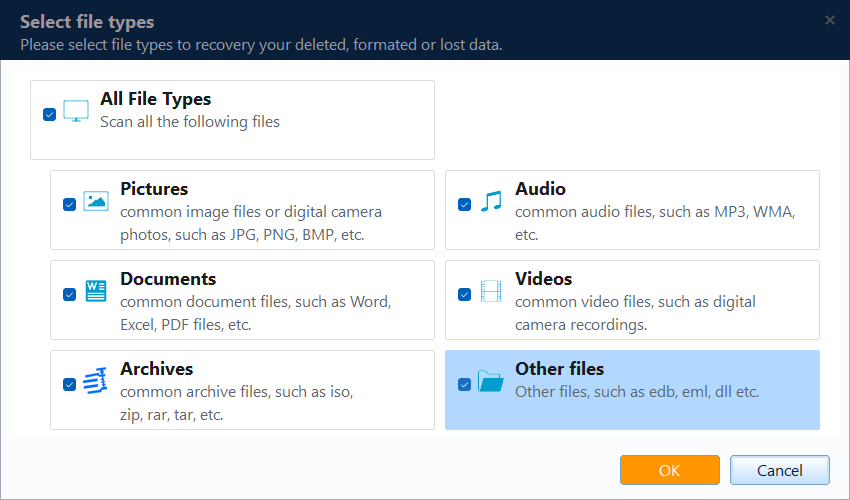
Step 2. Click file filters and select the file types you want to recover, such as Pictures, Documents, Videos, Audio, Archives, or All File Types. This helps reduce unrelated scan results.
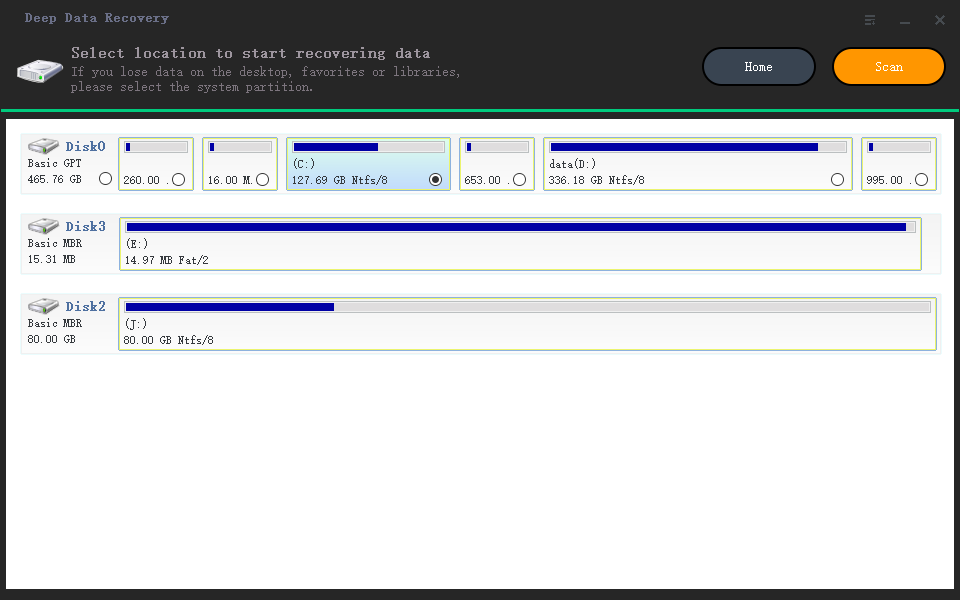
Step 3. Select the original drive, partition, USB drive, or SD card where the files were lost. Check the drive letter, capacity, and device type carefully, then click Scan. Do not scan or save recovered files to the wrong location.
Step 4. Wait for the scan to continue. Some files may appear early, but a complete scan usually gives a better recovery result, especially after deletion, formatting, or partition errors.
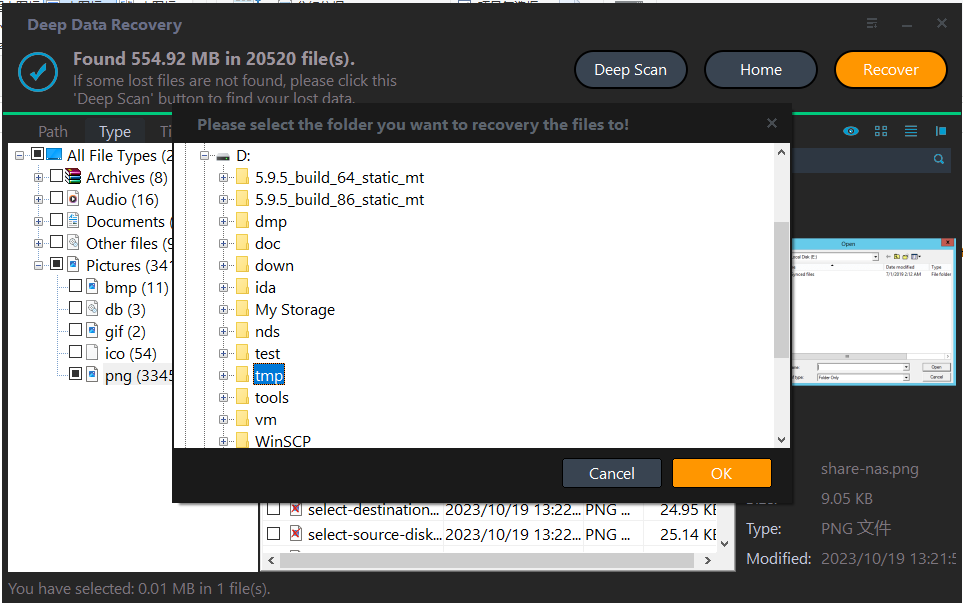
Step 5. Browse the results by Path or Type. Use the search box, file extension, size, and modified date to narrow the list. Preview supported files to confirm that they are the right versions before recovery.
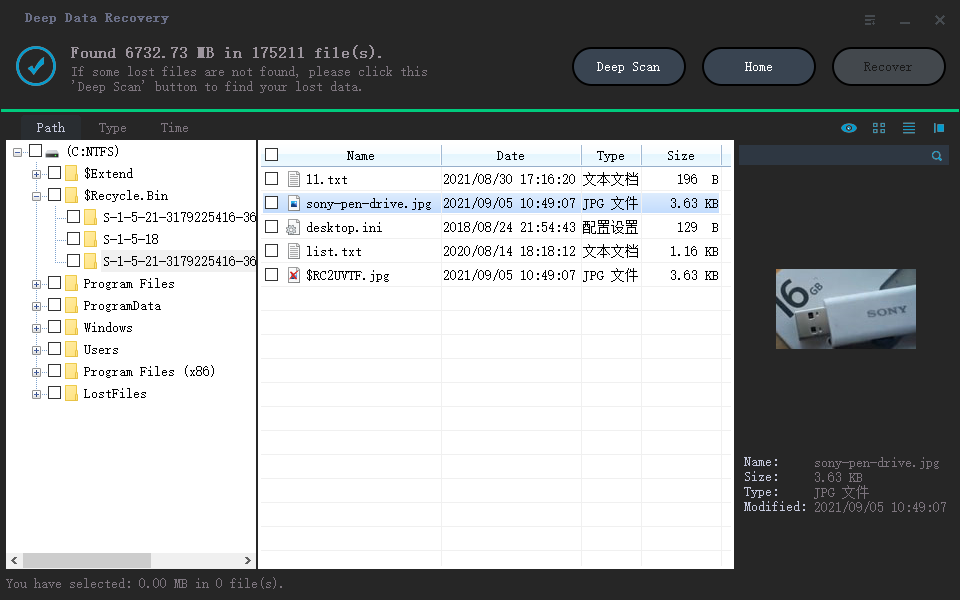
Step 6. If the needed files are not found, click Deep Scan. It takes longer, but it checks the selected storage area more thoroughly and is useful for formatted, RAW, corrupted, or partially lost partitions.
Step 7. Select the files you need and click Recover. Save them to a different physical drive, click OK, and open several recovered files afterward to make sure they are complete.
FAQs About EaseUS Data Recovery Alternatives
Is there a free alternative to EaseUS Data Recovery?
Yes. Recuva is completely free for personal use with no data limit. PhotoRec is also free and open-source. Qiling Data Recovery's free version allows up to 2GB of recovery.
Is Qiling Data Recovery better than EaseUS?
Qiling offers similar recovery features and success rates but at a lower price ($49.95 one-time vs $69.95/year). It also has faster deep scan speeds on large drives. For most users, Qiling is the better value.
Can I recover files without paying?
Yes. Recuva and PhotoRec are free with unlimited recovery. Windows File Recovery (built into Windows 10/11) is also free but has a command-line interface.
What is the best free data recovery software?
Recuva is the best free option for Windows users due to its unlimited recovery and simple interface. PhotoRec is best for advanced users who don't mind a command-line interface. See our Best Free Data Recovery Software guide for more options.
Can data recovery software recover files from a formatted drive?
Yes, most data recovery tools (Qiling, EaseUS, Recuva, Disk Drill) can recover files from formatted drives using deep scan technology. However, if you've written new data to the drive after formatting, some files may be overwritten and unrecoverable.
Conclusion
If you're looking for an EaseUS Data Recovery alternative, Qiling Data Recovery offers the best value with similar features at a lower one-time price. For a completely free option, Recuva is the best choice. Mac users should consider Disk Drill, while professionals may prefer R-Studio.
Whatever you choose, remember: stop using the drive immediately after data loss to prevent overwriting, and never save recovered files to the same drive you're recovering from.
For more data recovery options, see our complete Best Free Data Recovery Software guide.
Related Articles
- Best Free Data Recovery Software of 2026: Top 7 Picks
- How to Recover Deleted Photos on Windows PC (2026)
- How to Recover Formatted Hard Drive Data
Accidentally formatted your hard drive? Learn how to recover data from a formatted HDD or SSD using data recovery software with deep scan technology. - How to Backup a File with 3 Free Ways in Windows 11/10/8/7
Learn 3 free ways to backup files on Windows 11/10/8/7 to prevent future data loss, including Qiling Backup software, File History, and cloud drives.
Products
Articles & Tutorials
- Data Recovery
- Data Backup
- File Recovery
- File Backup
- System Backup and Restore
- Disk and Partition Clone
- Technical articles
- Mobile articles
- Disk Master Help
- Windows Data Recovery Tutorials
- Windows Secure Delete Tutorials
- Windows Partition Management Tutorials
- Windows File Backup and Restore Tutorials
- Windows System Backup and Restore Tutorials
- Windows Disk Backup and Restore Tutorials
- Windows Clone Tutorials