What Is Incremental Backup? Definition, Pros, and Cons
What Is Incremental Backup
Incremental backup is a type of backup where only the changes made since the last backup are stored, reducing storage space and backup time. It can backup files, folders, and external hard drives.
An incremental backup saves only the data and files that have changed since the last backup, recording every change, regardless of the type of backup created previously.
How Incremental Backup Works
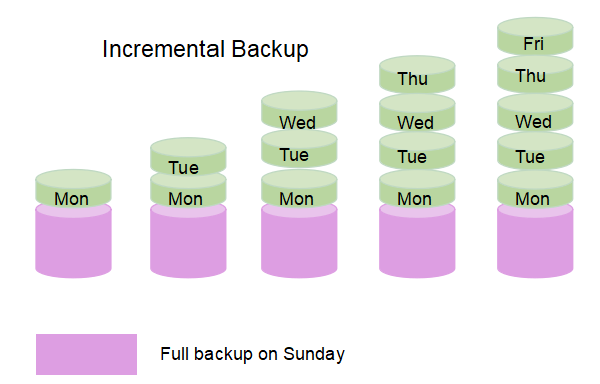
Try to understand how incremental backup works with this example:
- Last Sunday: A full backup was created.
- Today, one new file was added, and an incremental backup of Monday should only include this newly added file, without any other changes or files from previous backups.
- An incremental backup of Tuesday should contain only the three files added today.
- An incremental backup of Wednesday should only include the five files that were added today.
Four Types of Incremental Backup
People divide incremental backup into four types. These types can be briefly reviewed as follows:
- A synthetic full backup combines a full backup with incremental backups, requiring the previous full backup and any incremental backups to recreate the entire backup.
- Incremental Forever Backup creates only a full backup, with subsequent incremental backup files transferring to the system center. If needed, these incremental files are automatically organized into one file for easy restoration.
- The Enhanced Incremental Backup feature creates efficient backup files by automatically handling files that have been moved or renamed, allowing for streamlined backup processes.
- The system creates a new copy that combines the last full backup and incremental backup, creating a synthetic full backup that is made more often.
Advantages and Disadvantages of Incremental Backup
Incremental backup is notable for not backing up duplicate data, making it a space-efficient option. However, its choice depends on specific needs, as it may not be suitable for situations where data is constantly changing or when a full backup is required for auditing or compliance purposes.
Pros:
- Incremental backup files are small enough to save your storage space.
- It is fast to create an incremental backup.
- The Incremental backup can record changes and avoid repeat data.
Cons:
- Creating too many incremental backups can lead to data loss.
- As time passes, it becomes increasingly difficult to recover all the data.
Incremental VS Differential VS Full Backup Explained
There are three main backup methods: incremental, full, and differential backup. Each has its own features and differences, and understanding these can be clarified by comparing them with incremental backup.
Full Backup VS Incremental Backup
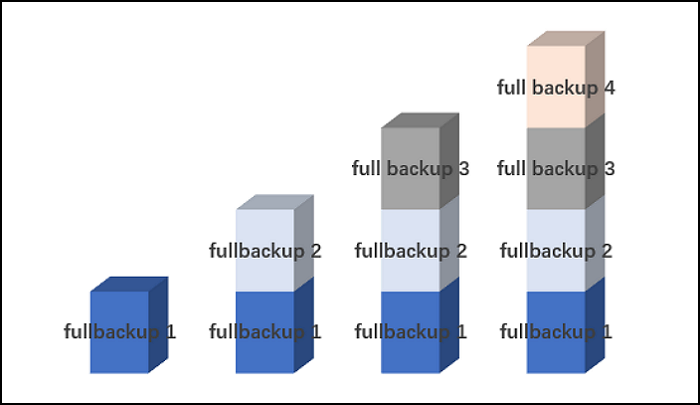
A full backup is a comprehensive backup of selected data or files, making a complete copy of everything included.
A full backup ensures you capture all important files, but it has some drawbacks.
- It takes too long to finish creating a full backup.
- If you want to back up the whole disk, too much space will be taken up.
- Too much repeat data will be recorded.
An incremental backup can help solve the problems of large backup files and long backup times by only recording changes, reducing the size of the backup files and shortening the backup time.
Differential Backup VS Incremental Backup
Differential and incremental backups are often confused with each other due to their similarities. Both types of backups involve saving only the changes made to data since the last backup, rather than saving the entire dataset.
Differential backup records all changing data, but only backs up the changes since the previous full backup. This type of backup relies on a full backup and should be performed in conjunction with it, as it only captures changes made after the last full backup. For instance, if a full backup was taken on Monday, and differential backups were taken on Tuesday and Wednesday, the differential backup on Wednesday would only contain changes made from Tuesday to Wednesday, not from Monday to Wednesday.
- Last Sunday: You made a full backup.
- On Monday, a file was added, which means that the differential backup of Monday will only include this new file.
- Two new files were added on Tuesday, in addition to the one added on Monday, so the differential backup will include those three files.
- On Wednesday, three new files were added, so the differential backup of Wednesday will contain the three new files, plus the two files added on Tuesday, and the file added on Monday.
Incremental backup files are generally smaller and faster to create than differential backup files, but as the number of incremental backups grows, it becomes increasingly difficult to restore data.
Incremental backup is actually easy to create but hard to restore. This is because it only saves the changes made since the last backup, making it efficient in terms of storage space.

Summary
With the increasing use of computers and mobile phones, it's essential to save precious data to prevent loss in case of a virus attack or the dreaded "blue screen of death".
A piece of full information about incremental backup is offered on this page. This method, like others, has its own features, and if you think it is necessary to back up your data with different methods, a professional backup software can be helpful.
Related Articles
- Laptop vs. Desktop: Which Is Better for You? [Comparative Analysis]
- Windows 11 Download: How to Download and Install Windows 11 [3 Ways]
- What Is SDRAM? Synchronous Dynamic Random-Access Memory Explained
- Introduction to Gigabyte and Terabyte: How Many Gigabytes Are There in a Terabyte
- What Is a Snapshot and How Is It Different from a Backup
The concept of a Snapshot is explained in this post, where it is defined and distinguished from a backup, providing a concise answer to the question. - What Is CIFS? Common Internet File System Explained
Have you ever heard about CIFS? In this article, we will briefly highlight CIFS's functionality and features in a brief manner. We will also distinguish between CIFS, NFS, and SMB protocols to provide you with additional information.
Products
Articles & Tutorials
- Data Recovery
- Data Backup
- File Recovery
- File Backup
- System Backup and Restore
- Disk and Partition Clone
- Technical articles
- Mobile articles
- Disk Master Help
- Windows Data Recovery Tutorials
- Windows Secure Delete Tutorials
- Windows Partition Management Tutorials
- Windows File Backup and Restore Tutorials
- Windows System Backup and Restore Tutorials
- Windows Disk Backup and Restore Tutorials
- Windows Clone Tutorials