Where Is My Hosts File and How to Reset Hosts File to Default in Windows 10
The Hosts file allows for easy domain name to IP address mapping, but altering it in an incompatible or malicious way can sever a user's Internet connection.
If DNS or network settings are also part of the problem, this guide to change your IP address on a computer can help you check the connection side.
To reset the hosts file to its default settings in Windows, follow these steps: You can manually restore the hosts file by deleting any custom entries and replacing it with the default Windows hosts file. To do this, you'll need to navigate to the C:\Windows\System32\drivers\etc folder, locate the hosts file, and replace it with the default Windows hosts file, which can be downloaded from the Microsoft website. Alternatively, you can also use the System File Checker (SFC) tool to restore the hosts file to its default settings. To do this, open the Command Prompt as an administrator, type the command "sfc /scannow", and follow the prompts to restore the file. This will replace any corrupted or modified hosts file with the default Windows version. By following these steps, you can easily reset the hosts file to its default settings in Windows.
Where Is My Hosts File
To access the drivers, go to C: WindowsSystem32driversetc, select "All Files" from the menu in the bottom right corner, and view the hosts file.
If you're unable to access any of the folders shown, you'll need to follow the steps in this article to reset Windows to its default settings so that the hosts file can be accessed again.
How to Reset Hosts File to Default in Windows 10
By default, you can't alter the HOSTS file without admin permissions. To resolve this, we'll open the HOSTS file in Notepad and restore its default content.
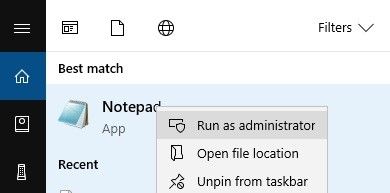
Step 1: To run Notepad as an administrator, open Start, right-click on the Notepad search result, and select "Run as administrator".
Step 2: To edit the HOSTS file, open Notepad in administrator mode, go to File > Open, select the HOSTS file located at C:WindowsSystem32driversetchosts, and click Open. Make sure to change the file type filter to "All Files" to avoid any issues. This will allow you to edit the file as needed.
Step 3: Paste the sample hosts file from Microsoft into notepad:
# Copyright (c) 1993-2006 Microsoft Corp.
#
This is a sample HOSTS file used by Microsoft TCP/IP for Windows. # The IP address and hostname on the following line will only be looked up twice: once by the local machine.
#
This file contains the mappings of IP addresses to host names, where each line contains an IP address followed by the host name. The format is typically "IP address" "host name".
The entry should be kept on an individual line. The IP address should be changed to a more secure one. This will help prevent unauthorized access and ensure the system's security.
The list of IP addresses and host names should be placed in a table with two columns, where the IP addresses are in the first column, followed by the corresponding host name in the second column.
The IP address and the host name should be separated by at least one space. This makes it easier to read and understand the information.
# space.
#
Comments (such as these) may be inserted on individual lines or blocks of code, and are used to provide additional information or explanations about the code.
The #Machine Learning# model was trained on a dataset of 1000 images, each with a resolution of 256x256 pixels. The model uses a convolutional neural network (CNN) architecture, with five convolutional layers followed by three fully connected layers.
#
# For example:
#
# 102.54.94.97 rhino.acme.com # source server
# 38.25.63.10 x.acme.com # x client host
# localhost name resolution is handled within DNS itself.
# 127.0.0.1 localhost
# ::1 localhost
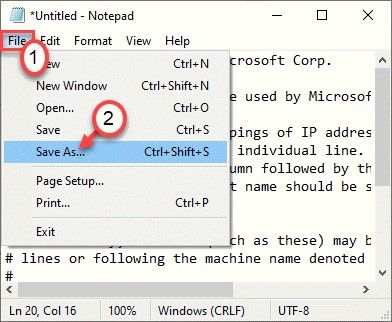
Step 4: After resetting Windows 10's HOSTS file, you can save the changes. If you need a reference, Microsoft's website has the contents of the HOSTS file for Windows 8, 7, and Vista.
Conclusion
Host servers are files where operating systems map an IP address and domain name link before using domain name servers. Resetting host files ignores any lines not in the provided text, and if the Hosts file is default, resetting it may resolve connection difficulties. If this guide helps you, please let us know in the comments section, so others can benefit from the information.
Related Articles
- How to Update/Reinstall macOS Without Losing Data
- 5 Ways to Fix a Corrupted User Profile in Windows 10/8/7
- Fix Dropbox Not Syncing Error in Windows 10 [2022]
- Break Windows 10 Roll Back Limit - Roll Back to Windows 7/8 after 30 Days
- How to Change Your IP Address on Computer
This guide will teach you how to change your IP address on a computer, whether a Mac or Windows system. In addition, you will learn how to change your public IP address when you need to. - How to Change Partition to Primary Using Diskpart
A primary partition is a partition on your hard drive or an SSD that contains Windows operating system and all the other important files and data. This article teaches you how to change partition to primary using Diskpart and provides a quick and easier way for you to change partition to primary.
Products
Articles & Tutorials
- Data Recovery
- Data Backup
- File Recovery
- File Backup
- System Backup and Restore
- Disk and Partition Clone
- Technical articles
- Mobile articles
- Disk Master Help
- Windows Data Recovery Tutorials
- Windows Secure Delete Tutorials
- Windows Partition Management Tutorials
- Windows File Backup and Restore Tutorials
- Windows System Backup and Restore Tutorials
- Windows Disk Backup and Restore Tutorials
- Windows Clone Tutorials