How to Use CMD Delete File/Folder [Windows 11 Applicable]
Windows Command Prompt Overview
The Command Prompt, also known as cmd.exe or cmd, is a command-line interpreter application used only in Windows operating systems. It's a powerful tool that enables advanced operations and helps solve Windows issues.
Command Prompt To delete files and folders quickly using cmd, first open the command prompt as an administrator. Then, navigate to the directory where the files or folders you want to delete are located using the cd command. Once you're in the correct directory, you can use the del command to delete individual files or the rmdir command to delete empty folders.
How to Use CMD Delete File Step by Step
Using the command prompt (cmd) to delete files is not like putting them in the Windows Recycle Bin, as you can't recover them directly. To delete files with cmd, be cautious as you won't be able to recover them without third-party software. First, open the command prompt to proceed with deleting files. Make sure you delete the files you no longer want to keep.
How to Open Command Prompt on Windows 11/10
To open the Command Prompt on Windows, follow these simple steps: right-click on the Start button, then select "Command Prompt" from the context menu. Alternatively, you can type "cmd" in the Windows search bar and click on the result to open the Command Prompt.
Step 1. Click "Start", and you'll see the search box.
Step 2. Type in cmd.
Step 3. Right-click cmd and select "Run as Administrator".
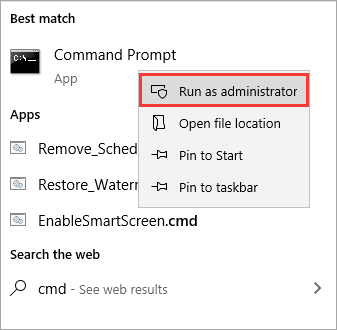
Step 4. Now you can use Command Prompt to delete files.
How to Use CMD Delete File with del
Once you have learned how to open the Command Prompt, you can type in command lines. To delete files, follow the tutorial and type in the correct command lines.
Step 1. Type in del with a space after it.
Step 2. To delete files, type the path for each file you want to delete, separating each file name with a space.
Step 3. You want me to type in the correct path and press Enter. I'll do that.

How to Use CMD Delete Folders with rmdir
To delete a folder with cmd, you can use the `rmdir` command, followed by the name of the folder you want to delete. For example, if you want to delete a folder named "myfolder", you would type `rmdir myfolder`. If the folder is not empty, you will need to use the `rd` command instead, which stands for "remove directory".
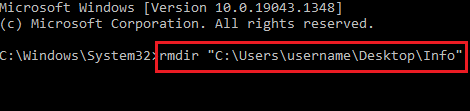
Step 1. Type in rmdir with a space after it.
Step 2. Then type the path for each folder you want to delete.
Step 3. Make sure you type in the correct path and press the Enter key.
Recover Deleted Files/Folders from CMD with the File Recovery Tool
If you've accidentally deleted key files and folders, you can recover them with Deep Data Recovery. This tool can help you retrieve essential items that you thought were lost forever. It's a simple and effective solution to recover permanently deleted files.
Regardless of whether you delete a file using PowerShell or the Command Prompt, Deep Data Recovery can help you recover the deleted file with ease. This professional recovery tool is also suitable for home users.
Don't worry about recovering deleted files, Deep Data Recovery has got you covered. They can help you recover deleted videos, photos, music, emails, and documents with ease.
This tool is also a handy recovery aid, allowing you to recover deleted files and folders in just three easy steps.
Step 1. Select file types and click "Fast Scan" to start
Connect your USB flash drive to your Mac, then launch Deep Data Recovery for Mac. Select the desired file types and click "Fast Scan" to begin the recovery process.
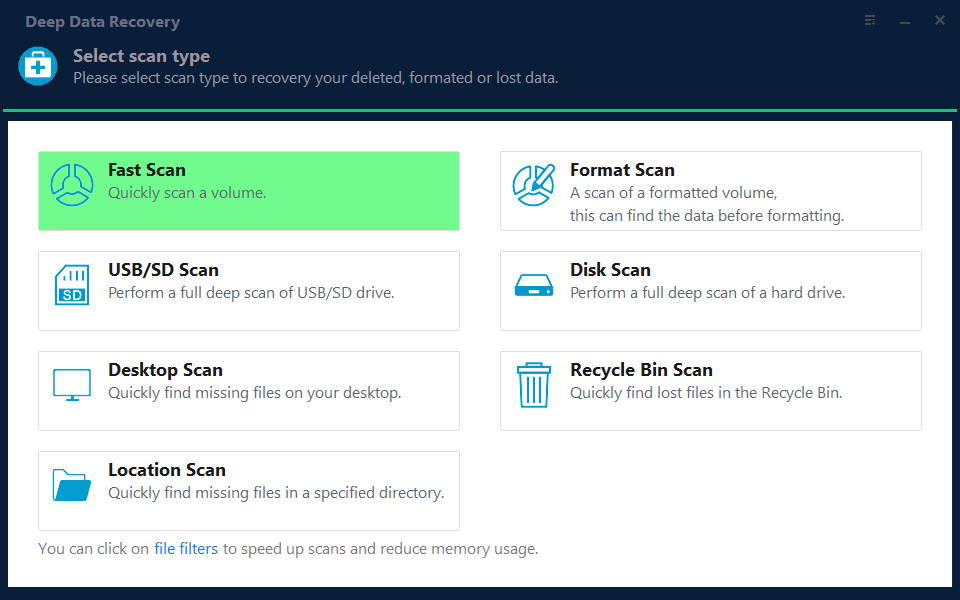
Note: You can choose different search modes based on where and why the data was lost.
Step 2. Select a location and start scanning
Launch Deep Data Recovery, hover on the partition/drive where the deleted files were stored, and click "Scan" to find lost files.

Step 3. Select the files you want to recover
When the scanning is complete, select the deleted files you want to recover. You can filter the results to show only specific file types or search for a file by name in the search bar. This is a quick way to find a specific file.

Step 4. Preview and recover deleted files
Preview the recoverable files, select the desired files to restore, and click "Recover" to move them to a new storage location, bypassing the original disk where the data was lost.
Summary
On Windows, the Command Prompt (cmd) is capable of more than just deleting files. It can also be used to show hidden files, which can be useful if you're unable to locate a file and suspect it might be hidden. This feature allows you to view and manage files that are normally invisible in Windows, making it easier to find and manage your files.
If you've accidentally deleted videos, photos, or files on your computer or laptop, you can quickly recover them with Deep Data Recovery. With this software, you can easily find and retrieve your lost files in just one click.
Command Prompt Delete File FAQs
We have listed some further questions and answers here:
What is delete command in cmd?
To delete files and folders using Command Prompt, you'll need the del command and rmdir command. The del command is typically used to erase one or multiple files, while the rmdir command is used to delete empty folders.
How do I delete corrupted files in cmd?
You can try deleting corrupted files with the Command Prompt (cmd) by navigating to the folder containing the file, typing `del filename` (replacing "filename" with the actual name of the corrupted file), and pressing Enter. If the file is indeed corrupted, this method may be able to delete it.
- 1. Click "Start", and you'll see the search box.
- 2. Type in cmd.
- 3. Right-click cmd and select "Run as Administrator".
- 4. To delete corrupted files, use the command `del /f /q /a` followed by the path to the files. The `/f` option forces deletion without prompting for confirmation, `/q` specifies quiet mode to suppress output, and `/a` specifies that the command should be applied to all files in the specified directory.
- 5. Press the Enter key.
How do I delete multiple files in command prompt?
You can delete a single file and multiple files with the del command.
- 1. Type in del with a space after it.
- 2. To delete files, type the path for each file you want to delete, separating each file name with a space.
- 3. Make sure you type in the right path and press the Enter key.
How delete all files and folders using cmd?
You can use the cmd command "del /S" to delete all files and folders in a directory and its subdirectories.
Related Articles
- 4 Ways to Fix Mac Won't Start in Safe Mode [Support macOS Ventura/Big Sur/Mojave]
- Why Can't I Format My External Hard Drive on PS4? [Ultimate Answer and Tutorial]
- How to Format a Disk on Mac? 2022 Step-By-Step Guide
- How to Fix Microsoft Excel Has Stopped Working 2007/2010/2013/2016
- B550 vs. X570 [Full & Detailed Comparison]
X570 and B550 are both AMD chipsets. Some users want to know how they differ and which one they should pick. You are coming to the right place if you're one of them. Read this article to learn more about B550 vs. X570. - What Are the Best External Hard Drive for PS4? Top 8 Choice in 2023
Are you tired of deleting your favorite games from your PS4's internal storage to make room for new ones? This article reviews the top 8 best external hard drives for PS4, helping you choose the perfect one to expand your gaming library without the hassle of deleting games.
Products
Articles & Tutorials
- Data Recovery
- Data Backup
- File Recovery
- File Backup
- System Backup and Restore
- Disk and Partition Clone
- Technical articles
- Mobile articles
- Disk Master Help
- Windows Data Recovery Tutorials
- Windows Secure Delete Tutorials
- Windows Partition Management Tutorials
- Windows File Backup and Restore Tutorials
- Windows System Backup and Restore Tutorials
- Windows Disk Backup and Restore Tutorials
- Windows Clone Tutorials