Check Disk Read and Write Speed in Windows 10
Key Takeaways of Checking Disk Read/Write Speed in Windows 10:
Our goal is to help you learn how to check the disk read/write speed in Windows 10, which can help you identify potential issues with your storage devices and optimize your computer's performance. By mastering this practical method, you can save time, boost productivity, and ensure your system runs smoothly.
Which Way Should I Take to Check Disk Read/Write Speed in Windows 10?
Checking disk read/write speed in Windows 10 has become a simple task, with various methods available. You can use professional tools like Qiling Disk Master, which is easy to use and provides accurate results. Alternatively, you can use built-in Windows 10 features such as Task Manager and Command Prompt (CMD) to check disk speed. If you're looking for the simplest method, Qiling Disk Master is an excellent tool that allows you to test HDD, SSD, and external storage devices with just a few clicks, making it a convenient and efficient option.
Here are the three easy methods:
To check disk read/write in Windows 10 using Qiling Disk Master, first, download and install Qiling Disk Master on your computer. Launch the program and select the disk you want to check from the list of available disks. Click on the "Read/Write" tab and then click on the "Start" button to begin the read/write test.
Qiling Disk Master is a reliable disk management tool that tests the read/write speed of various storage devices, including HDD, SSD, and external drives, with an intuitive and user-friendly interface.
To check disk read/write speed in Windows 10 using Task Manager, follow these steps: Open Task Manager by searching for it in the Start menu or by using the Ctrl+Shift+Esc shortcut. In the Task Manager window, click on the "Performance" tab. In the "Performance" tab, click on the "Disk" section to view disk read and write speeds.
Task Manager is a built-Task Manager is a feature in Windows 10 that allows users to monitor the performance of various system components, including disk read/write speed, and check the current disk activity to see how much data is being read or written to the disk at any given time.
To check disk read and write speed in Windows 10 using CMD, open Command Prompt as administrator, type `wmic diskdrive get name, status, size, totalheight, totalwidth, bytespersector, sectorspertrack, trackspercylinder, totalcylinders, totaltracks, totalsectors, serialnumber, model, firmwarerevision` and press Enter. Then, type `wmic diskdrive where status='OK' get name, bytespersector, sectorspertrack, trackspercylinder, totalcylinders, totaltracks, totalsectors, serialnumber, model, firmwarerevision` and press Enter. Next, type `wmic diskdrive where name='C:' get name, bytespersector, sectorspertrack, trackspercylinder, totalcylinders, totaltracks, totalsectors, serialnumber, model, firmwarerevision` and press Enter.
The Command Prompt (CMD) in Windows 10 is a powerful tool for performing various tasks, including checking the disk read and write speed. Users can obtain information on the current read and write speed of the disk by using a simple command.
Now, let's dive into the detailed operational steps. To start, you'll need to gather all the necessary materials and tools.
Method 1. Check Disk Read/Write in Windows 10 Using Qiling Disk Master
Qiling Disk Master is a software that offers a range of functions and features, including disk partitioning management and hard disk speed testing. It's a valuable tool for testing the read/write speed of hard drives (HDDs), solid-state drives (SSDs), and other storage devices, with its free DiskMark feature being a notable highlight.
DiskMark can measure the following parameters of a disk:
- The speed parameter measures the rate at which data is read from or written to a disk, typically expressed in megabytes per second (MB/s) or gigabytes per second (GB/s).
- The disk's IOPS is measured by the number of input/output operations it can perform per second, which is a key performance metric for evaluating disk performance.
- The parameter measures the latency or delay of the disk in responding to a read or write request.
Once the test is finished, Qiling Disk Master will generate a detailed disk speed test report, providing you with accurate results. This report allows you to compare and understand whether your disk speed matches the average speed for your specific type of storage device.
To check disk read/write in Windows 10 using Qiling Disk Master, follow these steps: First, download and install Qiling Disk Master from the official website. Next, launch the application and select the disk you want to check from the list of available disks.
Step 1. Launch Qiling Disk Master, click the download button to activate DiskMark feature under Discovery section.
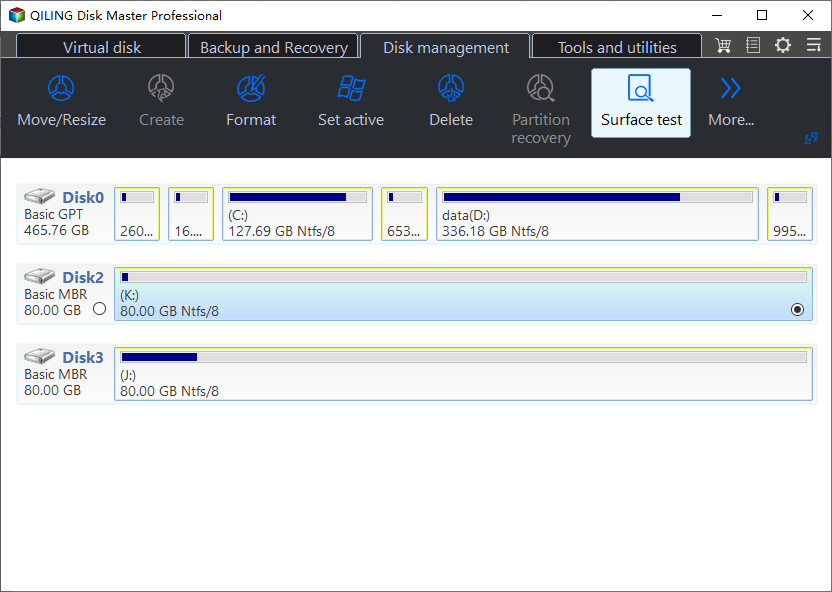
Step 2. Select the target drive, test data, and block size from the drop-down menu options.
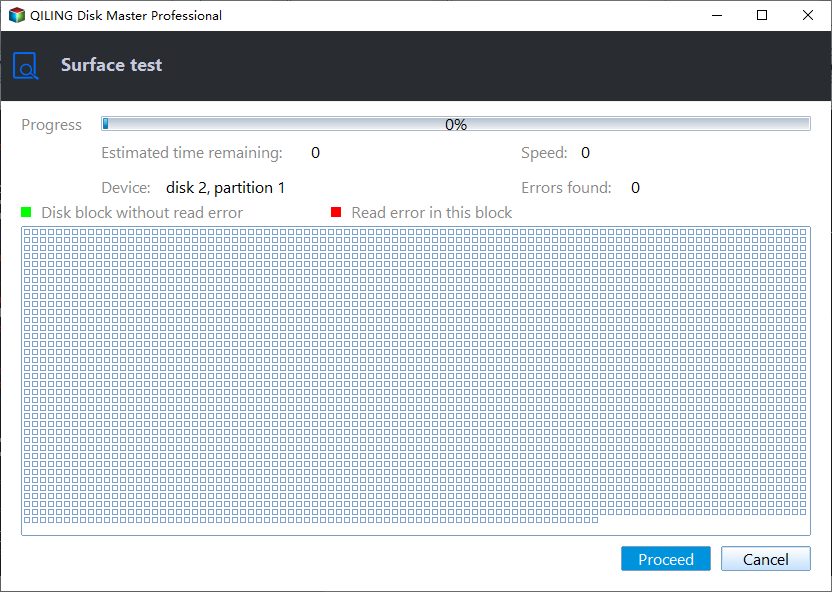
Step 3. Once everything is configured, click "Proceed" to begin the disk test, which will then display the Sequential read speed, I/O, and Delay data.
Method 2. Run Task Manager to Check Disk Read/Write Speed in Windows 10
A built-In the Task Manager of Windows 10, the Performance feature allows us to view real-time graphs for CPU, Memory, Disk, and Network usage, enabling us to monitor and check the read/write speed of our disk.
Here's how you can check read/write speed using Task Manager:
Step 1. Search for "Task Manager" in the search bar of the taskbar, and click on it to open it.
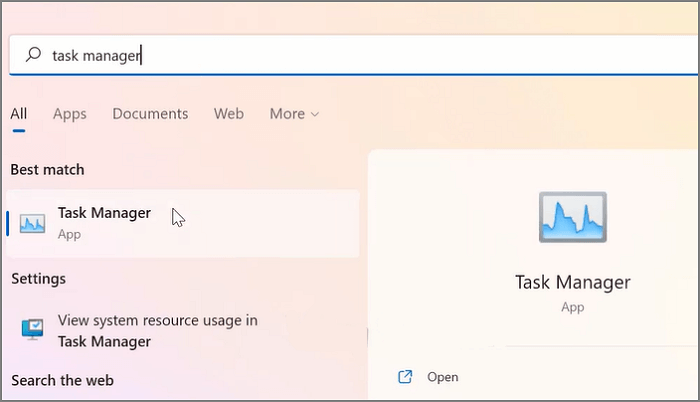
Step 2. Click the "More details" button located in the bottom left corner of the pop-up window.
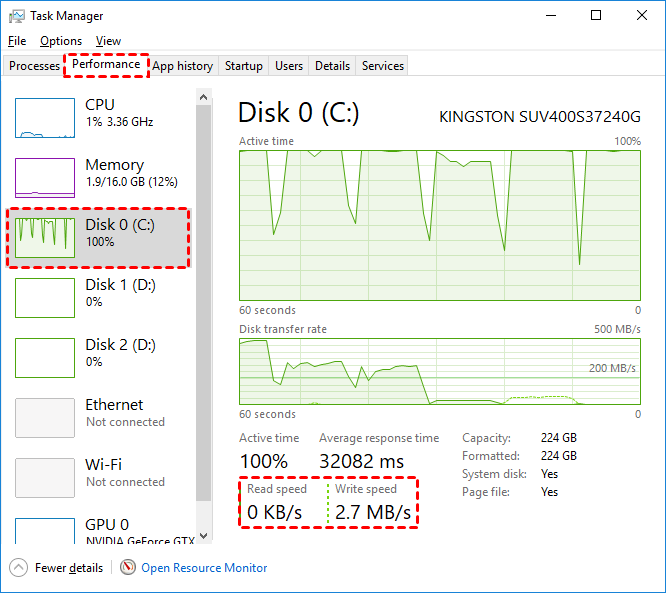
Step 3. Click the "Performance" tab.
Step 4. To check your disk's read and write speed, click on "Disk C" in the list of available disks. This will display the read and write speed of your disk, allowing you to see how quickly data can be read from and written to the disk.
Step 5. Here at the bottom left, you can see read and write speeds.
Method 3. Check Disk Read and Write Speed in Windows 10 Using CMD
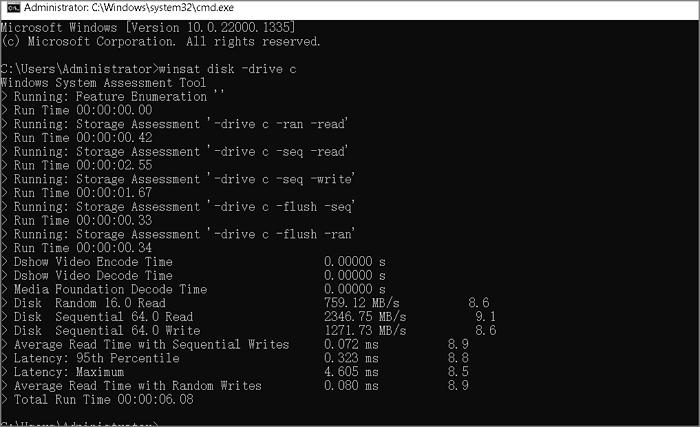
To check the disk read and write speed of an internal disk on Windows 10, you can use the "winsat disk -ran -write -drive (name)" command in the Command Prompt (CMD), which generates a system score for the disk based on its sequential and random read/write speeds, but this method only applies to internal disks.
For testing the speed of external storage devices like HDDs, SSDs, USB drives, or SD cards, Qiling Disk Master is a recommended tool. It's a complete tool that can test the speed of all types of storage devices, both internal and external hard drives.
To check your internal disk read and write speed in Windows 10 using CMD, open the Command Prompt as administrator, type `wmic diskdrive get Name, Size, Status, HotSwap, InterfaceType, Model, Mfr, SerialNumber, TotalHeads, TotalCylinders, TotalTracks, TotalSectors, TotalTracksPerCylinder, TotalTracksPerDisk, TotalTracksPerHead, TracksPerCylinder, TracksPerDisk, TracksPerHead, TracksPerSurface, TracksPerSurfacePerCylinder, TracksPerSurfacePerDisk, TracksPerSurfacePerHead, TracksPerSurfacePerSurface` and press Enter. Then, type `wmic diskdrive get Name, Size, Status, HotSwap, InterfaceType, Model, Mfr, SerialNumber, TotalHeads, TotalCylinders, TotalTracks, TotalSectors, TotalTracksPerCylinder, TotalTracksPerDisk, TotalTracksPerHead, TracksPerCylinder, TracksPerDisk, TracksPerHead, TracksPerSurface, TracksPerSurfacePerCylinder, TracksPerSurfacePerDisk, TracksPerSurfacePerHead, TracksPerSurfacePerSurface` and press Enter.
Step 1. To open the Command Prompt, search for "CMD" or "Command Prompt" in the taskbar's search box, and then right-click on it to select "Run as administrator".
Step 2. Type this command: "winsat disk -ran -write -drive (name)".
Final Verdict
We've explored three simple methods to check disk read and write speed, and you can choose the one that suits you best. While the Task Manager and CMD methods are easy, they may be a bit tricky, and only support internal hard drives. In contrast, Qiling Disk Master offers a straightforward and accurate way to test both internal and external hard drives, making it the easiest and most reliable option. This tool provides 100% accurate reports, making it a valuable resource for anyone looking to test their hard drives. Its advanced features and functions make it a great choice, and trying it out is highly recommended.
We hope you find this article helpful. If you want to learn more about technologies, just save this website on your favourite list and always get accurate information about new and upcoming technological inventions and updates. We keep a keen eye on new innovations and provide 100% real factual information to our honourable readers. If you have any queries or want to learn more about disk speed testing, move to the next part of the FAQs.
FAQs About Checking Disk Read and Write Speed in Windows 10
Do you have any questions about checking disk read/write speed in Windows 10? If so, please see the following frequently asked questions and answers:
1. Is it free to run Crystal disk speed test?
CrystalDiskMark is a free disk read/write speed testing tool that can be downloaded and used without any cost or licensing requirements. It is a freeware utility that does not need any payment or license.
2. How to check the read/write speed of SSD on Mac?
To check the read/write speed of an SSD on a Mac, use the built-in features such as the Activity Monitor window or the Dock, where you can click "Disk" in the Activity Monitor window or choose "View" > "Dock Icon" > "Show Disk Activity" in the Dock. This will display the disk activity, allowing you to check the read/write speed of the SSD.
3. How to check read and write speed without CMD?
To check the read and write speed of your disks in Windows 10, you can use Task Manager. This is a convenient alternative to using CMD.
- Open Task Manager.
- Click on the "Performance" tab.
- Click on the "Disk" option from the left sidebar.
- You can see your disk's read and write speed under the "Disk Activity" section.
Related Articles
- How to Fix Computer Stuck on Restarting | 2024 Hot Ways🔥
- How to Convert a Dynamic Disk to Basic Windows Server
- Top 5 Free Disk Format Utility Recommend for Windows & Mac
- How to Upgrade EMMC to SSD [Tutorial with Pictures]
- How to Fix Windows 11 Startup Repair Not Working | 7 Tips
Resolve Windows 11 startup issues easily with our comprehensive guide, featuring easy solutions and expert tips to fix 'Windows 11 startup repair not working' and get your computer up and running smoothly. - 7 Easy Ways to Fix Windows 11 Stuck on Boot Screen
Is your PC stuck on Windows 11 Stuck on Boot Screen, blocking you from accessing your account? Then follow this guide that offers easy ways to fix Windows 11 Stuck on Boot Screen.
Products
Articles & Tutorials
- Data Recovery
- Data Backup
- File Recovery
- File Backup
- System Backup and Restore
- Disk and Partition Clone
- Technical articles
- Mobile articles
- Disk Master Help
- Windows Data Recovery Tutorials
- Windows Secure Delete Tutorials
- Windows Partition Management Tutorials
- Windows File Backup and Restore Tutorials
- Windows System Backup and Restore Tutorials
- Windows Disk Backup and Restore Tutorials
- Windows Clone Tutorials