How to Format SD Card for Raspberry Pi
Key Takeaways of Format SD Card for Raspberry Pi:
1. To back up your Raspberry Pi SD card on Windows, insert the SD card into a card reader and connect it to your computer. Use a tool like Qiling Backup to create a backup of the SD card.
2. Formatting an SD card for Raspberry Pi can be a tedious process, but using a reliable tool can save you time and effort. A good SD card format tool can ensure that your card is properly formatted and ready for use with your Raspberry Pi, making it a worthwhile investment for anyone who frequently sets up new devices or needs to quickly prepare SD cards for use.
If you're looking to format an SD card for use with your Raspberry Pi, this guide is for you. Whether you're a beginner or experienced user, we'll walk you through the simple steps to get your SD card set up and ready to go on both Windows and Mac computers. Follow along to successfully format your SD card and get it ready for use in your Raspberry Pi.
- What Format Should I Format My SD Card for Raspberry Pi
- Guide 1. How to Format SD Card for Raspberry Pi on Windows
- Guide 2. Format SD Card for Raspberry Pi on Mac
What Is Raspberry Pi
The Raspberry Pi is a series of small, low-cost, and highly modular single-board computers developed by the Raspberry Pi Foundation, making it a popular choice for various applications, including weather monitoring, due to its open design and affordability.
The Raspberry Pi requires a SD card to store its operating system, games, and other data, as it does not have internal storage.
What Format Should I Format My SD Card for Raspberry Pi
The Raspberry Pi uses a FAT32 file system, which is the same as Windows XP. So, you'll need to format the SD card using FAT32. You can do this using a Windows machine or a Linux machine. If you're using a Windows machine, you can use the built-in formatting tool.
The Raspberry Pi accepts three file system formats for the OS SD card: FAT16, FAT32, and exFAT. The choice of format depends on the storage size of the SD card, with FAT16 and FAT32 suitable for smaller cards and exFAT recommended for larger ones.
- FAT16: 128MB - 2GB SD card
- FAT32: 4GB - 32GB SD Card
- exFAT: 64GB - 2TB SD Card
To confirm if your SD card is ready for use on the Raspberry Pi, check the following: ensure the SD card is properly inserted into the Raspberry Pi, verify that the card is not write-protected, and confirm that the operating system is installed and configured correctly. Additionally, you can check the SD card's file system and confirm that it is formatted correctly.
1. If you've backed up your essential data from the SD card to another location, you're good to go. You can replace the SD card with a new one and restore the backed-up data to it.
2. If the SD card has been formatted with the accepted file system format and the data has been cleared, then it should be ready for use.
- To install Raspberry Pi on an SD card, you'll need to download the Raspberry Pi OS image from the official website, and then use a tool like Etcher or the Raspberry Pi Imager to write the image to the SD card. This will prepare the SD card with the necessary operating system and files for your Raspberry Pi device.
- If your Raspberry Pi is not recognizing your SD card, follow these steps to format it efficiently. First, insert the SD card into your computer. Next, download and install the Raspberry Pi Imager tool, which is a free software that allows you to format your SD card for use with Raspberry Pi.
Guide 1. How to Format SD Card for Raspberry Pi on Windows
You can format an SD card for your Raspberry Pi in a Windows computer using one of four methods. The specific method you choose may depend on your personal preference or the specific requirements of your project.
- #1. Apply SD Card Formatter Software
- #2. Use File Explorer
- #3. Use Disk Management
- #4. Use Command Line
Here are the two easier ways to format SD cards for Raspberry Pi:
#1. Format SD Card for Raspberry Pi with Qiling SD Card Formatter Software
Qiling Partition Master Free is a third-party SD card formatter that allows Windows users to easily format their SD cards with various file systems, including NTFS, FAT32, exFAT, and EXT2, EXT3, EXT4.
Formatting a storage device, such as an SD card, for use with a device like the Raspberry Pi, is a straightforward process that can be completed in a few simple steps. To begin, insert the SD card into your computer's card reader or a USB adapter, then navigate to the Disk Management or Disk Utility tool, depending on your operating system. From there, select the SD card and choose the option to format it, selecting the file system type (such as FAT32 or exFAT) and allocation unit size as desired.
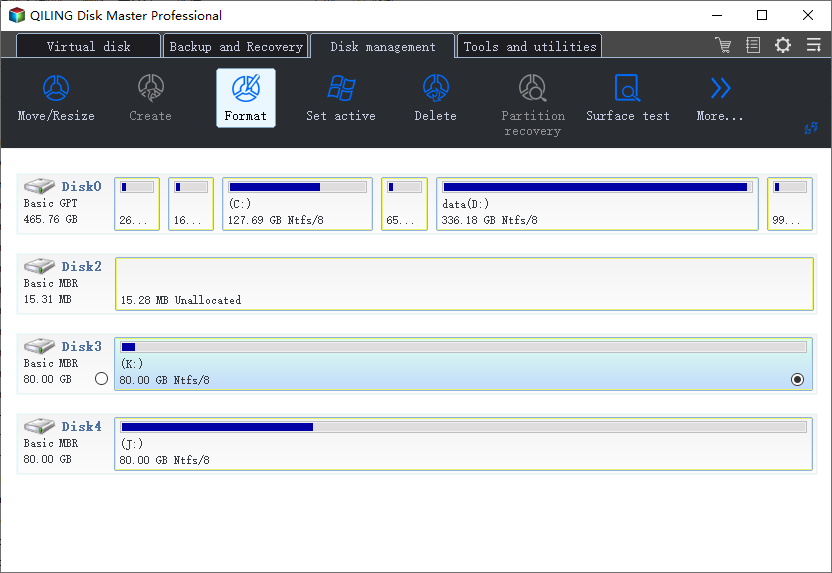
Step 1. Launch Qiling Partition Master, right-click the partition on your external hard drive/USB/SD card which you want to format and choose the "Format" option.
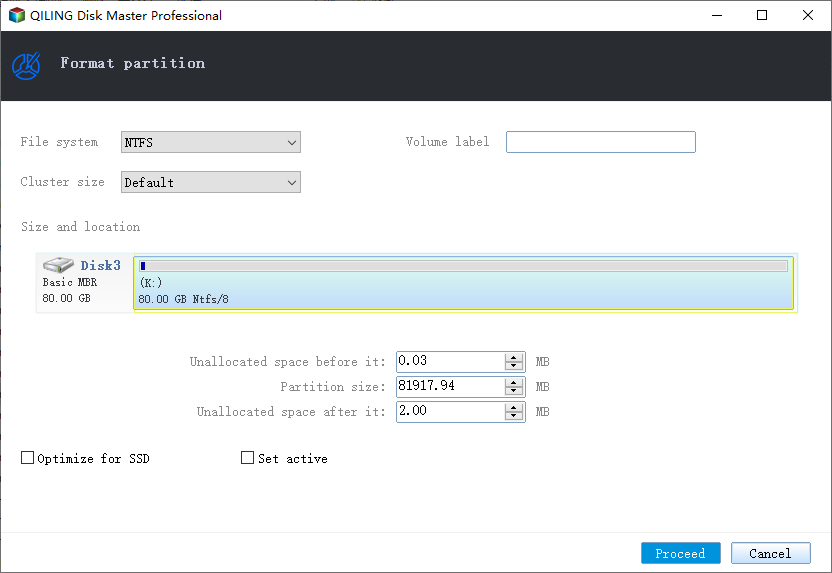
Step 2. Assign a new partition label, file system (NTFS, FAT32, EXT2, EXT3, EXT4, exFAT), and cluster size to the chosen partition, then click "Proceed".
Step 3. Click "Yes" to start formatting your external hard drive/USB/SD card in the Warning window.
This software can be used to format SD cards, as well as convert between NTFS and FAT32 file systems on storage devices without formatting.
#2. Format SD Card for Raspberry Pi with File Explorer
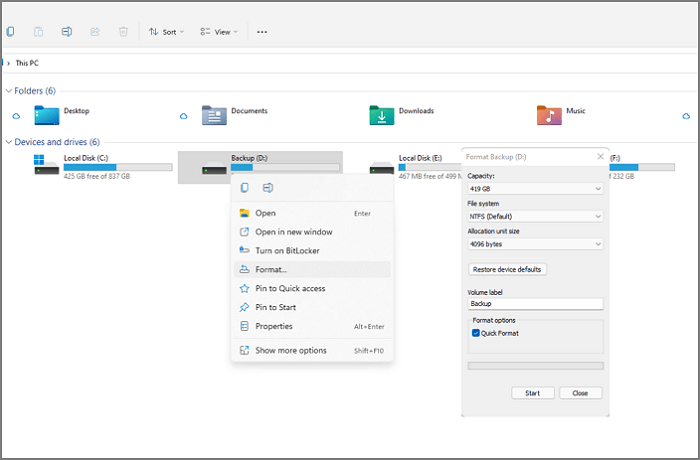
On a Windows computer, you can also format the SD card using File Explorer. Simply access File Explorer, right-click on the SD card, and select "Format" to convert it to exFAT or FAT32. This is a straightforward and easy method to ensure the SD card is formatted for use with your device.
Step 1. Connect your SD card to the computer via an SD card reader.
Step 2. Press Windows + E keys to open File Explorer.
Step 3. Find and right-click on the SD card that you tend to format for Raspberry Pi, and select "Format".
Step 4. Set a new file system format to the SD card - exFAT or FAT32.
The storage capacity of an SD card can be formatted in two ways: FAT32 for cards up to 32GB and exFAT for cards larger than 32GB.
Step 5. Tick "Perform a quick format" and click "Start". Then click "OK" when the formatting process finishes.
Advanced Windows users may consider trying methods 3 or 4, which involve formatting the SD card using Disk Management or the Command Prompt. If you're one of them, you can refer to the next two guides for assistance.
Guide 2. Format SD Card for Raspberry Pi on Mac
To format an SD card on a Mac, you can use Disk Utility or Terminal. For simplicity, we'll focus on the Disk Utility method, which is ideal for formatting an SD card for Raspberry Pi. To get started, launch Disk Utility, select the SD card from the left sidebar, click the "Erase" button, choose the desired format (such as MS-DOS or exFAT), and click "Erase" to confirm.
Here are the steps:
Step 1. Connect your Raspberry Pi SD card to your Mac via an SD card adapter.
Step 2. Go to the Apple Menu or Finder, click "Go" and click "Applications". Then, double-click "Utilities" in Applications.
Step 3. Double-click "Disk Utility" to open it and select the SD card on the left pane.
Step 4. To format the SD card, go to the top menu and click "Erase". Then, select the file system format you want to use - either DOS (FAT) or exFAT - and click "Erase" to complete the formatting process.
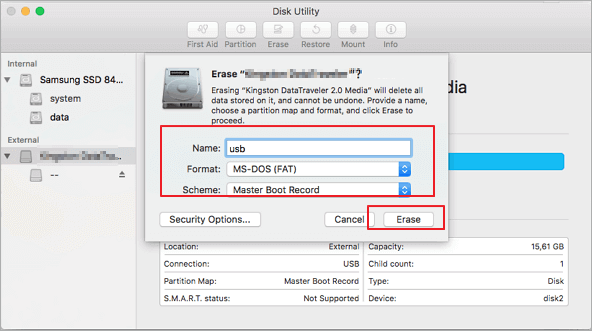
After this, you'll get the desired format on your SD card, which can then be used to install the Raspberry Pi operating system, Raspbian, and store games, photos, and other files on it.
Conclusion
The best format for SD cards using Raspberry Pi was discussed on this page, along with the easiest solutions to format SD cards for Raspberry Pi on both Windows and Mac.
For Windows users, Qiling Partition Master is a convenient option for formatting an SD card, making the process a few clicks easy. Meanwhile, for Mac users, Disk Utility is a more suitable choice than Terminal for formatting the SD card.
FAQs about Format SD Card for Raspberry Pi
If you have further doubts about Raspberry Pi or formatting an SD card, you can find answers below. There's a wealth of information on the Raspberry Pi website and community forums that can help address any questions or concerns you may have.
1. Can I set Raspberry Pi SD card format as exFAT?
If the SD card has a storage capacity of 64GB or larger, it's best to set it to exFAT for use with Raspberry Pi, but if it's 32GB or smaller, FAT32 is more suitable.
2. How do I Prepare my SD Card for Raspberry Pi?
First, back up SD card data to another location.
Second, format the SD card and clear all existing files.
To set a suitable format to the SD Card, you should choose a format that matches the size of your SD Card. For SD Cards with a size of 64GB or larger, exFAT is the recommended format.
3. Is there a Raspberry Pi format tool?
You can format an SD card for a Raspberry Pi using tools like Qiling Partition Master or File Explorer on Windows, or Disk Utility on a Mac.
You can also mount and format the SD card in Raspberry Pi settings.
Related Articles
- How to Stop Disk Check (CHKDSK) on Startup Windows 10
- Logical vs Primary | What's the Difference and Which Is Better
- How to Perform Diskpart Quick Format in Windows [Easy & Efficient Ways]
- Troubleshooting: Why Can't I Format My USB Drive as FAT32 [2022 Guide]
- Solved - "Virtual Disk Service Error: The Volume Size Is Too Big"
Received the virtual disk service error: the volume size is too big when formatting a hard drive beyond 32 GB using Diskpart? Here comes the best solution. - Wipe Hard Drive in Windows 7 from Command Prompt Completely
Want to know how to wipe a hard drive in Windows 7/XP/10 from command prompt? This page illustrates different ways of wiping hard drive for different purposes.
Products
Articles & Tutorials
- Data Recovery
- Data Backup
- File Recovery
- File Backup
- System Backup and Restore
- Disk and Partition Clone
- Technical articles
- Mobile articles
- Disk Master Help
- Windows Data Recovery Tutorials
- Windows Secure Delete Tutorials
- Windows Partition Management Tutorials
- Windows File Backup and Restore Tutorials
- Windows System Backup and Restore Tutorials
- Windows Disk Backup and Restore Tutorials
- Windows Clone Tutorials