Should You Put the Page File on a RAM Disk? (Short Answer: No)
It sounds like a neat trick. Windows uses the page file as extra memory when RAM runs out, so why not put it on a RAM disk and make that swap space lightning fast? The problem is that a RAM disk is made of the very memory you are trying to extend, so the two ideas cancel each other out. There are also better ways to use a RAM disk, and better ways to speed up a drive that is struggling.
This guide explains what the page file actually does, why hosting it in RAM usually backfires, the narrow cases where enthusiasts still do it, and what to move to a RAM disk instead.
PAGE CONTENT
- What the Page File Actually Does
- Why a RAM Disk Page File Backfires
- The Narrow Cases Where It Can Help
- What You Should Put on a RAM Disk Instead
- If You Still Want to Try It
- A Better Fix for a Slow System Drive
- FAQs About Page Files and RAM Disks
- Back Up Windows Before You Change Settings
What the Page File Actually Does
Windows keeps active data in RAM. When memory gets tight, it moves pages that have not been used recently out to the page file on disk and brings them back when they are needed again. The page file also backs a few things that must exist on disk, such as crash dump data used for troubleshooting a blue screen.
Two points matter for this discussion:
- The page file is a fallback, not a speed feature. Reading a page back from disk is always slower than keeping it in RAM. Its purpose is to prevent out-of-memory failures, not to make the PC faster.
- Windows expects the page file to be on persistent storage. Crash dumps and some diagnostic features assume it survives a reboot, and system-managed sizing works best on a real volume.
Why a RAM Disk Page File Backfires
A RAM disk takes memory away from Windows and presents it as a drive. If you then place the page file on that drive, you have created a loop:
- You are using RAM to fake disk space. A 4 GB RAM disk removes 4 GB from the pool Windows can use for running programs. Putting the page file there does not add memory, it just relabels it.
- You make memory pressure worse. The system now has less usable RAM, so it needs the page file sooner, while the page file itself is smaller than a real one would be because it lives on a small RAM disk.
- Nothing survives. The page file disappears at every shutdown. Some applications and diagnostic features expect a page file to be present and persistent, and the system may warn that no page file exists.
- You lose crash information. Without a page file on a real disk, Windows cannot write a memory dump, which makes troubleshooting a blue screen much harder.
- Note
- If a PC is slow because it is short of memory, the answer is more RAM or fewer running programs, not a page file in a RAM disk. Adding memory to the machine solves the problem; moving the page file around does not.
The Narrow Cases Where It Can Help
There is one historical situation where the idea made sense. On 32-bit versions of Windows, the operating system could only address about 3.2 GB of RAM, so if a machine had 8 GB installed, most of it was unusable. A RAM disk could reclaim that unreachable memory and put it to work. Even then, the usual destination was the TEMP folder and browser cache, not the page file.
On a modern 64-bit Windows 11 PC, every gigabyte of RAM is addressable, so that argument disappears. The remaining cases are experimental setups, test labs, and virtual machines where you deliberately want to observe swap behavior, or systems with an unusual amount of memory where a fixed, small page file is wanted for a specific workload. For a normal desktop or laptop, there is no real benefit.
What You Should Put on a RAM Disk Instead
A RAM disk is genuinely useful, just not for the page file. The best candidates are files that are temporary, frequently rewritten, and safe to lose at shutdown:
- Browser cache — speeds up page loads and keeps constant cache writes off your SSD. See Move Browser Cache to a RAM Disk.
- The Windows TEMP folder — installers, extractors, and editors write scratch files there constantly. See Move the TEMP Folder to a RAM Disk.
- Application scratch space — for example the Photoshop scratch disk, where large temporary data is produced and discarded. See Use a RAM Disk as a Photoshop Scratch Disk.
- Compiler and build temp files — short-lived output that never needs to survive a reboot.
Qiling Disk Master creates the RAM disk in a few clicks, and it remounts automatically at every startup so these paths are always available:
If You Still Want to Try It
If you want to experiment anyway, do it safely, and treat it as a test rather than a permanent setup.
Step 1. Back up your system first, because an incorrect page file configuration can cause application crashes that are hard to diagnose.
Step 2. Create the RAM disk with Qiling Disk Master from the Tools and Utilities page and give it a drive letter such as R:.
Step 3. Open sysdm.cpl, go to Advanced > Performance > Settings > Advanced > Virtual memory, and turn off automatic management.
Step 4. Set a page file on the RAM disk if you want to test it, but keep a small page file on your system SSD as well so the system always has one available for crash dumps and updates.
Step 5. Restart and watch memory usage in Task Manager for a few days. If the system shows more paging activity, lower free memory, or unstable apps, remove the RAM disk page file immediately.
A Better Fix for a Slow System Drive
Most people who consider a RAM disk page file are really trying to solve a different problem: the disk itself is slow. If the page file is being used heavily, the drive is asked to perform many small random reads and writes, which is exactly the pattern a hard drive handles worst.
Two fixes work better than moving the page file:
- Add memory. If Windows is paging constantly, more RAM removes the cause instead of hiding the symptom.
- Make the drive faster. Qiling Fast Cache caches the hot blocks of a slow drive in spare RAM and on a spare SSD, which speeds up everything that touches the disk, including paging traffic.
Step 1. Download and install Qiling Fast Cache.
Step 2. Open the program, click the + button, and select the drive that holds Windows and the page file.
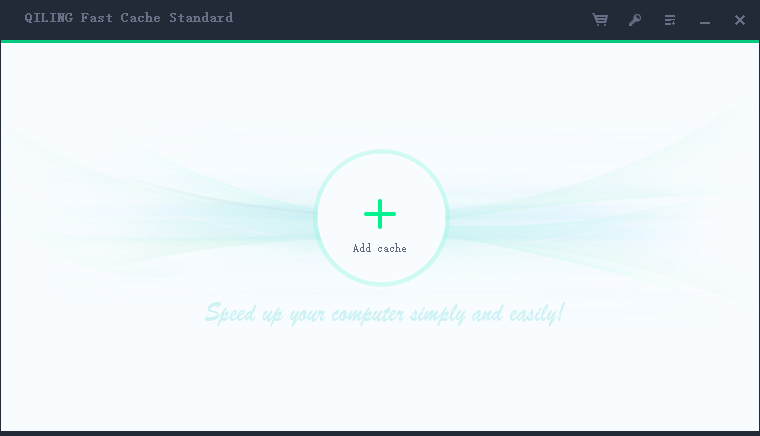
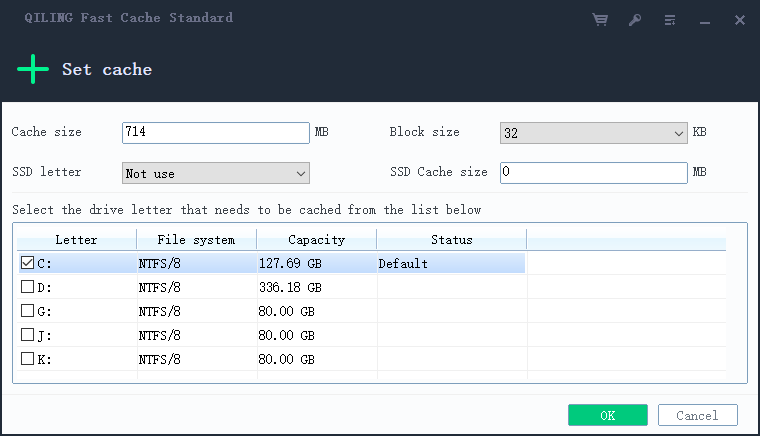
Step 3. Set the RAM tier, and add the SSD tier if you have a spare SSD, then click OK.
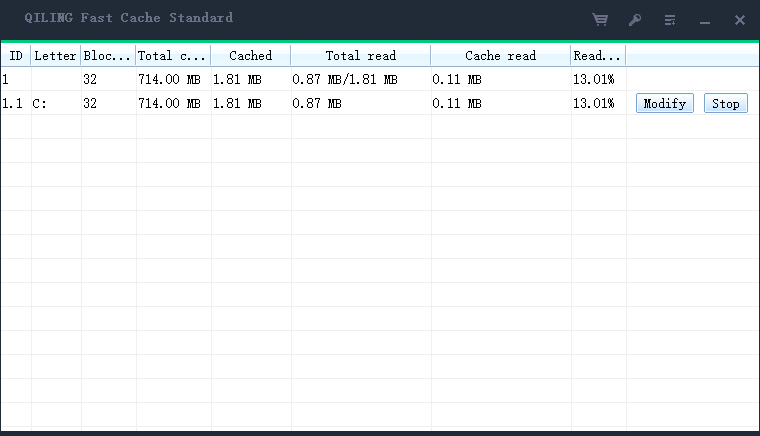
Step 4. Leave the page file where it is and let the cache absorb the repeated disk traffic. The statistics window shows the hit rate as the cache warms up.
FAQs About Page Files and RAM Disks
Can the page file be on a RAM disk at all?
Technically yes. Windows accepts a page file on any writable volume, including a RAM disk, but the practice is not recommended because it consumes the memory it is supposed to supplement and disappears at shutdown.
Is it safe to disable the page file completely?
No. Some applications commit memory they never actually use, and they can fail if no page file exists. Crash dumps also need one. If you have plenty of RAM, a small fixed page file on the system SSD is the sensible compromise.
Should the page file be on an SSD or an HDD?
An SSD is better, because paging is random I/O and SSDs handle it far faster. The extra writes are modest on a modern drive and are counted in its endurance rating.
Will a RAM disk page file make games smoother?
No. Games that need more memory than the PC has will still be limited by memory, and a RAM disk only reduces the total available. Fixing stutter usually means more RAM, updated drivers, or faster storage.
What is the best use of a RAM disk?
Temporary, rewritable data: browser cache, the TEMP folder, scratch files, and build output. Those benefit from the speed and disappear cleanly at shutdown.
Can I cache the page file drive instead?
Yes, and it is the practical approach. Cache the system drive with Qiling Fast Cache so the page file's traffic is served from RAM or SSD when possible, while keeping the page file on real storage where Windows expects it.
Back Up Windows Before You Change Settings
Changing virtual memory settings can cause problems if something goes wrong, so create a full system image first. Qiling Disk Master can restore Windows exactly as it was if the change does not work out.
Part 1: Create a Full System Backup
Step 1. Install and open Qiling Disk Master. On the home screen, open "Backup and Recovery" and choose "System Backup". This option automatically includes Windows and the hidden boot partitions, so you do not have to select them one by one.
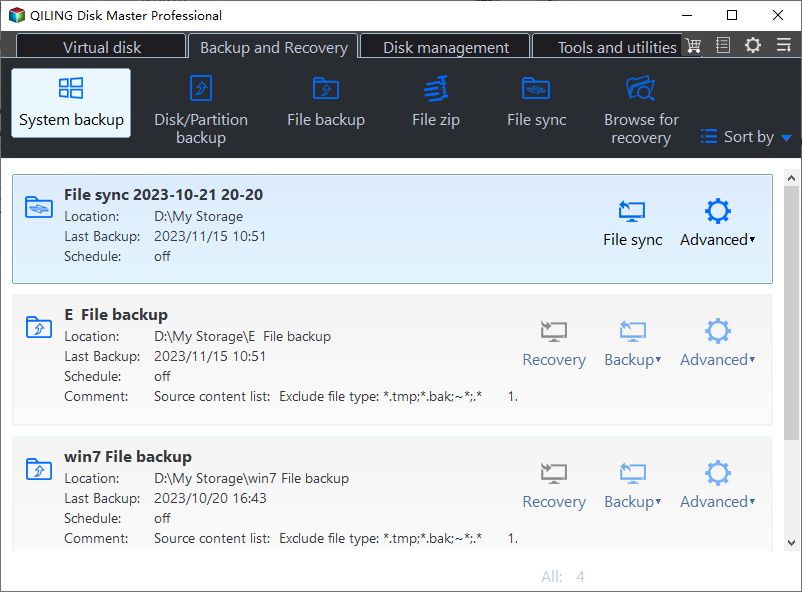
Step 2. Check the source. The disk where Windows is installed and its system partitions are already ticked for you. If you only need your personal documents, run a separate "File Backup" task instead.

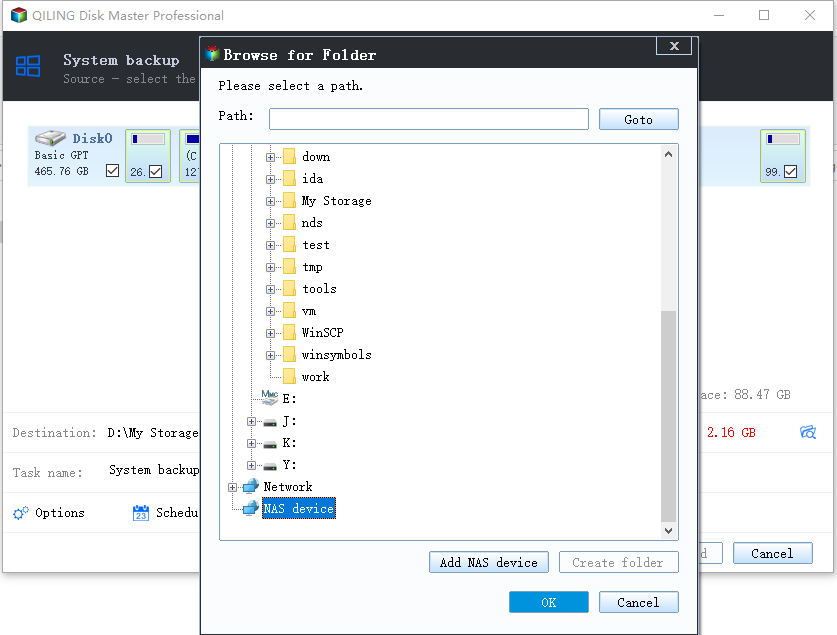
Step 3. Click the destination box and choose where the image should be saved. Use an external HDD or SSD, a NAS, or any drive other than the one Windows is installed on, and make sure it has enough free space.
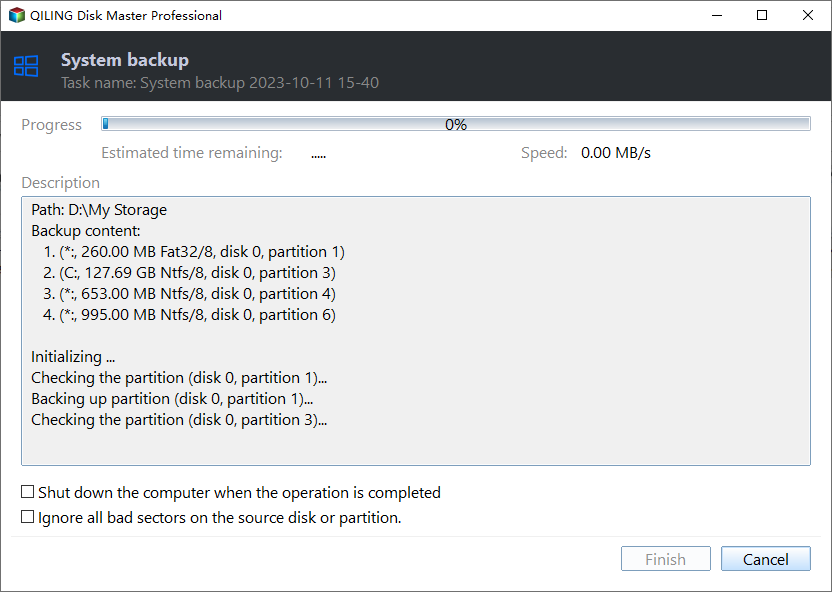
Step 4. Review the task summary and click "Proceed". Wait until the progress bar reaches 100%. Do not unplug the drive or turn off the PC while the backup is running.
Part 2: Restore Windows from the Backup
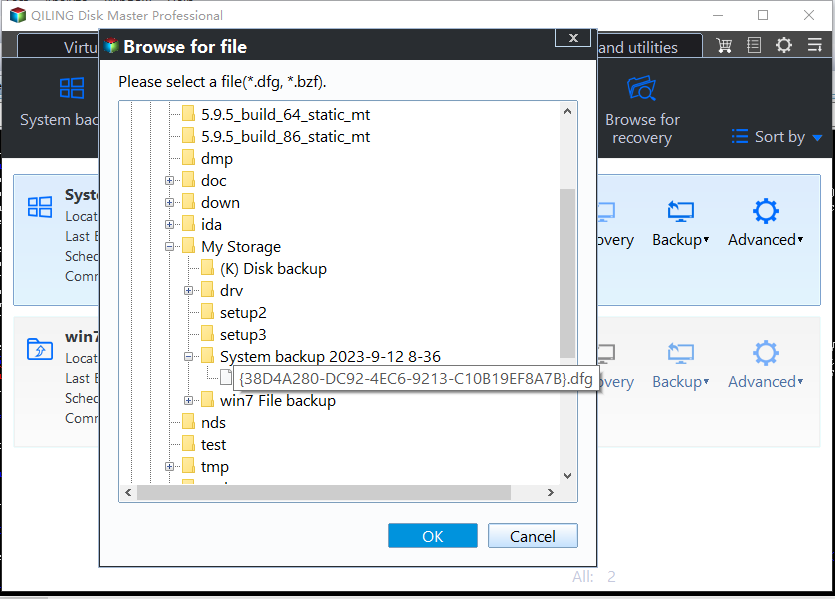
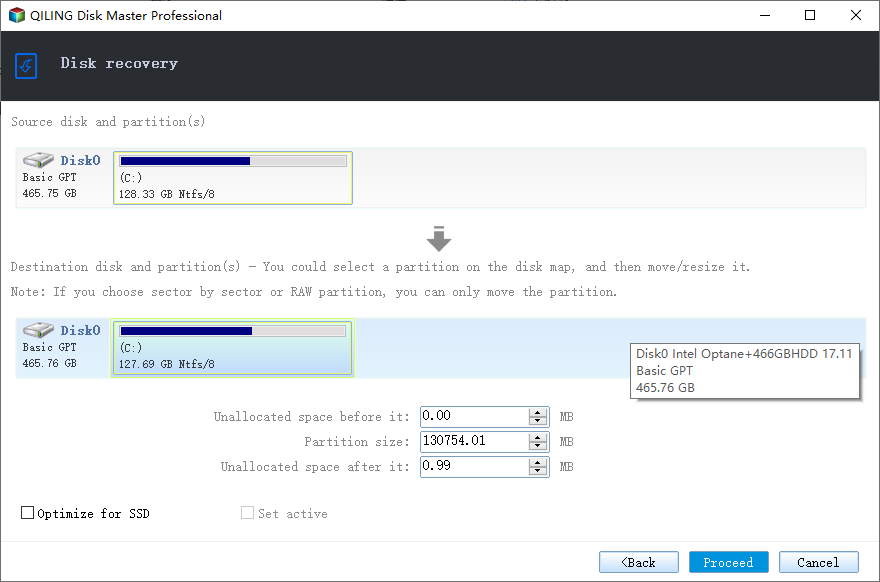
Step 1. Open Qiling Disk Master again, go to "Backup and Recovery", and select the recovery option. Your backup images are listed, so pick the one you created before the changes began.
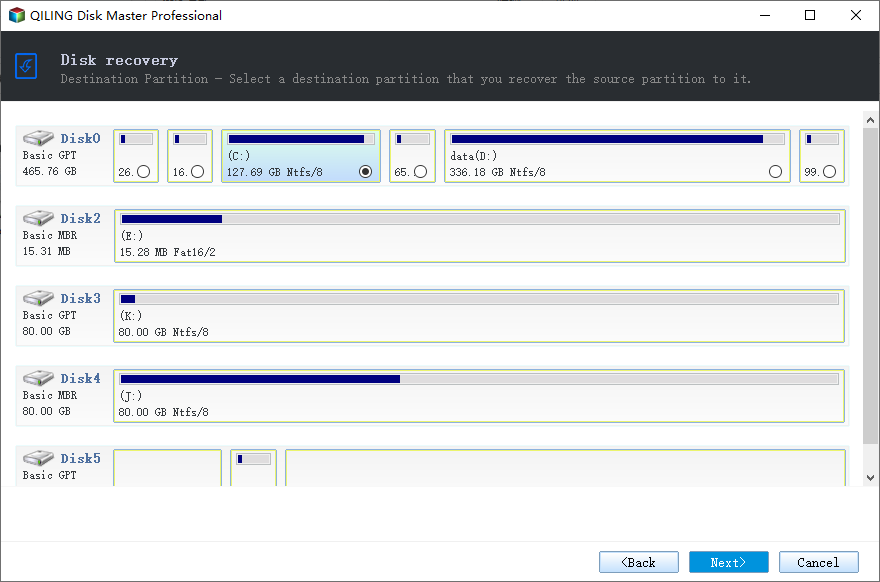
Step 2. Choose the target disk or partition. Normally you restore to the original system disk. If the drive was replaced, select the new disk instead, and the restore rebuilds Windows together with its boot partitions.
Step 3. Preview the restore plan, click "Proceed", and confirm the warning. The PC restarts to finish the job, and Windows comes back exactly as it was on the day the image was created, with your files and programs intact.
- Note
- Keep the backup image on a separate drive, and refresh it before changing virtual memory or storage settings.
Conclusion
Putting the page file on a RAM disk is one of those ideas that looks smart and behaves badly. The RAM disk is built from the memory the page file is meant to supplement, so the machine ends up with less usable RAM, a smaller swap area, and no crash dump when you need one. Leave the page file on your system SSD, where Windows manages it and diagnostics expect it, and give the RAM disk the jobs it is good at: browser cache, the TEMP folder, and scratch files. If the real problem is a slow drive, let Qiling Fast Cache accelerate it with spare RAM and a spare SSD instead of rearranging the page file.
Protect your PC with Qiling Backup—create a system image before your next round of settings changes.
For more Windows 11 performance guides, see How to Create a RAM Disk in Windows 11, Windows 11 Fast Cache, How to Use Extra RAM to Speed Up Your PC, Move the TEMP Folder to a RAM Disk, and What Is Cache Warm-Up?.
Related Articles
- How to Create a RAM Disk in Windows 11: Step-by-Step Guide
See what a RAM disk is good for before you commit memory to one. - How to Use Extra RAM (16GB/32GB) to Speed Up Your PC
Put spare memory to work in ways that actually help performance. - Move the TEMP Folder to a RAM Disk
- Windows 11 Fast Cache: Speed Up HDD with RAM and SSD Cache
- SSD Cache vs RAM Disk: Which Speeds Up Windows 11 More?
Products
Articles & Tutorials
- Data Recovery
- Data Backup
- File Recovery
- File Backup
- System Backup and Restore
- Disk and Partition Clone
- Technical articles
- Mobile articles
- Disk Master Help
- Windows Data Recovery Tutorials
- Windows Secure Delete Tutorials
- Windows Partition Management Tutorials
- Windows File Backup and Restore Tutorials
- Windows System Backup and Restore Tutorials
- Windows Disk Backup and Restore Tutorials
- Windows Clone Tutorials