Best 8 Windows Temperature Monitor Software Free Download
Software utilities can monitor CPU metrics like temperature, voltage, fan speed, battery life, and more, providing data to take preventative measures to protect the CPU.
Keeping an eye on your computer's internal temperature is crucial, especially if your disc runs hot, as overheating can cause it to fail. To monitor your CPU temperature, you can use one of the 8 Windows temperature monitor software options available, allowing you to stay informed and take necessary precautions to prevent damage.
Why Do We Need Windows Temperature Monitor
To ensure optimal performance and longevity, monitoring the disk's temperature is crucial. The disc functions best within a specific average temperature range. If the Windows temperature exceeds this range, the computer may experience various issues, including but not limited to, decreased performance, system crashes, and potential hardware damage. Maintaining a healthy temperature range is essential for a smooth and efficient computing experience.
- Temperatures lower than 25 degrees Celsius are uncomfortably low.
- Twenty-five to forty degrees centigrade is ideal.
- 41°C to 50°C is within an acceptable range.
- As the temperature rises above 50 degrees Celsius, it becomes too warm.
High temperatures on your hard drive can cause a range of issues, including.
- Boisterous fans
- Strangely hot surfaces, sudden power loss
- Frustratingly Slow File Access Time
- Data corruption; files won't open
- Disk use at 100% on a computer
- Continued reports of a bad sector in the disc drive
To prevent overheating, ensure good airflow around the hard drive by keeping it away from other components and dust. Regularly clean dust from the drive and its surroundings. Check the drive's temperature and adjust its placement accordingly.
You May Also Like:
Top 8 Windows Temperature Monitor Software [Pros & Cons]
To keep your CPU at a safe temperature, we've selected the top 8 CPU temp monitors available today, providing you with the necessary tools to monitor and maintain a healthy CPU environment.
- 1. Qiling Disk Master
- 2. Core Temp
- 3. HWMonitor
- 4. Speed Fan
- 5. Open Hardware Monitor
- 6. AIDA64 Extreme
- 7. HWiNFO
- 8. NZXT CAM
Let's compare the two options and choose the one that's best for our computer by weighing their pros and cons.
1. Qiling Disk Master
The easiest way to keep tabs on your hard drive's temperature in Windows 10, 8, or any other Windows version is with Qiling Disk Master. This potent tool allows you to test its functionality and monitoring capabilities with just a few clicks, providing real-time data on hard drive temperature to aid in problem-solving.
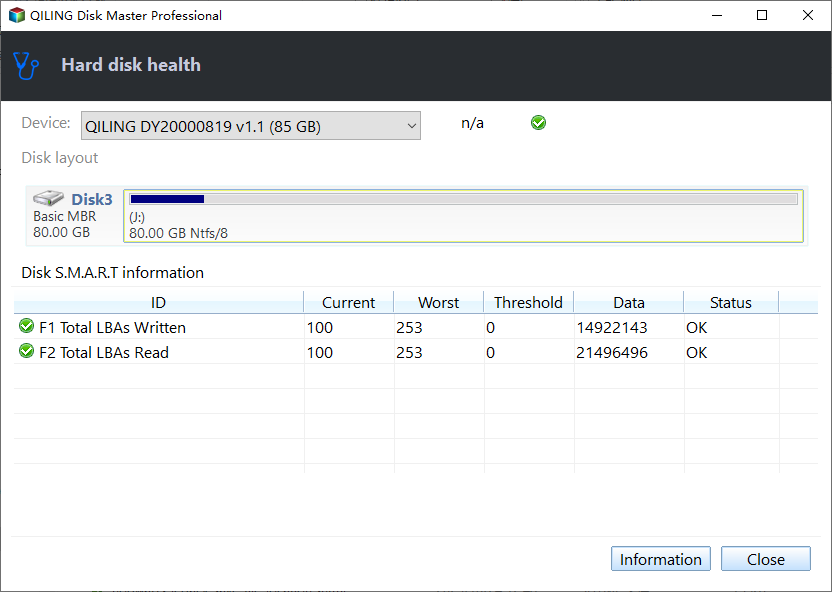
If you want an up-To get a current temperature report for your hard drive, you can click on this link to launch the software, and then select the drive you want to check. This will provide you with an up-to-date reading of the temperature of your hard drive.
| Pros | Cons |
|---|---|
|
|
Download button:
Qiling Disk Master is a reliable tool that can check SSD/HDD health and temperature, and run disk I/O tests on Windows, making it a valuable addition to your system maintenance toolkit.
2. Core Temp
Core Temp is a simple and lightweight CPU temperature monitor that's ideal for those who don't need a full-featured hardware monitoring suite. It displays the current temperature and load of each core of your Intel processor separately, allowing you to keep tabs on your CPU's performance in real-time.
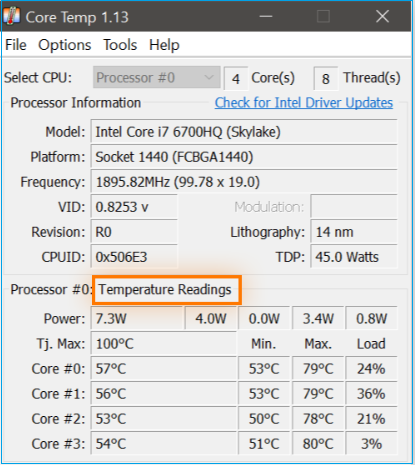
The software identifies the CPU's processor, socket, and lithography, and also provides data on the current operating frequency, power consumption, and core voltage.
| Pros | Cons |
|---|---|
|
|
Download Link: www.alcpu.com/CoreTemp/
3. HWMonitor
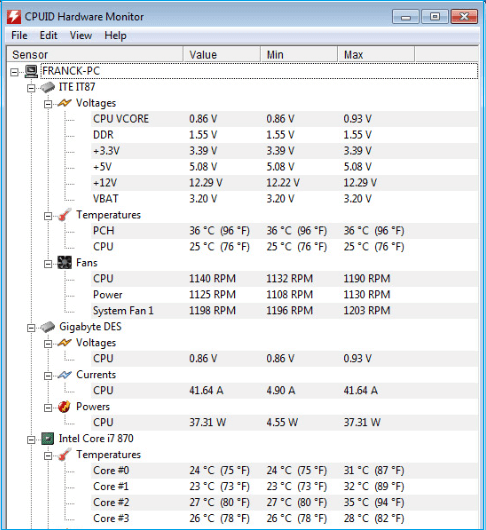
HWMonitor is a monitoring application that goes beyond just tracking CPU performance. It displays a wide range of system information, including CPU temperature, core voltage, operating frequency, and load, as well as GPU, fan, and storage device data. If you're looking for a CPU temp monitor that offers more than just temperature readings, HWMonitor is definitely worth considering.
| Pros | Cons |
|---|---|
|
|
Download Link: www.cpuid.com/softwares/hwmonitor.html
4. Speed Fan
Speed Fan is another CPU temperature monitoring application worth considering. It displays real-time data on your computer's processor and other components, similar to other alternatives. However, Speed Fan stands out by allowing you to adjust the fan's velocity directly within the program.
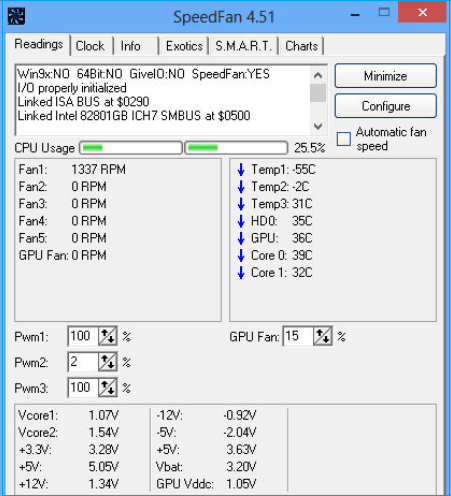
Speed Fan offers flexibility in allowing for personalization, functioning as either a basic hardware monitor with manual fan speed control or a highly configurable software that enables specifying fan speeds and other parameters.
| Pros | Cons |
|---|---|
|
|
Download Link: www.techspot.com/downloads/547-speedfan.html
5. Open Hardware Monitor
Open Hardware Monitor is a lightweight tool that efficiently monitors your computer's CPU and other hardware components, displaying temperatures, voltage, and frequency for the CPU, memory, fans, and GPU.
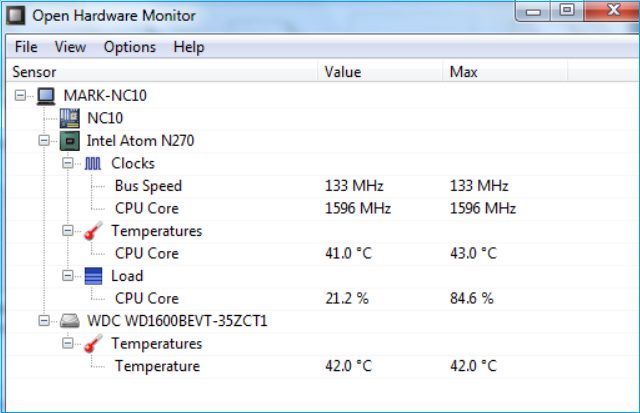
Open Hardware Monitor is a free and open-source monitoring program that provides detailed information about your system's hardware, including temperatures, voltages, and fan speeds. It's a more comprehensive alternative to the built-in Windows Task Manager or the System Monitor in Linux.
| Pros | Cons |
|---|---|
|
|
Download Link: https://openhardwaremonitor.org/downloads/
6. AIDA64 Extreme
The AIDA64 Extreme version, previously touted as free, actually comes with a price tag. However, its versatility makes it worth mentioning, despite our earlier focus on free tools.
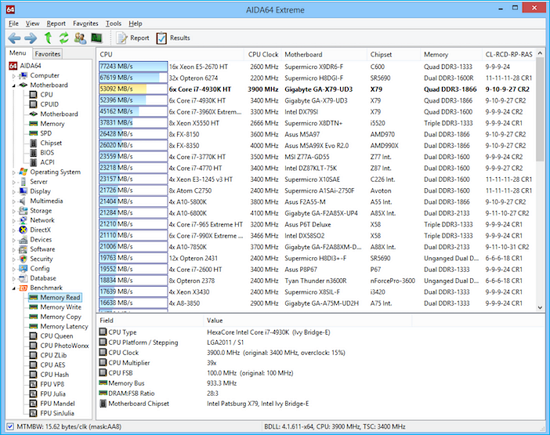
AIDA64 Extreme offers a wide range of features, including hardware monitoring and benchmarking, stress testing, and diagnostics, making it a comprehensive tool for professional system developers. However, for basic tasks like monitoring CPU temperature, the software is unnecessary and a costly option, as there are many free alternatives available.
| Pros | Cons |
|---|---|
|
|
Download Link: www.aida64.com/downloads
7. HWiNFO
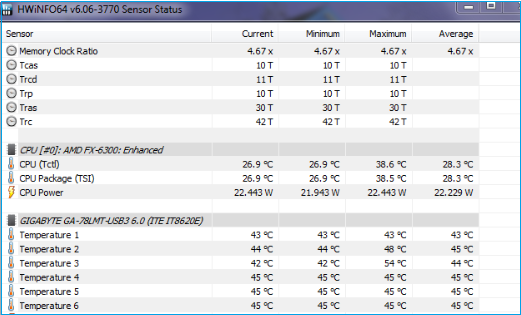
HWiNFO is a powerful monitoring tool that displays real-time temperatures and loads of critical computer components, allowing users to plot data and track system behavior over time. However, its wealth of information may overwhelm newcomers, making it less ideal for those unfamiliar with PC hardware.
| Pros | Cons |
|---|---|
|
|
Download Link: www.hwinfo.com/download/
8. NZXT CAM
You can monitor your gaming PC's CPU temperature using NZXT CAM, an app that lets you control and manage various aspects of your system, including the environment and other gadgets, from a single interface.
With NZXT CAM, you can monitor your computer's performance in real-time, tracking processor status, data usage, and program performance. This allows you to quickly identify issues and optimize system performance.
Super reliable and low-The NZXT CAM in-game overlay allows you to monitor various game performance metrics while gaming, including temps, bandwidth, FPS, and more. It also tracks time played, current FPS, GPU/CPU temperature, battery life, GPU/CPU load, and numerous other metrics.
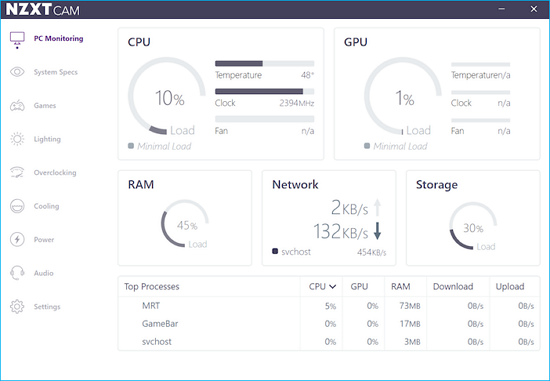
The software provides a user-friendly interface to manage the system's power supply, fans, and illumination, allowing users to monitor their processor's heat output in real-time.
| Pros | Cons |
|---|---|
|
|
Download Link: https://nzxt.com/software/cam
Conclusion
The article highlights 8 top Windows Temperature Monitor software, each with its pros and cons, providing a primer on the best tools to protect your hard drive from extreme heat.
You can obtain current hard disk temperature readings using highly regarded programs such as Qiling Disk Master, which provide real-time results with just one click.
FAQs About Windows Temperature Monitor
If you're still unsure, the FAQs might provide the clarity you need to solidify your understanding.
1. Does Windows 10 have a temperature monitor?
The BIOS/UEFI has an integrated temperature monitor that displays the CPU temperature when you boot into it, and you can access it by pressing a specific key during startup.
2. How do I monitor my CPU temp?
To check CPU temperature, install a CPU heat monitoring tool, such as Qiling Disk Master or the Windows built-in CPU Monitor, and keep an eye out for sudden spikes.
3. Is 27 degrees Celsius hot for a CPU?
Above 27 degrees Celsius, the processor's health starts to decline, and if the temperature reaches 254 Fahrenheit (75 Celsius), the computer will fail. The CPU may frequently overheat, causing it to shut down unexpectedly.
Related Articles
- How to Upload Files to Google Drive Automatically
- How to Reset NVRAM/PRAM on Your MacBook Pro/Air [2023 Fresh Guide]
- How to Backup Gmail Emails to Outlook for Windows 11/10/8/7
- How to Run CHKDSK on SSD [2023 Most Efficient Ways]
- How to Enable and Disable Airplane Mode on Windows
This guide explains what airplane mode is on a laptop and how to turn on or off airplane mode on Windows 10. Keep reading and you will find something useful. - System Service Exception Stop Code 0x0000003B in Windows 10 [10 Fixes]
Your Windows computer ran into an error - SYSTEM_SERVICE_EXCEPTION with code 0x0000003B, this post provides you with 10 effective ways to fix the SYSTEM_SERVICE_EXCEPTION BSOD error.
Products
Articles & Tutorials
- Data Recovery
- Data Backup
- File Recovery
- File Backup
- System Backup and Restore
- Disk and Partition Clone
- Technical articles
- Mobile articles
- Disk Master Help
- Windows Data Recovery Tutorials
- Windows Secure Delete Tutorials
- Windows Partition Management Tutorials
- Windows File Backup and Restore Tutorials
- Windows System Backup and Restore Tutorials
- Windows Disk Backup and Restore Tutorials
- Windows Clone Tutorials