Can You Use an SSD Cache for a NAS or Network Drive?
If caching makes a slow local drive feel fast, it seems obvious that the same trick should work on a NAS. In practice the answer is more specific: your PC cannot cache a network share the way it caches a local disk, because there is no local block device underneath the files. What does work is a set of alternatives, some on the NAS itself and some on your PC, and knowing which is which saves you from buying an SSD that cannot help.
This guide explains why network shares behave differently, what can and cannot be cached, and the four approaches that actually make a NAS feel quicker in Windows 11.
PAGE CONTENT
- Why a Network Drive Is Different
- What Can and Cannot Be Cached
- Option 1: The NAS's Own SSD Cache
- Option 2: Cache the Local Drive That Holds Your Working Files
- Option 3: Fix the Network Bottleneck
- Option 4: Keep Active Projects Local
- FAQs About Caching a NAS
- Back Up Windows Before You Change Settings
Why a Network Drive Is Different
A disk cache works below the file system. It watches read and write requests going to a specific device, keeps copies of the hot blocks on faster storage, and answers later requests from there. That requires the drive to be a real device with addresses the caching layer can see.
A mapped network drive is not that. When you open \\NAS\Photos, Windows sends file-level requests over SMB to another computer, which decides which blocks of which disk to read. Your PC never sees a block device, only a set of files. There is nothing for a local caching layer to intercept.
The consequence is simple: software that caches local volumes cannot accelerate a mapped share, no matter how much spare SSD you give it. The bottleneck moves from the disk to the network and to the NAS itself.
What Can and Cannot Be Cached
| Storage type | Can a local cache help? | Why |
|---|---|---|
| Internal HDD or SSD | Yes | It is a local block device, the ideal cache target |
| External USB or Thunderbolt drive | Yes | Still appears as a local volume |
| Mapped SMB share on a NAS | No | File-level access over the network, no local block device |
| iSCSI LUN from a NAS or SAN | Yes | It is presented as a local disk, so caching layers can see it |
| Cloud storage folder | No | Files are streamed by the sync client, not read from a volume |
The iSCSI row is the interesting one. Because an iSCSI target is presented to Windows as a normal disk, it can be cached like any other drive — a useful detail if you already run a NAS that can export block storage.
Option 1: The NAS's Own SSD Cache
Both major NAS platforms offer SSD caching, and it is the closest thing to what people expect when they ask about caching a NAS.
- Synology supports SSD cache on many models, using one or two NVMe or SATA SSDs as a read cache, or as a read-write cache. Some models require Synology-branded drives for the cache feature.
- QNAP offers SSD caching as well, along with tiering features that move hot data to SSDs and cold data to hard drives automatically.
A few practical points before you buy an SSD for this:
- Read cache is the safe choice. A read-only cache can be lost without losing data, and it accelerates the repeated reads that dominate everyday use.
- Read-write cache needs redundancy. With a single SSD in read-write mode, a cache device failure can take the volume with it. Use a mirrored pair, and make sure the NAS has a UPS.
- Cache size is limited by usefulness. A cache larger than your working set does not add much; matching the SSD to the data you actually reuse is better than buying the biggest drive.
- The network is still the ceiling. On a 1 Gbps link, transfers cap around 110 MB/s. Caching the NAS makes it respond faster, but it cannot exceed the link.
These are NAS-side features configured in the NAS operating system, not in Windows, and they are independent of any caching tool you run on your PC.
Option 2: Cache the Local Drive That Holds Your Working Files
The part of the workflow you can accelerate on your PC is the local one. If you copy projects from the NAS to a local drive to work on them, cache that local drive so the repeated reads are served from fast storage.
Step 1. Download and install Qiling Fast Cache.
Step 2. Open the program and click the + button to create a cache task.
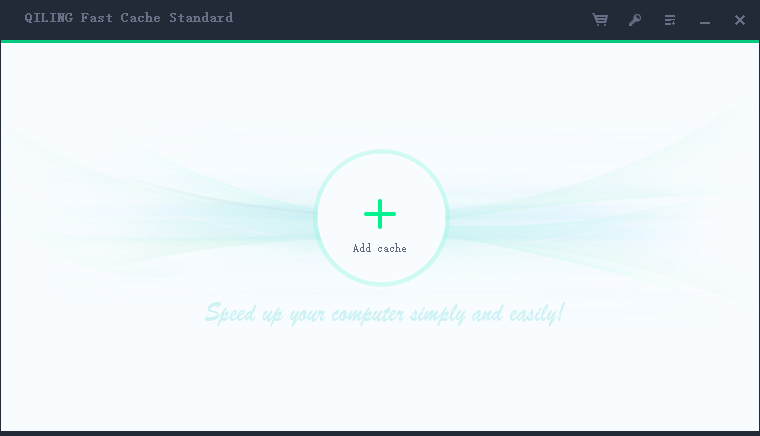
Step 3. Select the local drive that holds your working copies, set the cache size, and add the SSD tier if you have a spare SSD so the cache persists across reboots.
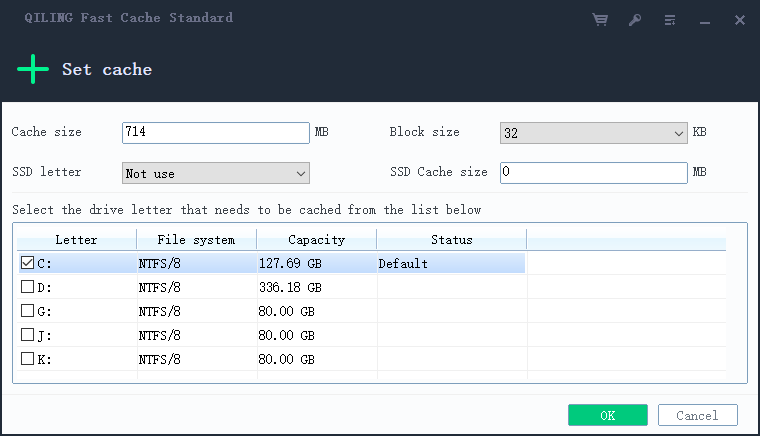
Step 4. Click OK and work as usual. The cache accelerates the repeated reads of project files without touching the NAS or the network.
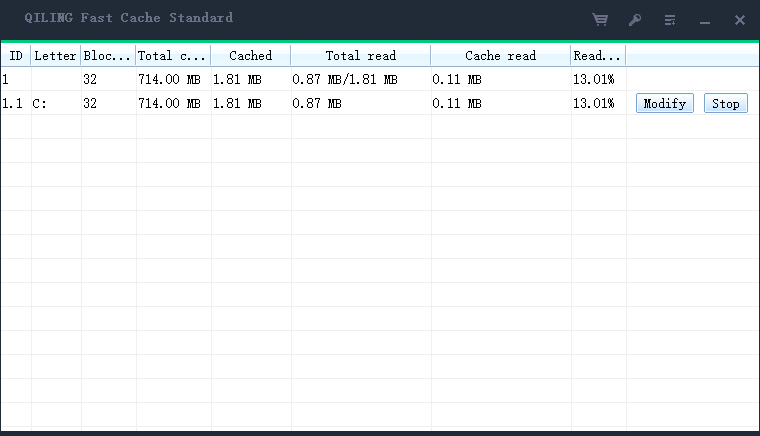
If you also use an external SSD as your working drive, the same approach applies; see Use an SSD Cache for an External Drive.
Option 3: Fix the Network Bottleneck
When a network share is slow, the limit is often the connection rather than the disks in the NAS. Check these in order:
- Confirm the link speed. Open the adapter's status in Windows and look for 1.0 Gbps or higher. A cable or switch that has negotiated 100 Mbps silently caps you near 11 MB/s.
- Use a wired connection for large transfers. Wi-Fi varies with distance and interference, which makes transfers unpredictable.
- Consider 2.5 GbE or 10 GbE. A single 1 Gbps link limits you to roughly 110 MB/s. Faster networking is often a bigger upgrade than a cache.
- Enable SMB Multichannel if both the PC and NAS support it, so multiple network connections are used together.
- Keep large sequential transfers and small random requests from competing. A backup running in the background will make browsing the same NAS feel sluggish.
Option 4: Keep Active Projects Local
The most reliable way to make NAS-based work feel fast is not to work off the NAS at all for the files you touch constantly:
- Keep active projects on a local SSD, then copy finished work to the NAS for storage and sharing.
- Use the NAS for archives, media libraries, and backups, where sequential throughput matters more than latency.
- Do not browse network folders in large-icon or thumbnail view. Each preview costs a network round trip, which is why NAS browsing feels so much slower than local browsing.
- Keep a backup of anything you move off the NAS. Qiling Disk Master can image the local drive that holds your working files, and if you want the NAS copy protected as well, see How to Back Up Windows 11 to a NAS and NAS to NAS Backup.
FAQs About Caching a NAS
Can Qiling Fast Cache speed up a mapped network drive?
No. It caches local volumes, and a mapped share is not a local volume. Cache the local drive that holds your working copies instead.
Can I cache an iSCSI drive from my NAS?
Yes. An iSCSI LUN is presented to Windows as a local disk, so it appears as a normal cache target. Performance still depends on the network and the NAS behind it.
Does an SSD cache in the NAS make browsing faster?
It can, because it accelerates the repeated reads the NAS performs. It does not raise your network ceiling, so large sequential transfers are unchanged.
Is read-write SSD cache risky on a NAS?
With a single SSD, yes: if the cache device fails, unwritten data and sometimes the volume can be damaged. Use a mirrored pair of SSDs and a UPS if you enable read-write caching.
Would a RAM disk help with NAS work?
Only for the local side. A RAM disk can hold temporary files your apps create while working with NAS content, but it cannot cache the share itself. See Is a RAM Disk Worth It?.
What is the single best upgrade for a slow NAS workflow?
Faster networking, or keeping active projects on a local SSD. Both address the real bottleneck, which is usually the link or the latency of remote access rather than the drives inside the NAS.
Back Up Windows Before You Change Settings
Changing storage or network settings is low risk, but a backup protects your system and your working files. Qiling Disk Master creates a full Windows image you can restore from if anything goes wrong.
Part 1: Create a Full System Backup
Step 1. Install and open Qiling Disk Master. On the home screen, open "Backup and Recovery" and choose "System Backup". This option automatically includes Windows and the hidden boot partitions, so you do not have to select them one by one.
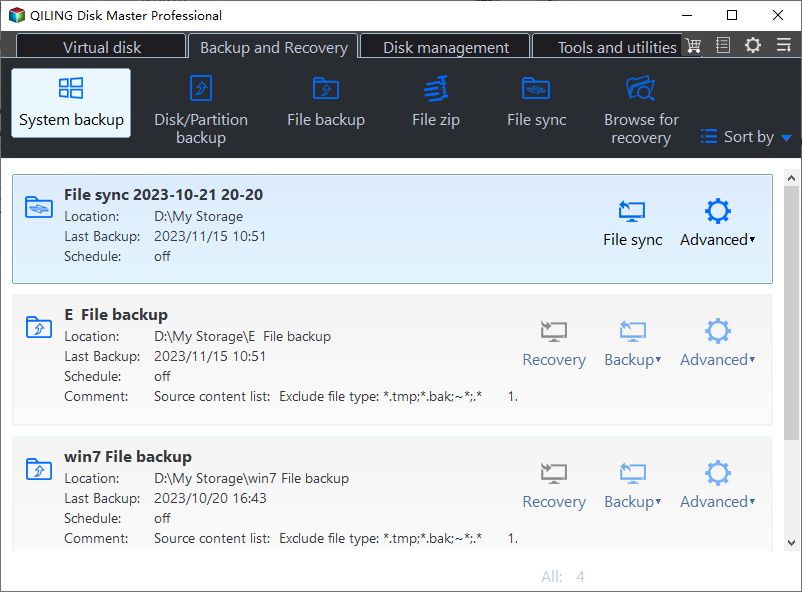
Step 2. Check the source. The disk where Windows is installed and its system partitions are already ticked for you. If you only need your personal documents, run a separate "File Backup" task instead.

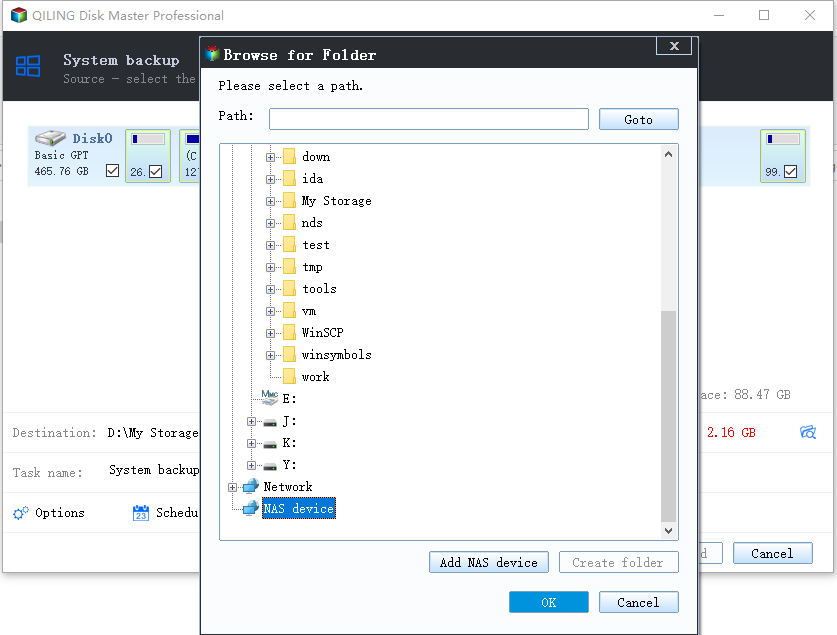
Step 3. Click the destination box and choose where the image should be saved. Use an external HDD or SSD, a NAS, or any drive other than the one Windows is installed on, and make sure it has enough free space.
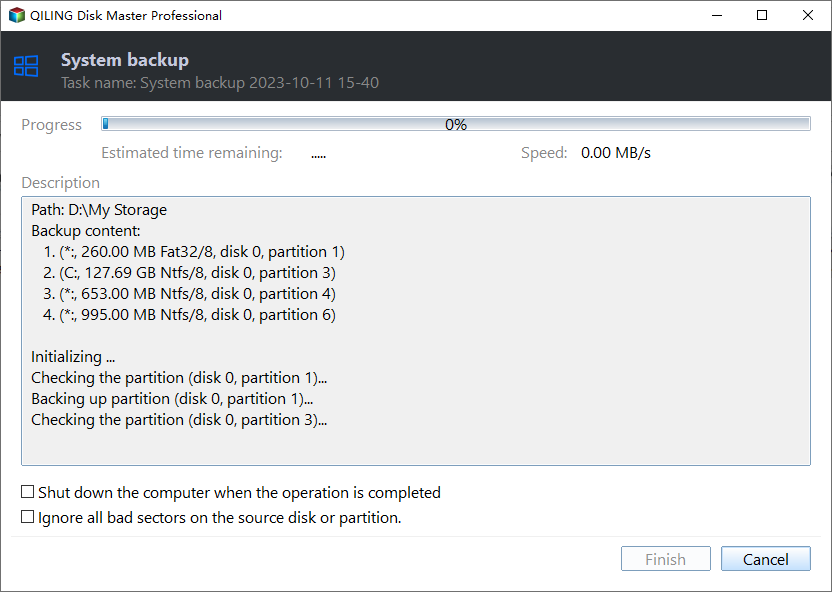
Step 4. Review the task summary and click "Proceed". Wait until the progress bar reaches 100%. Do not unplug the drive or turn off the PC while the backup is running.
Part 2: Restore Windows from the Backup
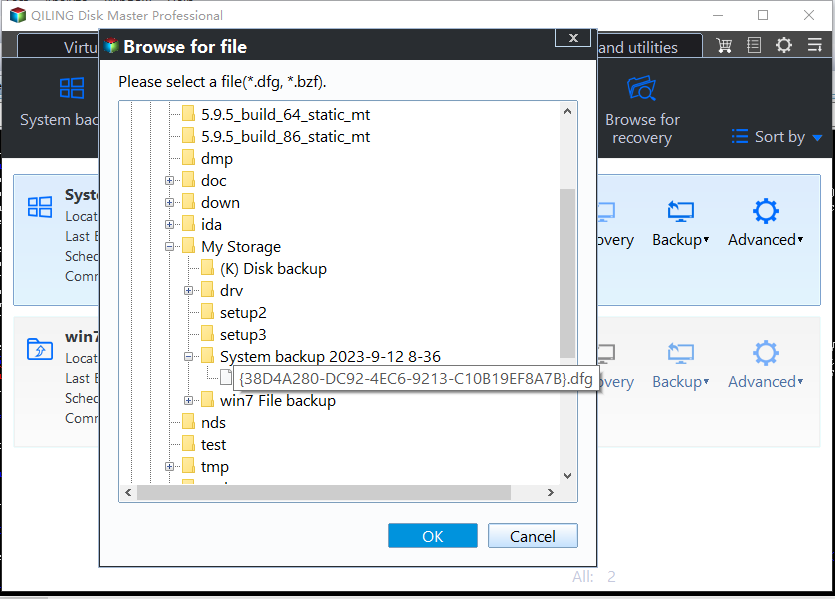
Step 1. Open Qiling Disk Master again, go to "Backup and Recovery", and select the recovery option. Your backup images are listed, so pick the one you created before the changes began.
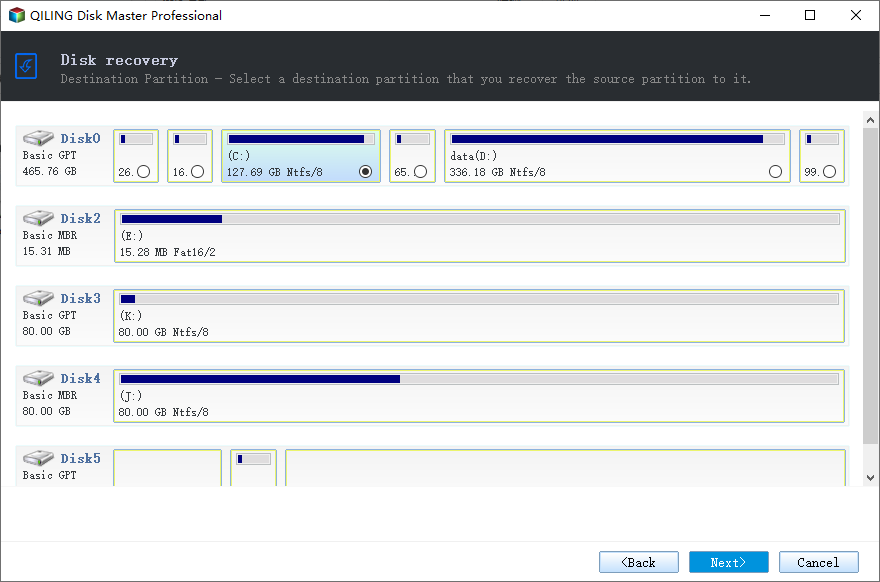
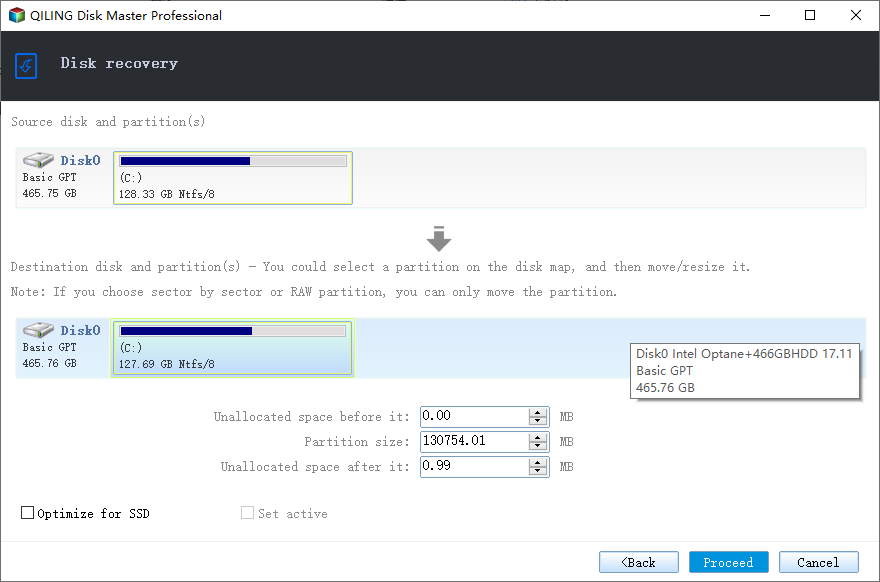
Step 2. Choose the target disk or partition. Normally you restore to the original system disk. If the drive was replaced, select the new disk instead, and the restore rebuilds Windows together with its boot partitions.
Step 3. Preview the restore plan, click "Proceed", and confirm the warning. The PC restarts to finish the job, and Windows comes back exactly as it was on the day the image was created, with your files and programs intact.
- Note
- Keep the backup image on a separate drive or on the NAS itself, and refresh it before changing storage or network settings.
Conclusion
You cannot cache a mapped network share from your PC, because a share is not a local block device — but that does not leave you without options. Use the NAS's own SSD cache for read acceleration inside the NAS, cache the local drive that holds your working copies with Qiling Fast Cache, check whether your network link is the real limit, and keep active projects on local storage while the NAS holds archives and backups. If your NAS offers iSCSI, remember that those LUNs appear as local disks and can be cached normally. Match the fix to the bottleneck and you will get more from a modest SSD than from any single purchase.
Protect your PC with Qiling Backup—create a system image before your next round of settings changes.
For more Windows 11 performance guides, see Use an SSD Cache for an External Drive, Windows 11 Fast Cache, What Are L1 and L2 Cache?, SSD Cache vs RAM Disk, and Cache vs Buffer.
Related Articles
- How to Use an SSD Cache for an External Hard Drive
The local-storage version of the caching described here. - What Is a NAS? Storage Explained
Background on how a NAS presents files over the network. - How to Back Up Windows 11 to a NAS
- How to Speed Up a Plex Media Server with a Disk Cache
- Does a Disk Cache Work on iSCSI and Network Storage?
- How Cloud Sync Clients Use Your Disk and Cache
Products
Articles & Tutorials
- Data Recovery
- Data Backup
- File Recovery
- File Backup
- System Backup and Restore
- Disk and Partition Clone
- Technical articles
- Mobile articles
- Disk Master Help
- Windows Data Recovery Tutorials
- Windows Secure Delete Tutorials
- Windows Partition Management Tutorials
- Windows File Backup and Restore Tutorials
- Windows System Backup and Restore Tutorials
- Windows Disk Backup and Restore Tutorials
- Windows Clone Tutorials