Samsung T7 vs. T9: Which SSD to Choose?
- 📚Key Takaways
- ✅The Samsung T7 SSD offers excellent value for its price, providing good gaming performance without excessive concern about latency. With a compact size of 85mm in length, 57mm in breadth, and 8mm thickness, it's a great choice for those on a budget.
- ✅Users can see monumental reading and writing speeds for the T9, almost double that of the T7, making them suitable for gaming, work, and processing large files.
- ✅Qiling Disk Copy Samsung's SSD cloning tool, , is an excellent and reliable tool that enables you to migrate data to your Samsung T7/T9 SSD without losing any data.
Free Download this awesome SSD cloning software to safely and easily migrate data to Samsung T7/T9 SSD without any loss.
Samsung is expanding its presence in the tech industry, following in the footsteps of Apple. Having made significant strides in mobiles, tablets, laptops, and other areas, Samsung is now entering the SSD market, aiming to take on established players like Apple, Microsoft, and Google. With a focus on improving technology and increasing speeds, Samsung is positioning itself to be a major player in the industry.
The Samsung T7 and T9 SSDs have made significant strides in recent times, offering users a range of options for upgrading their laptop's storage drive. With numerous models available, it can be overwhelming to determine which one is best suited for individual needs. This comparison aims to provide clarity, pitting the Samsung T7 against the T9 to help readers make an informed decision.
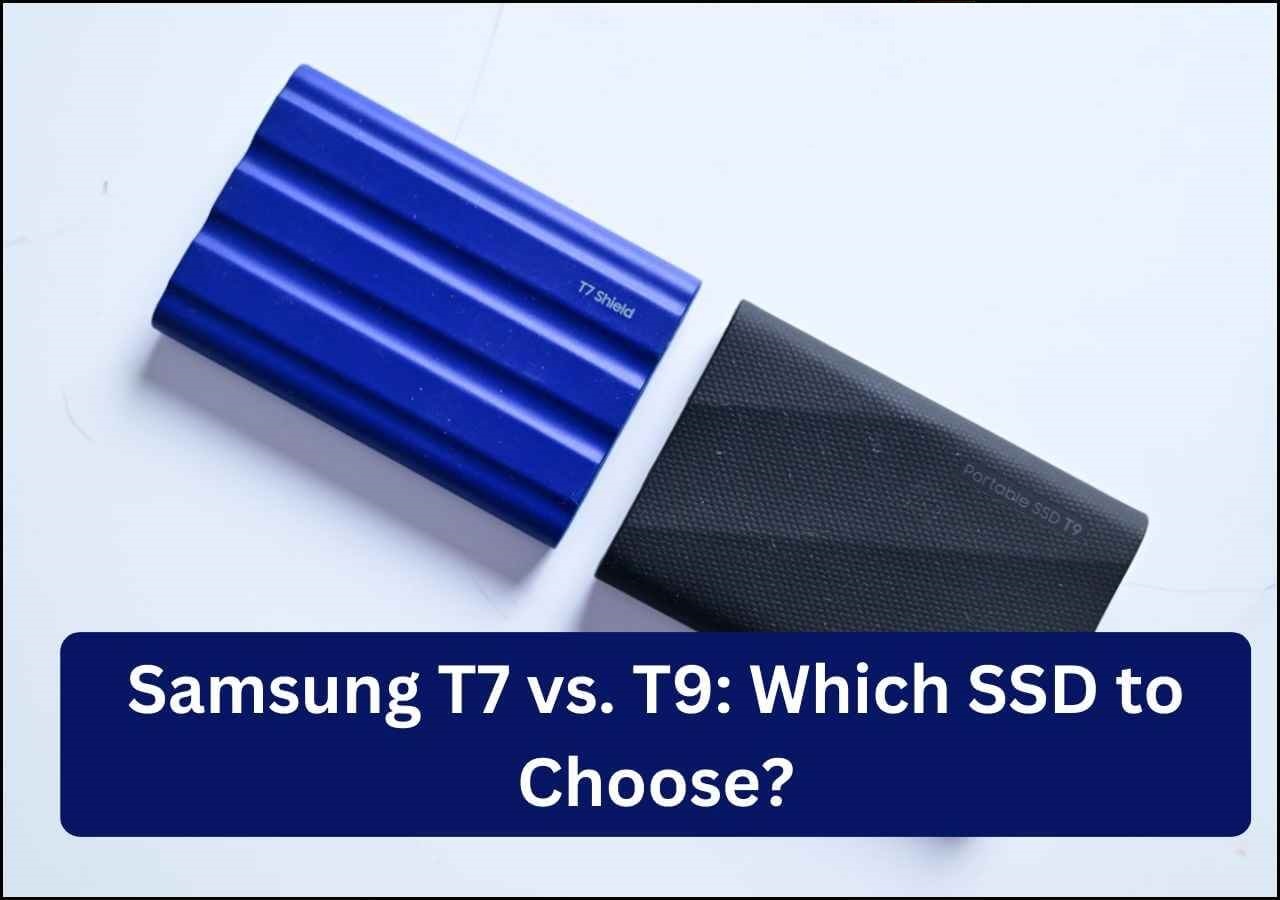
Samsung T7 vs. T9: Specification, Feature, Price, Storage
Samsung's SSDs have gained significant traction since their introduction in 2006, with the compact and portable T models being particularly popular. Before buying an SSD, it's essential to consider the key factors of the Samsung T7 and T9, which are crucial in making an informed decision.
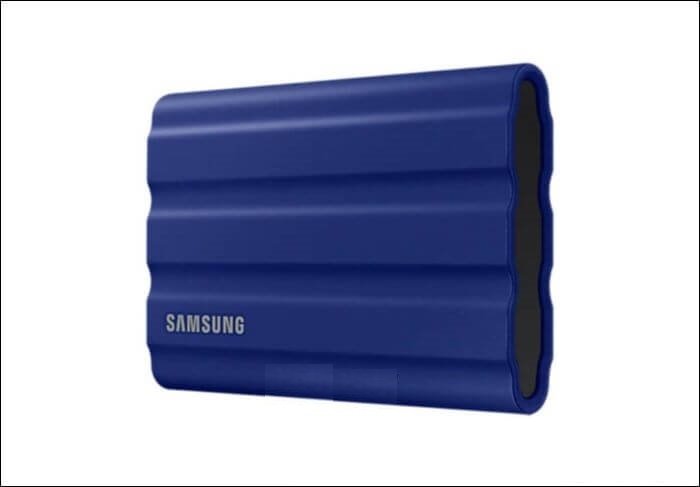
💾Samsung T7: The Samsung T7 Portable SSD variants were released on April 26, 2022, and come in three types: standard T7, rugged T7 shield, and T7 touch. All T7 variants have similar technology, with reading and writing speeds of 1050Mb/s and 1000Mb/s. The rugged T7 shield adds a protective shield, while the T7 touch includes a fingerprint mechanism for added security. The T7 SSDs are compact, with the regular T7 measuring 85mm x 57mm x 8mm.
Read Also: Best Samsung T7 Backup Software
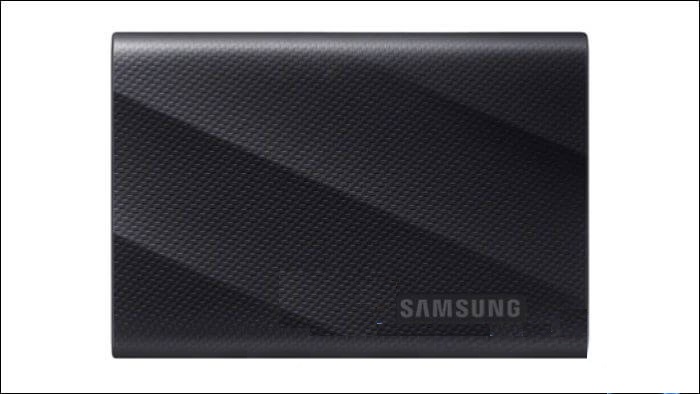
💾Samsung T9: The Samsung T9 Portable SSD was released on October 3, 2023, featuring a native USB 3.2 Gen 2x2 interface (USB Type-C). It boasts a proprietary Samsung controller and the company's new 3D V-NAND, enabling monumental reading and writing speeds, almost double that of the T7. The T9 also supports Samsung's proprietary TurboWrite technology, which enhances writing speed by using NAND flash memory as an SLC cache.
📚You may be interested: Samsung 990 Pro vs 980 Pro | Samsung 990 Pro vs WD Black SN850X
1️⃣Samsung T7 vs T9: Specifications
To compare the T7 and T9 drives, let's look at their specifications in a table. Both drives use Samsung's NVMe form factor and PCle interfaces, providing a similar foundation for performance.
| Specification | Samsung T7 | Samsung T9 |
| ✨Dimensions | 85 x 57 x 8 mm | 88 x 60 x 14 mm |
| 🎊Interface | USB 3.2 Gen 2 (10 Gbps) | USB 3.2 Gen 2×2 (20 Gbps) |
| 🎊Weight | 58g | 122g |
| ⏰Read and Write Speeds | 1050Mb/s and 1000Mb/s | 2000Mb/s and 1950Mb/s |
| 🎞️Encryption | AES 256-bit hardware encryption | AES 256-bit hardware encryption |
| 🎁Warranty | 3 Year | 5 Year |
| 🧵Resistance | Falls of up to 3m, dust, water | Falls of up to 3m, dust, impact |
2️⃣Samsung T7 vs T9: Capacity and Price
The T9 has more user storage and is faster due to its larger size and 3D V-NAND flash.
| Samsung T7: | Samsung T9: |
|
|
🎗️Note: Prices for Samsung SSDs may fluctuate based on time and discounts, so it's best to check the official website for the most up-to-date pricing. Buying from the official website also helps ensure you're getting a genuine product.
3️⃣Samsung T7 vs T9: Performance and Speed
The T9 is significantly faster than the T7, with nearly double the read and write speeds, thanks to its advanced NAND Cache and TurboWrite technology.
The T7 and T9 use the USB 3.2 Gen interface with 1 and 2 10 Gbps lanes respectively, enabling fast data transfer and making it easier to process large files, with Samsung claiming transfer speeds of 4GB in nearly 2 seconds and a 90-minute 4K recording in 12 seconds.
4️⃣Samsung T7 vs T9: Features
The Samsung T7 is a portable and lightweight external hard drive that offers fast speeds and secure data storage, making it ideal for managing large files. It also features embedded upgrade software for PC and Mac to add an extra layer of protection and ensure you have the latest firmware updates. The drive comes with a USB-C cable and Type-C-to-A cables for easy connectivity.
The Samsung T9's transfer speeds outpace the T7's, efficiently processing and transferring large files without latency. Additionally, the T9's Dynamic Thermal Protection minimizes overheating, enhancing performance. The drive comes with Samsung's Magician software 8.0 package, which includes tools for data migration, software security, and card authentication.
Share the blog on your Twitter, Facebook, or Reddit to help others understand the difference between the Samsung T7 and the T9.
Which SSD Should You Choose: Samsung T7 or T9?
The T9 outperforms the T7 in terms of speed and performance, but the cost and necessary specifications are also crucial considerations when selecting an SSD.
🎯The Samsung T9 SSD price range starts from $119.99, a considerable amount. If you are into gaming, working, and processing large files, you can prefer the T9 SSDs. T9 offers more protection with the shield and is accessible for all major operating systems.
🎯If you are on a budget, looking for good gaming, and okay with a substantial latency, the T7 is an excellent value for money. T7 Shield comes with a sturdy casing and offers more protection with encryption. Except for the transfer speeds, the T7 is as good as the T9.
How to Migrate Data to Samsung T7/T9 SSD Without Losing Data
Upgrading to a Samsung T7 or T9 SSD can significantly improve your computer's speed, but the data transfer process can be tricky and lead to data loss if not done correctly. To ensure a safe and reliable transfer, it's recommended to use specialized software specifically designed for this purpose.
Qiling Dick Copy Qiling Disk Copy is a cloning tool for Windows that applies advanced algorithms to clone old drive data to a new T9 SSD, allowing users to safely upgrade to the new SSD and boot their PC without reinstalling Windows. It also serves as a backup tool, enabling users to protect data and recover it in emergencies. This tool enables users to upgrade their T7 to T9 SSD with Qiling Disk Copy and boot their device instantly.
Migrate data between HDDs and SSDs with confidence using a free download that makes the process seamless and efficient.
Note: Please activate Qiling Disk Copy for a smooth disk copying or cloning process.
Step 1. Download, install and run Qiling Disk Copy on your PC.
Click Disk Mode and select the source disk that you want to copy or clone, then click Next to continue.
Note: To successfully copy or clone a disk, the destination disk should be at least the same size, and ideally larger, than the source disk, ensuring a sector-by-sector copy.
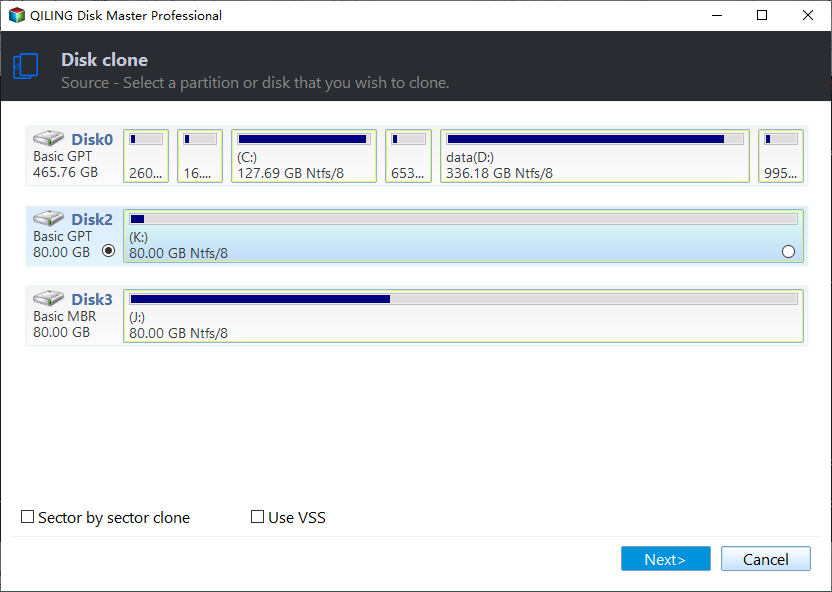
Step 2. Select the destination disk where you want to clone/copy the old disk and click Next to continue.
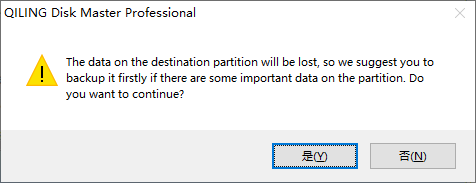
If the program asks to erase data on the destination disk, click OK to confirm.
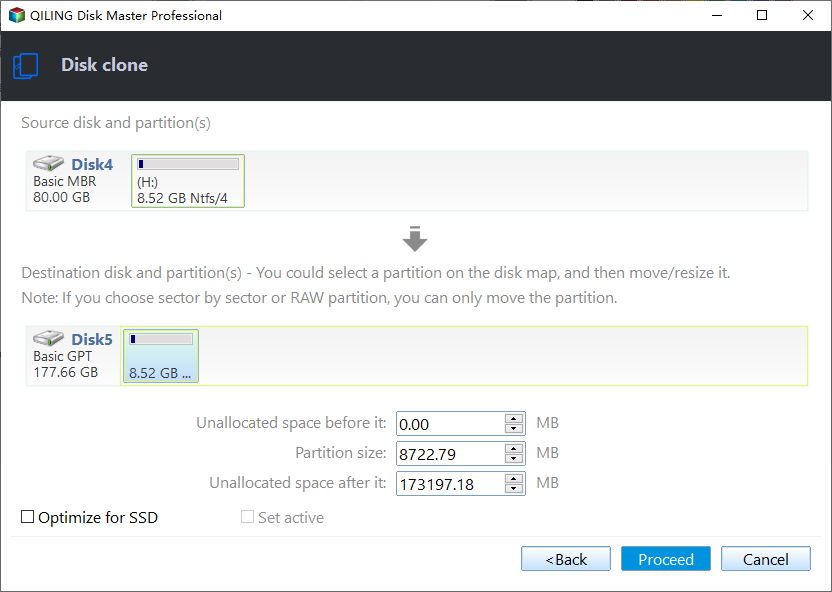
Step 3. To modify the disk layout, select the "Check and edit the disk layout" option, which will automatically adjust the disk layout. Alternatively, you can choose "Autofit the disk" to automatically optimize the disk layout.
Autofit the disk is recommended.
Copy as the source option allows you to clone the same layout of partitions on your source disk to the destination disk.
Edit disk layout allows you to manually resize or move partition layout on the destination disk, giving you more control over the disk configuration.
If your destination disk is an SSD drive, make sure to select the "Check the option if the target is SSD" option.
To start the disk cloning or disk copying process, click Proceed. This will initiate the process of creating an exact copy of the selected disk, which includes all its content, settings, and configurations.
Sum Up
The Samsung T7 and T9 are two high-performance external SSDs, but the T9 is the clear winner due to its superior technology and speeds. However, the choice between the two ultimately comes down to personal preference and budget, as both options offer reliable storage solutions.
Upgrading and migrating data to a new SSD is crucial once you've chosen the new drive. The safest way to do this is to clone the SSD, and Qiling Disk Copy offers powerful methods to transfer all data to the new T7 or T9 SSD.
FAQs Related to Samsung T7 vs. T9
1. How fast is the Samsung T9?
The T9 has two 10 Gbps lanes on its USB interface, making it faster and more powerful. It achieves sequential read and write speeds of 2000 Mb/s and 1950 Mb/s respectively, thanks to its USB 3.2 Gen 2x2 interface.
2. Is the Samsung T9 better than the T7?
The transfer speeds of T9 are twice as fast as those of T7, with T7 reaching 1050 Mb/s (Sequential reads) and 1000 Mb/s (Sequential write), and T9 performing operations at 2000 Mb/s (Sequential reads) and 1950 Mb/s (Sequential writes).
3. What is the difference between Samsung T5 and T9?
The Samsung T5 EVO is slower than the T9, with performance that's less than half as good, writing at 66% faster and reading at 50% faster than a hard drive.
4. How fast is USB 3.2 on Samsung T7?
The USB 3.2 Gen drive is a compact and portable option, featuring a 10 Gbps lane that enables high-speed data transfer, with read speeds of up to 1050 Mb/s and write speeds of up to 1000 Mb/s.
Related Articles
- Windows 11 Is Getting ReFS Support for Enhanced Data Proteciton
- How to Fix IRQL_NOT_LESS_OR_EQUAL Error in Windows 8.1✅
- How to Fix Lenovo Laptop Stuck in Boot Loop in Windows 10/11 [Quick and Easy]
- What Are the Benefits of Dynamic Disk [Detailed Elaboration]
The benefits of dynamic disks are numerous, but should you convert your basic disk to dynamic. - How to Fix WAN Miniport Driver Issues in Windows OS [Updated 2023]
If you're experiencing issues with the Wan Miniport driver in Windows OS, we're here to help. Let us know how we can assist you in resolving this problem. - How to Fix Windows 10 DVD Drives Not Working? [2024 Guide]
If your DVD drive has stopped working on your Windows 10 PC, it's an easy fix. To get your DVD drive up and running again, you can try updating your Windows 10 to the latest version, as sometimes a simple update can resolve the issue.
Products
Articles & Tutorials
- Data Recovery
- Data Backup
- File Recovery
- File Backup
- System Backup and Restore
- Disk and Partition Clone
- Technical articles
- Mobile articles
- Disk Master Help
- Windows Data Recovery Tutorials
- Windows Secure Delete Tutorials
- Windows Partition Management Tutorials
- Windows File Backup and Restore Tutorials
- Windows System Backup and Restore Tutorials
- Windows Disk Backup and Restore Tutorials
- Windows Clone Tutorials