Cloud Backup vs Cloud Storage: What's the Difference
Quick Navigation:
- 1. What Is cloud backup and How Does It Work
- 2. What Is cloud storage and How Does It Work
- 3. cloud backup or cloud storage: Which One Should You Choose and Why
- 4. The Most Efficient Way to Ensure Data Security in the Cloud
Cloud backup and cloud storage are often confused with each other, but they serve different purposes. cloud backup is a service that automatically saves copies of your data to a remote server, usually on a schedule, to ensure that your files are safe in case of a disaster or hardware failure. On the other hand, cloud storage is a service that allows you to store and access your files from anywhere, but it's not necessarily backed up. In essence, cloud backup is a safety net for your data, while cloud storage is a place to store and share your files.
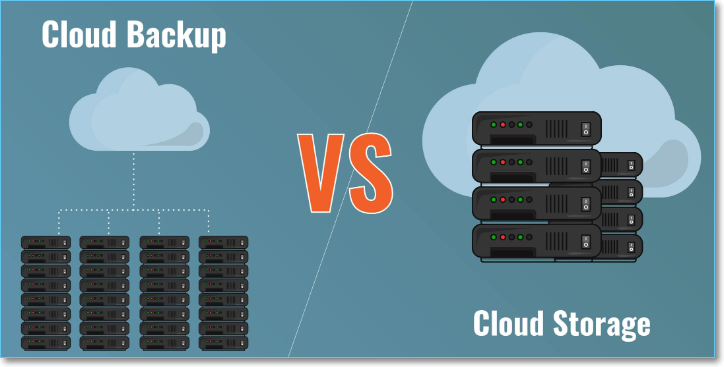
Cloud storage services like Google Drive and OneDrive are designed for storing and sharing files, while third-party backup software is designed for backing up and restoring files in case of data loss or system failure. The main difference is that cloud storage is typically used for storing and sharing files, while backup software is used for creating a copy of important files for disaster recovery purposes. Cloud storage providers like Google and OneDrive may offer some backup features, but they are not designed for backup and recovery, and may not provide the same level of data protection as dedicated backup software.
What Is cloud backup and How Does It Work
Cloud backup is a service that allows users to back up their data, such as files, folders, and even entire hard drives, to a remote server. This server is usually managed by a cloud provider, like Google Drive, Dropbox, or Microsoft OneDrive. The user can set up automatic backups to run at regular intervals, such as daily or weekly, to ensure that their data is safely stored off-site. This way, if the user's computer or device is lost, stolen, or damaged, their backed-up data can be easily restored.
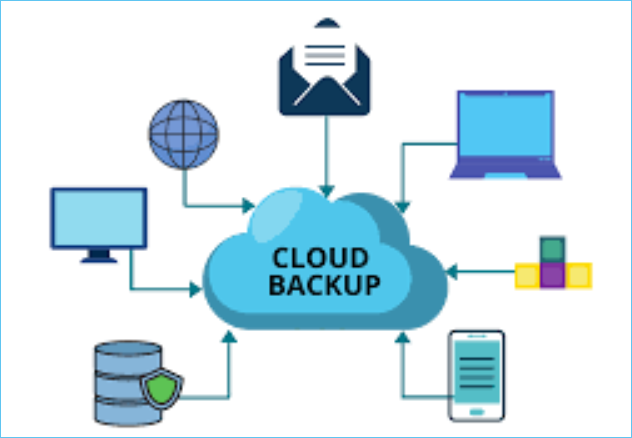
Cloud backup is a backup of files stored in online storage, which can be encrypted or non-encrypted, and is stored on a server where users can set up one or multiple restore points to recover their files in case of data loss or hardware failure.
Some key features include:
- Backup automation - automatically creating backups
- Recovering files in case of a virus attack
- Easy recovery in case of hardware failure, i.e., hard disk or solid-state drives fail, is ensured by using a cloud-based backup solution or a local backup system that stores data on a separate drive or device, allowing for quick restoration of data in case of hardware failure.
- Controlled restore points – a user can set various
Cloud backup allows you to recover files from an earlier point in time, before a virus attack, ensuring the original and virus-free state of the files.
What Is cloud storage and How Does It Work
cloud storage is a secondary storage system that stores your important files outside of your computer. It's typically used to keep essential files, such as documents, photos, and videos, accessible from multiple devices.
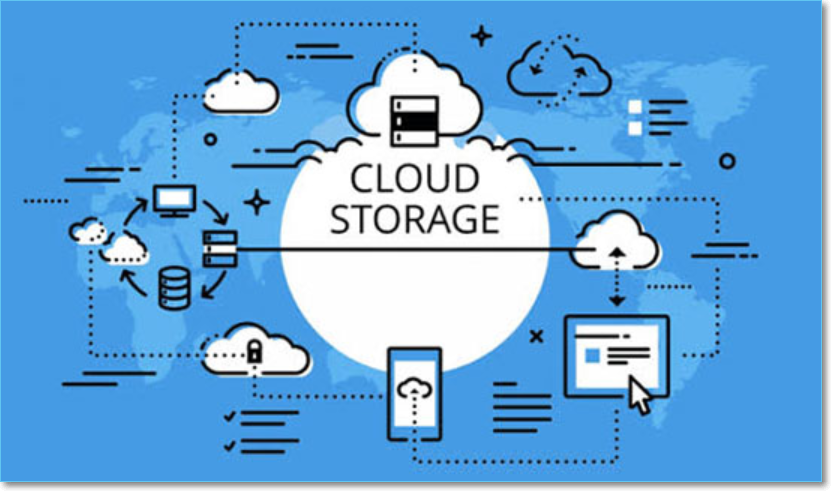
The cloud allows for a central location to store up to Gigabytes of data, but with modern computers having up to terabytes of physical storage, cloud storage is mainly used for smaller, important files.
Some key features include:
- Most cloud storages offer synchronized backups
- You can access cloud storage from multiple devices
- 24/7 access to data across devices
- Easy to restore specific files
You can back up your files by synchronizing cloud storage, which automatically updates as you make changes, or at set times. This also allows you to access files from multiple devices.
Cloud backup or cloud storage: Which One Should You Choose and Why
Cloud backup and cloud storage are two distinct services that cater to different needs. Cloud storage, ideal for accessing files across devices, is access-centric, whereas cloud backup, focused on preserving data, is file or time centric. This difference in approach makes cloud storage suitable for users who need to access files from anywhere, while cloud backup is better suited for those who want to ensure their data is safe and secure.
While Cloud Backups are crucial to safeguard personal or important data from loss or damage, the distinction between Cloud Backups and antivirus software lies in their primary functions. Cloud Backups ensure that data is securely stored and can be restored in case of loss or damage, whereas antivirus software prevents and removes computer viruses, protecting the system from malware and other online threats.
Key Features of Cloud Backups
- Cloud backups provide a safety net by creating restore points in case of data loss, ensuring that important information can be recovered and restored.
- Cloud Backups have specialized and encrypted security.
- They are quicker to recover because of their selective nature.
- They can automatically backup specific files upon your choosing.
- Cloud Backups have much better virus protection & ransomware prevention.
- Cloud storage services can be pricey, especially when compared to other storage options. They often come with a monthly or yearly fee, and the cost can add up quickly, especially for large storage needs.
Key Features of cloud storage
- cloud storage allows users to access and store files from any device, at any location, making it a convenient and flexible way to manage digital content.
- While most cloud storage services are secure, they may not provide the same level of protection as cloud backup services.
- It can selectively recover files, but it may involve dealing with a large number of backup points.
- cloud storage requires manual updates to data.
- cloud storage files are encrypted only on the server's side.
Experts believe that Cloud Backups are less expensive than cloud storage in some cases, mainly due to their increased security and advantages.
In cloud storage, server-side encryption alone may not be enough to protect your files, as they remain vulnerable during transfer. However, combining server-side encryption with client-side encryption, such as using a VPN or encryption software, can provide a robust double-layer of protection, safeguarding your files against viruses, ransomware, and malware.
Cloud backup and local backup are two different methods of data storage and retrieval. Cloud backup involves storing data on remote servers accessed through the internet, providing offsite protection and scalability. Local backup, on the other hand, involves storing data on a physical device, such as an external hard drive or USB drive, offering immediate access and control. Ultimately, the best approach may be a combination of both, using cloud backup for long-term storage and local backup for immediate access and disaster recovery. This hybrid approach can provide the best of both worlds, offering both offsite protection and local control.
The debate between cloud backup and local backup continues. Users must decide which option is more suitable for their needs. Cloud backup offers the convenience of storing data remotely, accessible from anywhere, and often includes automatic backups and security features. On the other hand, local backup provides physical storage of data, which can be more secure and faster to access, but may require manual backups and more maintenance.

The Most Efficient Way to Ensure Data Security in the Cloud
Using both cloud backup and cloud storage services is the most efficient way to secure your data. Cloud backup ensures the safety of your important files, while cloud storage helps keep your computer's storage organized, making it easier to clean up in case of a virus attack. This two-pronged approach, combined with other steps such as regular cleanups, can provide a robust defense against data loss and ensure your digital safety.
- Encrypt backups and data in your primary/physical storage
- Backup significant important data only, i.e., work or personal files
- Create strong passwords for extra protection
To ensure the security of your files, it's essential to choose the right cloud service with robust security features. Qiling Backup can help you achieve this by securing your files on your own device and through reliable online storage.
Qiling Backup
- Get a free 250GB cloud backup storage and back up your OS, disks, partitions, and other devices without any downtime, ensuring your data is safe and secure.
- A simple backup management system ensures efficient and secure data storage, with password-protected backups and the ability to store data across multiple paths.
- The system supports various backup strategies, including scheduled backups, differential and incremental backups, and enabling the image reverse strategy, all of which can be encrypted for added security.
To create a dependable online and on-device backup, use this efficient software to back up your computer to cloud. With the added double refuge of the Security Zone, your data will be securely protected even confronted with viruses and other threats. You can follow the steps below to learn how to use this software and ensure your data is safely backed up.
Step 1. When using Qiling Backup for the first time, click on "File backup" on the home screen, allowing you to select and back up various file types such as pictures, videos, documents, and more.
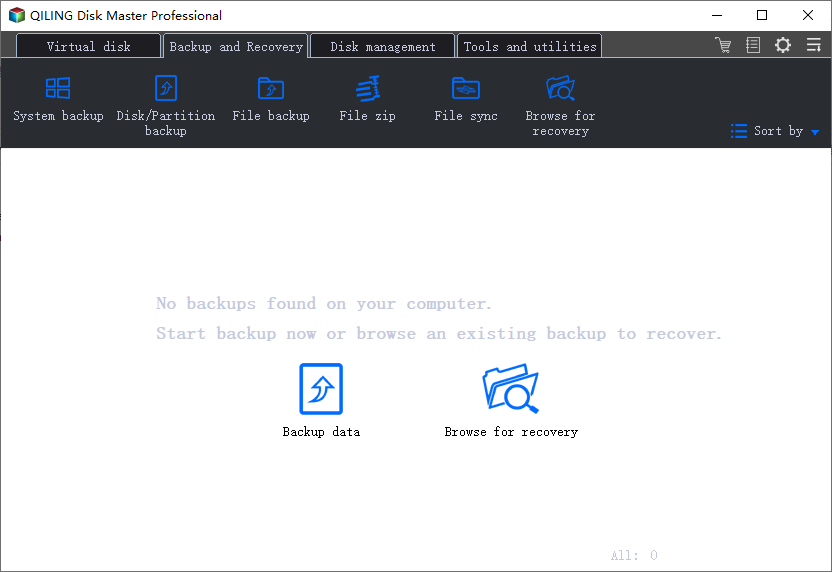
Step 2. To backup files, folders, or directories, follow the paths to locate the items you want to back up, then select them all.
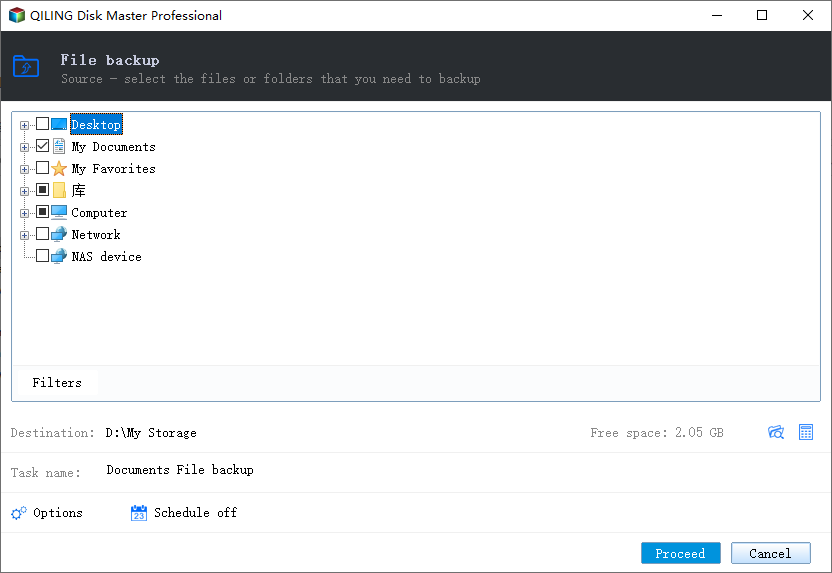
Step 3. To complete the backup process, you'll need to choose a location to save and retain the backup. This will ensure that your data is safely stored and can be easily accessed if needed.
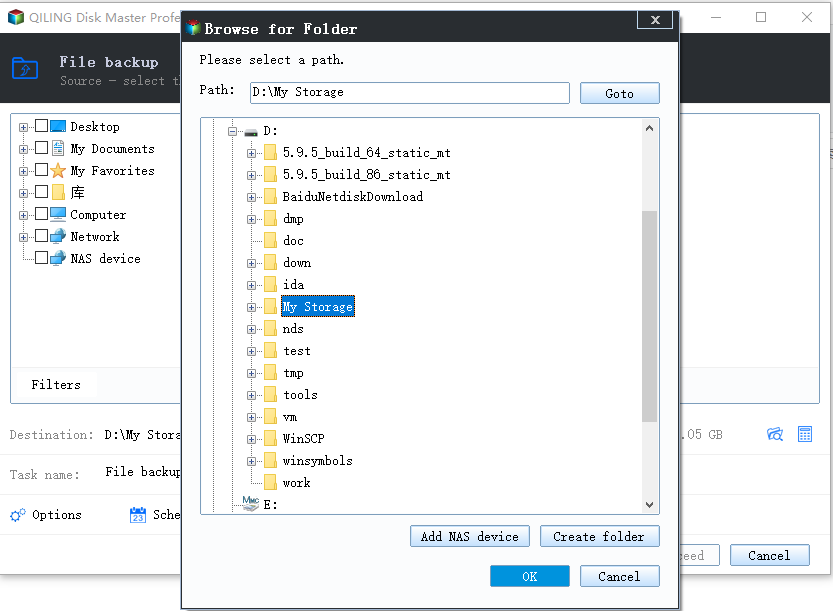
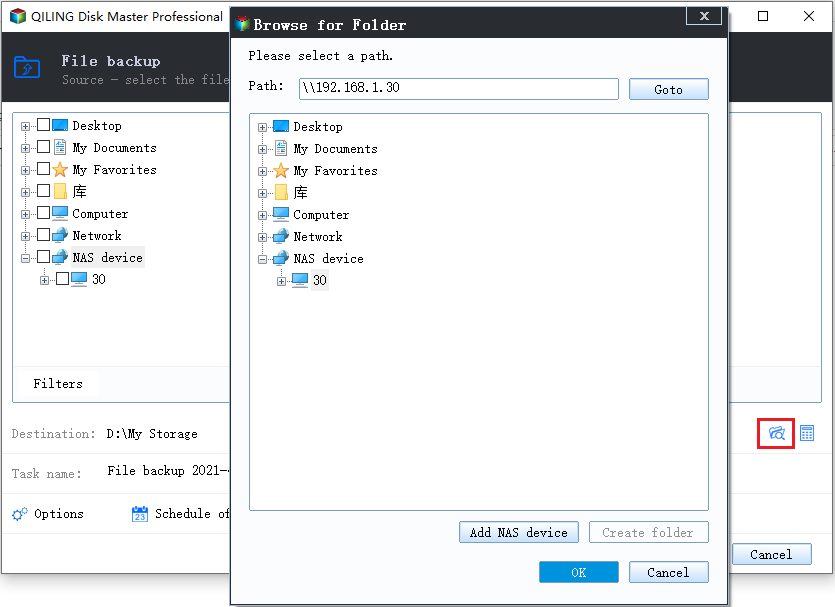
Step 4. Qiling Backup allows users to save backups on various devices, including local hard drives, external USB drives, SD cards, network drives, and NAS drives, as well as a cloud drive from Qiling. It is recommended to save backups on the cloud drive for greater accessibility, flexibility, and safety.
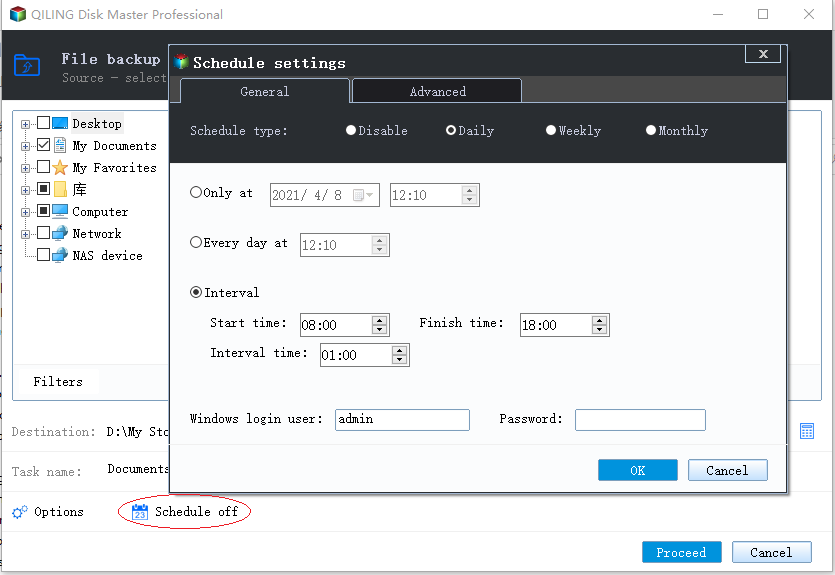
Step 5. If you're looking for an automated and smart backup schedule for your next file backup task, go to the "Options" setting. There, you can set up encryption for confidential files, compress the backup image size, or customize a backup schedule to specify when the next backup should start.
Customize an advanced and automatic backup task here:
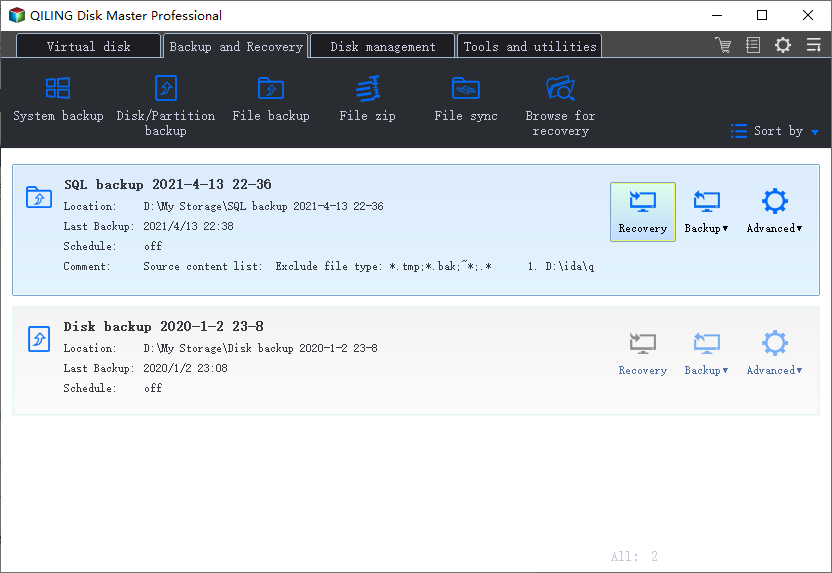
Step 6. Clicking "Proceed" initiates the file backup process, and the completed backup files are displayed in a card style on the left area.
Conclusion
Employing a combination of both local and cloud backup and storage is crucial for ensuring data security. While local storage provides faster access to data and is ideal for frequently accessed files, cloud storage offers greater scalability, flexibility, and disaster recovery capabilities. By utilizing both types, you can ensure that your data is protected and accessible, and Qiling Backup can provide additional security measures to safeguard your files.
Related Articles
- Quick & Easy: Fix Cannot Download from Google Drive Problem
- How to Create A Bootable USB in Linux | All You Want Is Here
- Is Windows Defender Good Enough to Protect My PC? Check the Best Answer
- What Is Cloud-to-cloud backup? Definition & Examples of 2022
- Quick Fixes: Loading Operating System, Disk Boot Failure
Are you troubled with the issue of "loading operating system, disk boot failure"? Try the following quick fixes and perform prevention measure to prevent data loss. - How to Fix M2 Drive Disappeared (3 Ways)
The article describes why M.2 drive disappeared and how to fix M.2 drive disappeared with 3 methods. You can also learn how to back up M.2 drive. Please read on.
Products
Articles & Tutorials
- Data Recovery
- Data Backup
- File Recovery
- File Backup
- System Backup and Restore
- Disk and Partition Clone
- Technical articles
- Mobile articles
- Disk Master Help
- Windows Data Recovery Tutorials
- Windows Secure Delete Tutorials
- Windows Partition Management Tutorials
- Windows File Backup and Restore Tutorials
- Windows System Backup and Restore Tutorials
- Windows Disk Backup and Restore Tutorials
- Windows Clone Tutorials