How to Run SSD SMART Test Safely [SMART Attributes Explained]
Many of us have experienced the frustration of an SSD failure, which can lead to data loss and financial loss. To mitigate this, some users explore the reliability and predictive capabilities of SSDs through SMART technology. SMART (Self-Monitoring, Analysis, and Reporting Technology) is a built-in feature that monitors SSD health and performance. We'll delve into how SMART works and provide a step-by-step guide on how to run the SSD SMART test.
An SSD SMART Test is a diagnostic tool that checks the health and status of a Solid-State Drive (SSD). It scans the drive for any potential issues, such as bad sectors, wear leveling, and other problems that might be affecting its performance.
What Is SSD SMART Test
The SSD SMART test checks the health condition of the target SSDs via SMART attributes, which helps check if the SSD is healthy, by monitoring its internal information, independent of the operating system, BIOS, or software. This technology, Self Monitoring, Analysis and Reporting Technology, was invented to monitor the SSD performance and predict its potential failure, providing a warning before it stops working.
SMART status items vary from software to software, but the most important metric is "Health", which indicates the overall status of the drive. Additional details are usually listed after the health score, highlighting any areas that need attention. In the context of SSD SMART Attributes, common entries include a variety of metrics, with "Health" being the most critical one, and other details listed afterwards to indicate any areas that need attention. (Note: I removed the "Generally speaking" phrase to make the paragraph more concise)
- Raw read error rate - the number of errors when reading data
- Retired blocks - During the life of a storage drive, certain blocks may become unsafe for data storage due to various factors. These blocks, also known as bad blocks, can arise from physical wear and tear, manufacturing defects, or other environmental factors.
- Power On Hours - Total number of hours the drive has been powered on
- Power Cycles - The drive was turned off and on again 5 times.
- Device Temperature - The current internal temperature of the drive
- Total LBAs Written - the number of logical block addresses written
- Total LBAs Read - the number of logical block addresses that have been read
This part helps users understand the SSD SMART status, including its meaning, how to check it, and what the different values indicate. It also provides tips on how to interpret and use the information to maintain and optimize SSD performance.
While Windows has a built-in way to check SSD health, it only provides limited information via the Command Prompt. To get a detailed SSD SMART status or SMART attributes, a professional third-party SSD SMART test tool is required.
Run SSD SMART Test via Qiling Disk Master
Qiling Disk Master provides detailed health checks of SSDs, displaying over 20 SMART attributes such as critical warnings, composite temperatures, and available spare. Its clear interface presents these results, and it sends immediate warning messages if it detects an impending SSD crash, effectively reducing the troubles caused by SSD failure.
Qiling Disk Master is a tool that allows users to create a bootable USB drive from a Windows installation media, such as a Windows 10 or 11 ISO file. This can be useful for troubleshooting and repairing a Windows installation, as well as for creating a portable version of Windows that can be booted from a USB drive.
- Support system: Windows 11/10/ 8.1/7 and Windows XP/Vista
- Interface: Clear and well-organized
- The difficulty of operation: Low
- Target users: Beginners and experienced users
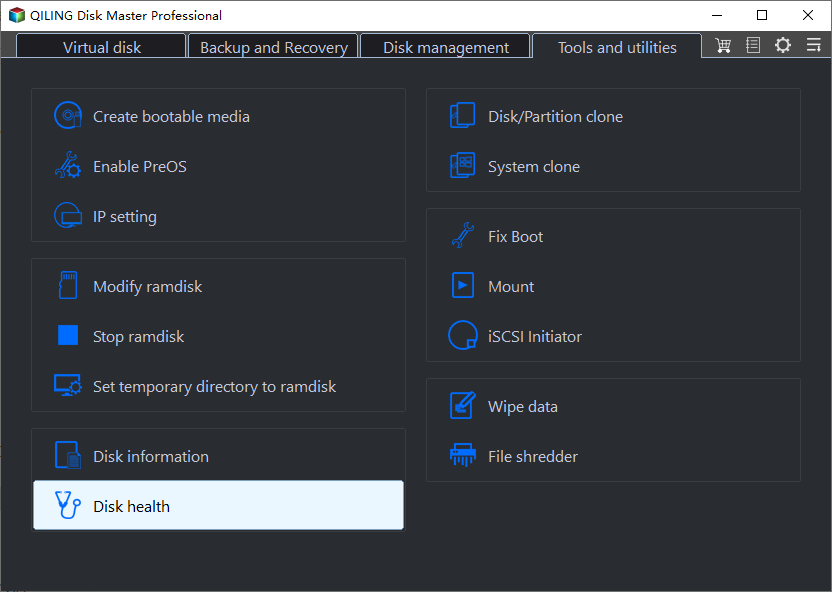
Step 1. Launch Qiling Disk Master, click the blue arrow to activate the "Disk Health" feature from the "Tools and utilities" section.
Step 2. Select the target disk, and you can see the health condition of your disk.
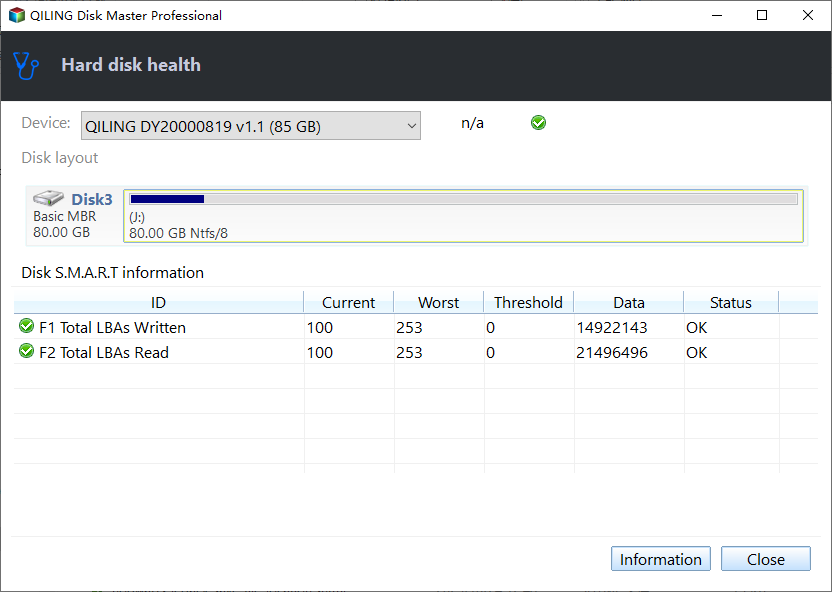
You can get the SSD SMART status from the result shown above. Qiling Disk Master not only can check the SSD health, but also has a lot of other features, such as.
- Test SSD read/write speed
- Check SSD temperature on Windows 10
- Check external hard drive health
- Check speed for SD card/USB/SSD/HDD
- Resize/split/delete/create/merge partitions on SSD
To keep your SSD healthy and manage it well, don't hesitate to download it to try.
Conclusion
Predictable SSD failures can occur due to normal wear and tear over time or a high number of failed erase attempts, ultimately leading to a drive failure. To monitor the health of your SSD, SMART (Self-Monitoring, Analysis, and Reporting Technology) tracks various variables. Qiling Disk Master allows you to check the SMART attribute of a disk or SSD and run a HDD SMART test. By following a step-by-step tutorial, you can run an SSD SMART test and gain insight into the SSD's SMART status.
If you are an SSD user, you may also like the following links:
In the next part, you can see some other questions related to our topic today. Continue to read if you get extra confusion.
SSD SMART Test FAQs
Here are the answers to your questions about SSD SMART attributes and their potential impact on your drive's reliability and lifespan:
1. How to run the Samsung SSD SMART test?
The Samsung Magician Tool is a testing and troubleshooting software designed by Samsung to check the health of their SSDs. It allows users to monitor the status of their Samsung SSDs, and is a useful tool for checking the health of these devices.
Step 1. To get started, visit Samsung's official website to download and install the Samsung Magician software, which is necessary for managing and optimizing your Samsung SSD.
Step 2. Launch the app and go to the Drive Dashboard menu.
Step 3. To check the Samsung SSD health and temperature status, click on the Status tab.
Step 4. To optimize performance, go to the performance optimization tab and check the active time, I/O speed, and read and write speed.
Step 5. To check the health of the Samsung SDD, select the SMART button next to Samsung mode, which will take you to the SMART function interface, providing detailed information about the drive's health.
2. How to run disk SMART check on Windows 10?
Windows 10 doesn't have built-To check the SMART attributes of a disk, download and install Qiling Disk Master on your computer, launch the software, select the disk you want to check, click on the "SMART" tab, select the attributes you want to check, click on the "Run" button, wait for the software to complete the check, and use the results to determine the health and reliability of your disk. Qiling Disk Master is a reliable choice for showing detailed SMART attributes.
Step 1. Download and launch Qiling Disk Master, then navigate to the "Disk Health" feature within the Discovery section.
Step 2. To view SSD attributes in the Disk Health window, select your target disk and click "Refresh" to initiate the process, allowing you to view the SSD attributes.
3. How do you diagnose a dead SSD?
An SSD may have the following symptoms before it dies:
- Overheat
- Boot failure
- Strange sound
- Slow response
- Multiple bad sectors
- File suddenly disappears
- Computer crashes frequently
Related Articles
- How to Install a Second SSD[Comprehensive Guide]
- How to Move Partition in Windows Server
- How to Upgrade EMMC to SSD [Tutorial with Pictures]
- 4 Ways to Factory Reset Windows 7 Without Password
- I Need Solid Ways That Can Create a New Partition on the Hard Drive, Help
If you are looking for solid ways to create a new partition on the hard drive, read this article, in which you can find the partition methods with detailed tutorials. - I Need to Format a Hard Drive to Work With Windows, Help
What should I do to use my Mac-formatted hard drive on Windows? The answer is to format a hard drive to work with Windows. This page will provide a safe way to help you format the hard drive.
Products
Articles & Tutorials
- Data Recovery
- Data Backup
- File Recovery
- File Backup
- System Backup and Restore
- Disk and Partition Clone
- Technical articles
- Mobile articles
- Disk Master Help
- Windows Data Recovery Tutorials
- Windows Secure Delete Tutorials
- Windows Partition Management Tutorials
- Windows File Backup and Restore Tutorials
- Windows System Backup and Restore Tutorials
- Windows Disk Backup and Restore Tutorials
- Windows Clone Tutorials