How to Check NVMe Temperature in Windows 10/11
To check NVMe temperature in Windows 10/11, you can follow two working solutions. Firstly, you can use the built-in tool, Command Prompt, to check the temperature of your NVMe drive.
| Workable Solutions | Step-by-step Troubleshooting |
|---|---|
| Check SSD Temperature in Windows 10/11 - Qiling Disk Master | Step 1. Launch Qiling Disk Master and click the blue arrow to activate the "Disk Health" feature under the "Discovery" section.Full steps |
| To check the SSD temperature in Windows 10/11, you can use the built-in "Manage Disks and Volumes" feature. To do this, press the Windows key + R to open the Run dialog box, type "diskmgmt. | Step 1. To access storage settings, go to Start, then click on Settings, followed by System, and finally Storage from the menu.Full steps |
Checking the NVMe temperature in Windows 10/11 is essential to ensure the health and performance of your storage drive. To do this, you can follow a simple process. However, the necessity of checking the NVMe temperature is not explicitly stated in the provided text. If you're experiencing issues with your NVMe drive, such as overheating, it's crucial to monitor its temperature to prevent potential damage.
Why Do I Need to Check NVMe Temperature in Windows 10/11
If your PC's components overheat, they can suffer catastrophic damage, leading to decreased performance, frequent BSOD issues, and potentially irreparable harm. To prevent this, it's essential to monitor their temperature regularly, as temperatures between 0 and 70 degrees Celsius are suitable for optimal NVMe performance, while temperatures beyond this range may damage NVMe performance.
Windows 10 initially lacked a built-in monitoring capability, leaving only BIOS and third-party applications as options. However, with Windows 10 builds 20226 and later, the SSD Temperature can be accessed through Storage Settings, allowing for examination of NVMe SSDs for any irregularities. This feature provides a built-in solution to monitor SSD temperatures, addressing the initial oversight.
How to Check NVMe Temperature in Windows 10/11
The SSD temperature can be determined using two methods, with the choice depending on your Windows version and other requirements. For Windows 10 Insider builds 20226 and later, you can use the brand-new option "Manage Disks and Volumes" in Qiling Disk Master to ensure success. Otherwise, you can use the other method.
To check the hard drive's temperature using the command line, you can use the command `smartctl -a /dev/sda` (replace `/dev/sda` with the actual path to your hard drive). This will display a variety of information, including the temperature of the hard drive.
Solution 1. Check SSD Temperature in Windows 10/11 - Qiling Disk Master
Qiling Disk Master is a professional NVMe SSD health-checking application that provides a clear overview of drive health with its "Disk Health" feature, displaying temperature, status, and other data with a single click. It is compatible with all Windows versions, eliminating compatibility concerns, and features an intuitive user interface that makes it easy to use.
Download the tool and follow the instructions to check the temperature of your SSD.
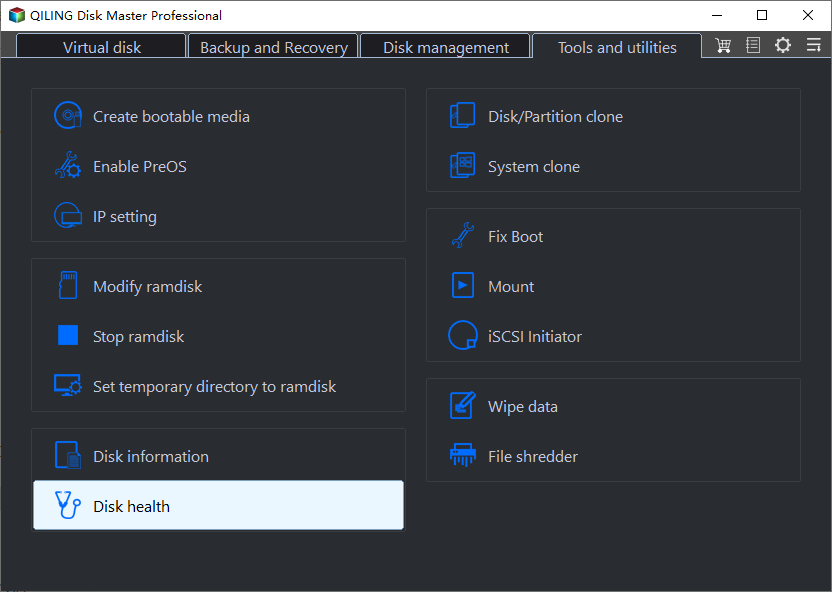
Step 1. Launch Qiling Disk Master and click the blue arrow to activate the "Disk Health" feature under the "Tools and utilities" tab page.
Step 2. To check the health condition of your disk, select the target disk and click the "Refresh" button. This will allow you to see the current status of your disk.
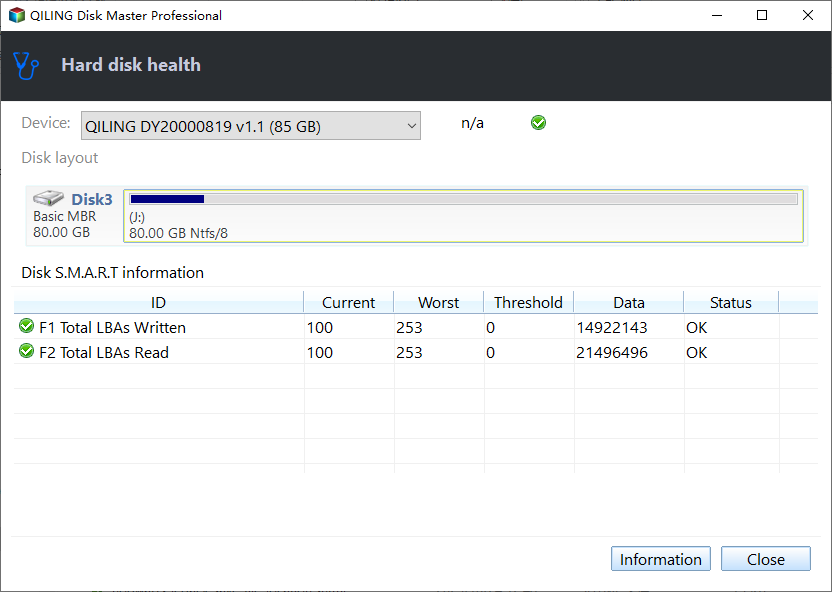
Qiling Disk Master is a professional tool that allows you to easily observe the temperature of your SSD, as well as learn more about its characteristics. With Qiling, you can determine the SSD's temperature and gain a deeper understanding of its features.
- Check SSD health in Windows
- Format NVMe SSD
- Clone Windows to NVMe
- Split or merge partitions on SSD
- Resize partition on SSD
You can download Qiling Disk Master to manage your SSD more effectively.
Solution 2. Check SSD Temperature in Windows 10/11 - Manage Disks and Volumes
Microsoft has introduced a new feature in Windows 10 Build 20226, called Manage Disks and Volumes, which allows users to check the temperature of their Solid-State Drives (SSDs). This feature provides additional storage management capabilities, enabling users to monitor and manage their disks and volumes more effectively. To access this feature, users can follow the steps listed below. However, the exact steps are not provided in the given text.
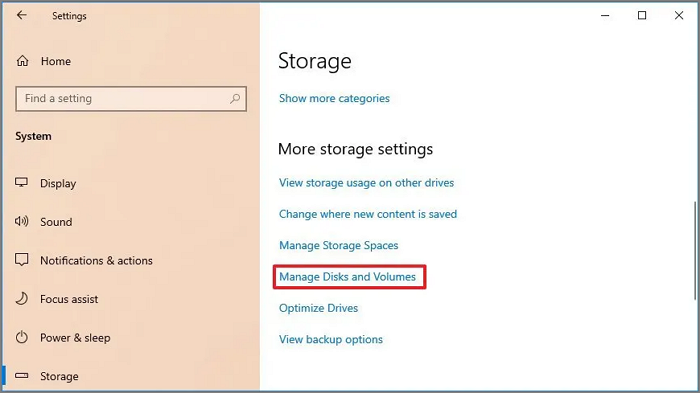
Step 1. Select Start, then Settings, then System, and finally Storage from the menu.
Step 2. Click Manage Disks and Volumes at the bottom of the page.
Step 3. Click the hard drive whose temperature you wish to view, and then click Properties.
Step 4. Your current temperature can be found under Drive health.
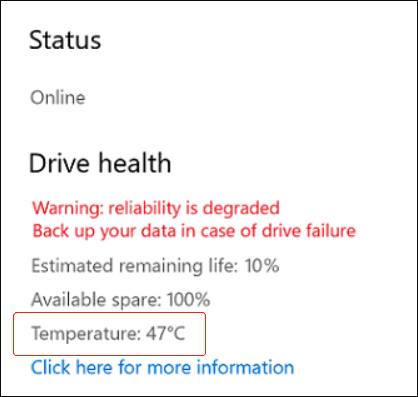
After completing the procedures, you will have a current temperature reading of the storage device, which is useful for troubleshooting or considering adjustments to the cooling system.
If you're unable to view temperature details, it might be due to using an unsupported drive (currently only NVMe SSDs are supported) or running a version of Windows 10 without the drive health feature.
Conclusion
In Windows 10/11, you can check NVMe's temperature using two methods. However, the temperature and health monitoring functions integrated into Windows 10 are only compatible with internal SSDs, making external drives like flash drives and memory cards incompatible. To monitor the health of external drives, you can use software like Qiling Disk Master, which can display the current temperature and status of a designated hard drive, making it easy to use and complete the task in just two steps.
You May Also Like:
FAQs About How to Check NVMe Temperature in Windows 10/11
If you're wondering how to check NVMe temperature in Windows 10, here are some frequently asked questions to help clarify any confusion. You can check NVMe temperature in Windows 10 by following a few simple steps, and if you have further questions, feel free to ask.
1. How do I check the temperature of my NVME Drive?
Follow the steps below to try Windows built-in tool to check the NVMe temperature.
Step 1. Go to the Windows 10 Settings menu and select Storage under the System.
Step 2. To access the "Manage Disks and Volumes" option, go to "More storage settings" and select it from the available choices.
Step 3. Select the drive whose temperature you wish to know.
Step 4. Select the Properties menu item.
Step 5. The temperature of the hard disk can be verified under the "Drive health" column, where the temperature is displayed in degrees Celsius. This information is useful for monitoring the health and performance of the hard disk.
2. What temperature is NVMe SSD?
An NVMe SSD's optimal performance and longevity are ensured when kept within a temperature range of 0-70 degrees Celsius (32-158 degrees Fahrenheit).
3. Does NVMe SSD overheat?
NVMe solid-SSDs are faster than SATA drives but can overheat in systems with limited ventilation.
Related Articles
- [How-to] Format Disk from MBR to GPT with DiskPart in Windows 10
- Partition Magic Server 2003 Free Download for Windows Server 2003 [How-To Guide]
- Nintendo Switch Not Reading SD Card? 10 Fixes Here!
- Partition Magic VS Qiling Disk Master, Which Is Better & How to Select
- 5 Methods to Fix Bootrec /Fixboot Access Is Denied Windows 11
If you are trying to fix your computer with Bootrec.exe but only to find out Bootrec /Fixboot access is denied, what should you do? Here, we provide you with 5 solutions to fix 'Bootrec /Fixboot access is denied Windows 11'. - How to Burn ISO to USB on Windows 8 Efficiently
Learn how to efficiently burn an ISO to a USB drive on Windows 8 with our step-by-step guide, making it easy to create bootable USB drives for installation or backup purposes.
Products
Articles & Tutorials
- Data Recovery
- Data Backup
- File Recovery
- File Backup
- System Backup and Restore
- Disk and Partition Clone
- Technical articles
- Mobile articles
- Disk Master Help
- Windows Data Recovery Tutorials
- Windows Secure Delete Tutorials
- Windows Partition Management Tutorials
- Windows File Backup and Restore Tutorials
- Windows System Backup and Restore Tutorials
- Windows Disk Backup and Restore Tutorials
- Windows Clone Tutorials