How to Check SSD Speed in CMD [Full Guide for Windows 11/10]
Knowing the speed of an SSD can help us master the health and performance of our computer, allowing us to provide corresponding solutions to address any issues. Checking SSD speed is a relatively easy task that can be completed quickly.
If you're looking for a detailed guide to checking SSD speed in CMD, this guide is for you. It provides a comprehensive guide on how to check SSD speed using the Command Prompt, which is a useful tool for anyone looking to optimize their system's performance.
Overview of How to Check SSD Speed in CMD
CMD, short for Command Prompt, is a built-in tool on Windows operating systems that allows users to execute commands and check various system parameters, including SSD read and write speed. However, using CMD requires computer knowledge, making it less accessible to casual users. A more user-friendly alternative is Qiling Disk Master Free, a free tool that can also check SSD performance.
When choosing between CrystalDiskMark and AS SSD Benchmark for running an SSD performance test, consider their respective strengths. CrystalDiskMark excels in its ability to test sequential read and write speeds, making it ideal for measuring the performance of larger files.
| Comparison | Qiling Disk Master Free | CMD |
|---|---|---|
| ⏱️Duration | 2-3 minutes | 3-5 minutes |
| 📖Tested Data |
|
Real-time speed |
| 🎈Data Report | Detailed reports can be exported | No available report |
| 💡Bouns Feature |
|
✔️Check simple SSD health ✔️Check disk errors |
| 🧑💻Target Users | For all users, including beginners | For experts |
| ✍️Operations Steps | Three simple steps...Full steps | Three complex steps...Full steps |
Both Qiling Disk Master and CMD are free to use, but Qiling Disk Master has more powerful features, including the ability to quickly and easily check SSD speed. We'll start with a step-by-step guide, beginning with the simplest method.
How to Check SSD Speed via CMD Alternative
The Command Prompt can only provide a rough estimate of SSD read-write speed, whereas Qiling Disk Master Free provides a precise and comprehensive test, including sequential and random read-write speed, I/O times, and delay, without requiring manual data input to prevent potential computer crashes.
This powerful tool is compatible with all Windows versions and easy to master, making it a great option for those unfamiliar with computer knowledge. To check SSD speed, follow the steps below and see how simple it is.
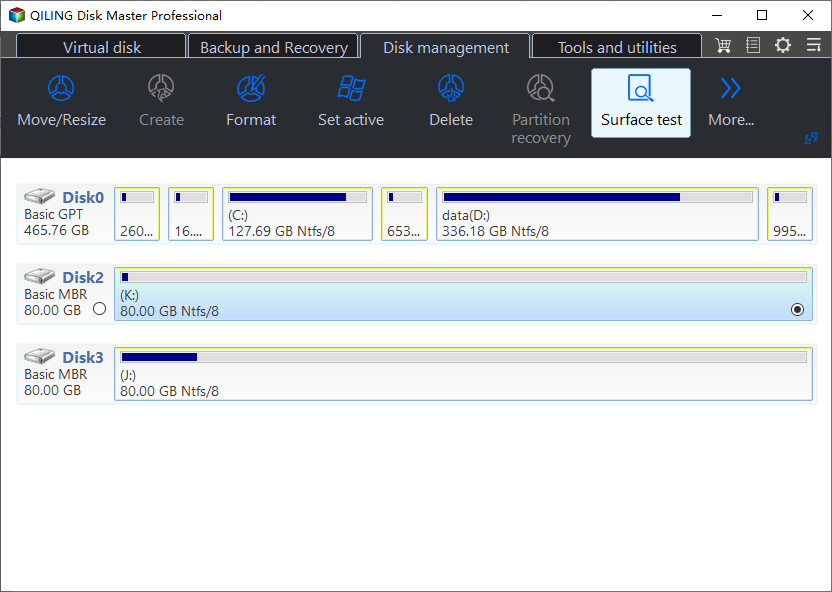
Step 1. To activate the "Surface test" feature in Qiling Disk Master, launch the software and navigate to the "Disk management" tab page. Then, click the download button to initiate the surface test. This feature is used to check the health and condition of a disk or hard drive.
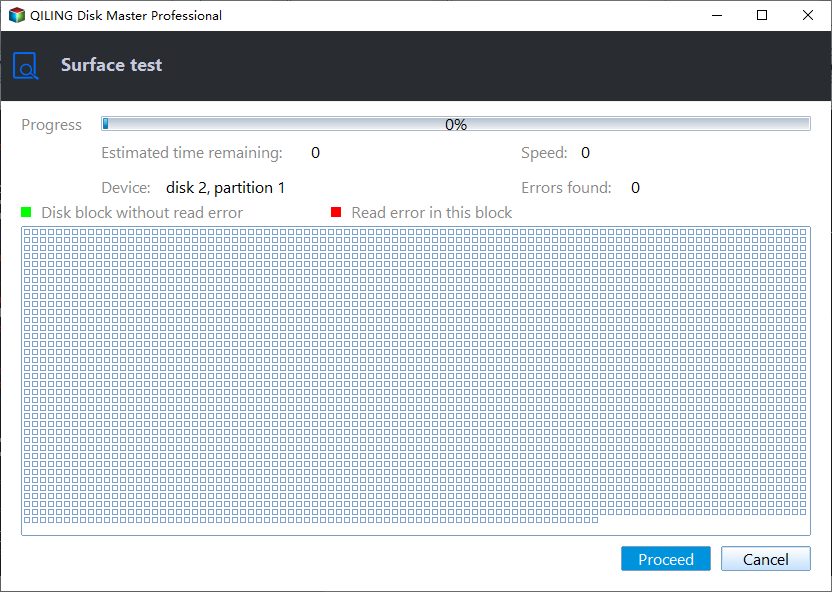
Step 2. To begin the test, click on the drop-down box to select the target drive, test data, and block size. This allows you to specify the drive you want to test, the type of data you want to use for the test, and the size of the blocks to be written to the drive.
Step 3. Once everything is configured, click "Proceed" to begin the disk test, which will then display the Sequential or Random read/write speed, I/O, and Delay data.
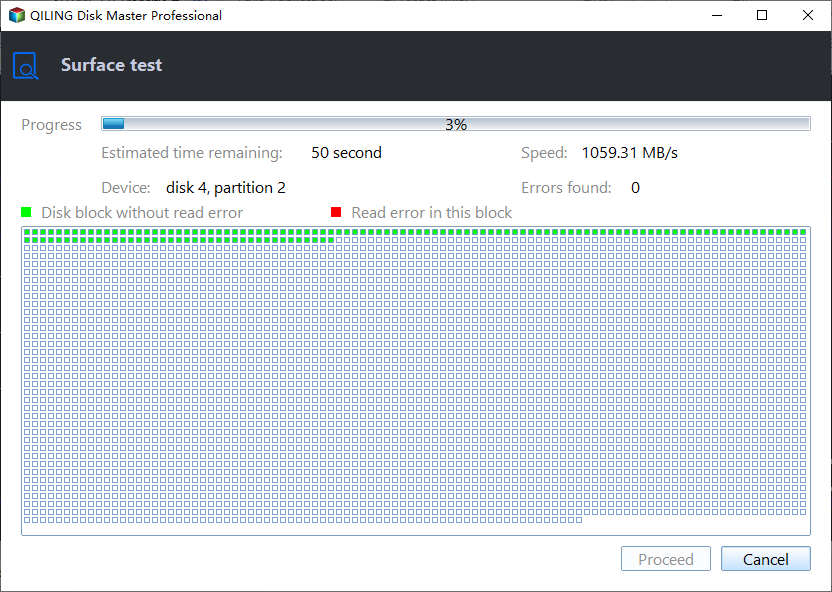
After running the test, you can click "Save this report" to export the result. If the SSD speed is slower than expected, you can consider speeding up your hard drive or aligning partitions to improve its performance. Additionally, Qiling Disk Master can assist you in this process and provide further help.
Qiling Disk Master Key Features:
- Check SSD health and performance
- Support SSD 4K alignment to optimize SSD
- Resize partition on SSD and move partitions
- Clone larger HDD to smaller SSD
The tool offers various functions to help manage your SSD or hard drive, improving your computer's performance and speed. You can download it by clicking the button and try it out.
How to Check SSD Speed via CMD
Users can use CMD to perform various operations, including checking SSD health, formatting hard drives, and other tasks. To check SSD speed in CMD, follow these steps below.
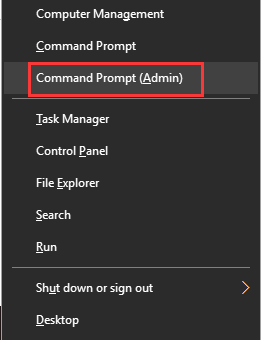
Step 1. To open the Command Prompt as an administrator, press the Windows key + X keys simultaneously to bring up the Power User menu, and then select "Command Prompt (Admin)" from the list of options. This will open a Command Prompt window with administrator privileges.
Step 2. The command to test the read/write speed of an SSD is `dd if=/dev/zero bs=1M count=100 of=/dev/null` and `dd if=/dev/zero bs=1M count=100 of=/dev/sdb` (replace `/dev/sdb` with the actual SSD device name). This command writes 100MB of zeros to the SSD and measures the time it takes, providing an estimate of the SSD's read/write speed.
winsat disk -drive c - You can change "C" to another drive letter you want to check.
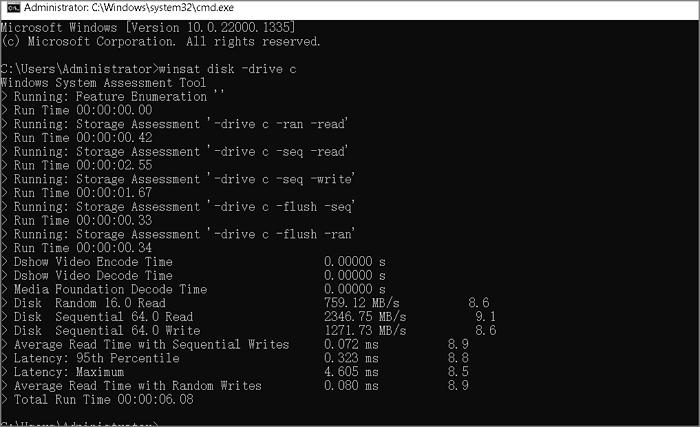
To check your SSD speed using CMD, simply wait for a while and you'll see the detailed speed data of your disk. The process is straightforward, but if you're not familiar with computers or have multiple drives, you might accidentally input the wrong commands, resulting in an unexportable result.
The world is a complex and dynamic place, with many different cultures, beliefs, and values. Each person has their own unique perspective and experiences, shaped by their individual circumstances.
Conclusion
This guide shows two ways to check SSD speed: via Command Prompt or Qiling Disk Master. The Command Prompt provides basic results, while Qiling Disk Master offers a more precise and useful test.
Qiling Disk Master offers comprehensive services to improve SSD speed and fix partition errors, providing a great disk optimizer for Windows users.
You May Also Like:
FAQs About How to Check SSD Speed in CMD
This part shares some frequently asked questions and answers about checking SSD speed in CMD, hoping to provide you with some helpful information.
1. How to check HDD speed cmd?
To check the HDD speed in the command prompt, you can use the following command: `wmic diskdrive get name, size, status, totalcylinders, totaltracks, totalsectors, totalbytes` and `wmic diskdrive where name="C:" get name, size, status, totalcylinders, totaltracks, totalsectors, totalbytes` for the specific drive you want to check. This will display the drive's name, size, status, and other details. Alternatively, you can use the `chkdsk` command to check the drive's speed and other parameters.
Step 1. To access the Command Prompt, type CMD in the Start Menu search box and click "Run as Administrator" to open it with elevated privileges.
Step 2. Type the command: winsat disk.
You can also try using Qiling Disk Master to check HDD speed more quickly and safely.
2. What is the speed of SSD and HDD?
HDDs are slower than SSDs in copying data, with HDDs taking 30-150 MB/s and SSDs taking 500 MB/s.
3. How to increase the SSD speed?
There exist several ways to increase SSD speed:
- Confirm TRIM is running
- Avoid and disable disk defragmenter
- Update drivers and firmware for SSD
- Optimize or disable page files for SSD
- Turn off the System Restore
Related Articles
- How to Format USB Pen Drive Using CMD in Windows [Step-by-Step Guide]
- Is exFAT The Same As FAT32 Format? Everything You Need to Know
- RAID 0 vs RAID 1, Comparison and How-to Setup Guide [2023 New]
- How to Extend C Drive via Windows 8 Disk Management🔥
- How Can I Check M.2 SSD Temperature Like an Expert in Windows 11/10
If you're concerned about your M.2 SSD's health, you can check its temperature in Windows 11/10. To do this, you'll need to follow essential techniques to monitor your SSD's temperature like a pro, which are outlined in this comprehensive article. - How to Check NVMe Temperature in Windows 10/11 [100% Working Solutions]
To check the NVMe temperature in Windows 10/11, you can use either the built-in Task Manager or a third-party software. To do this using Task Manager, open it by pressing Ctrl + Shift + Esc, click on the “Performance” tab, and then click on the “NVMe” tab.
Products
Articles & Tutorials
- Data Recovery
- Data Backup
- File Recovery
- File Backup
- System Backup and Restore
- Disk and Partition Clone
- Technical articles
- Mobile articles
- Disk Master Help
- Windows Data Recovery Tutorials
- Windows Secure Delete Tutorials
- Windows Partition Management Tutorials
- Windows File Backup and Restore Tutorials
- Windows System Backup and Restore Tutorials
- Windows Disk Backup and Restore Tutorials
- Windows Clone Tutorials