Does a Disk Cache Help Screen Recording and Streaming?
A recording session is one of the few everyday tasks that writes continuously for hours. If the destination drive cannot keep up, frames are dropped, and no amount of processor power will bring them back.
This guide explains what a recorder actually writes, when a cache prevents dropped frames, and when the encoder is the real limit.
PAGE CONTENT
- What Recording Writes to Disk
- Bitrate, Encoder, and Disk Load
- Where a Cache Helps
- Where the Encoder Is the Limit
- Configure a Cache for Recording
- FAQs About Recording and Caching
- Back Up Windows Before You Change Settings
What Recording Writes to Disk
Almost every recorder, from OBS to the built-in Xbox Game Bar, follows the same pattern:
- Frames arrive at a fixed rate. Thirty or sixty frames per second, captured whether or not anything on screen has changed.
- They are buffered in memory. The encoder takes frames from a buffer rather than directly from the screen.
- Encoded output is written as a stream. The result is one long file that grows by the second, usually with very large sequential writes.
- The write never stops. Unlike a copy or a backup, there is no pause to catch up, which is why a disk that stalls loses frames permanently.
- The pattern is close to pure writing. Reading barely matters here, which is the difference explained in write caching vs read caching.
Bitrate, Encoder, and Disk Load
The load on the disk is set by the recording settings, not by the resolution alone:
- Bitrate is the real number. A 1080p recording at 6 Mbps is about 0.75 MB per second, while 4K at 60 Mbps is roughly 7.5 MB per second.
- Quality settings change it fast. Raising the quality or switching from a hardware to a software encoder can multiply the file size several times.
- Multiple tracks and layers add up. Separate audio tracks, overlays, and a second recording of the same session all write at the same time.
- Buffered writing is the first defence. A recorder keeps a memory buffer so that short stalls do not show - the same idea as cache vs buffer.
- Filling that buffer is what costs frames. Once it overflows, the recorder has nowhere to put the next frame.
Where a Cache Helps
A write cache changes how smoothly the stream reaches the disk, and that is exactly what prevents dropped frames:
- It absorbs bursts. When the encoder produces a heavy frame or a keyframe, the cache holds the extra data instead of stalling the write.
- It reorders and batches. Small scattered writes become fewer, larger sequential writes that the drive handles more efficiently.
- It matters most on a mechanical drive. A hard drive writing video while the system also reads other files is the classic case for caching.
- Block size affects the result. Large sequential streams prefer larger blocks, as described in SSD cache block size explained.
- It cannot create time. A cache buys a second or two of headroom; it does not raise the average write speed of the drive.
Where the Encoder Is the Limit
Dropped frames have more than one cause, and the disk is only one of them:
- The encoder itself. Software encoding on a modest processor cannot keep up with 4K at a high frame rate, and frames are lost before they reach the disk.
- The graphics card. Hardware encoders are fast, but running a game and encoding at the same time competes for the same chip.
- Memory pressure. A small capture buffer leaves no room for a slow moment.
- Overloaded system drive. Recording to the same disk Windows is using forces writes and reads to share headroom.
- Tell the symptoms apart. A stream that stutters throughout points to the encoder; a stream that breaks during heavy moments points to the disk - see when a disk cache does not help.
Configure a Cache for Recording
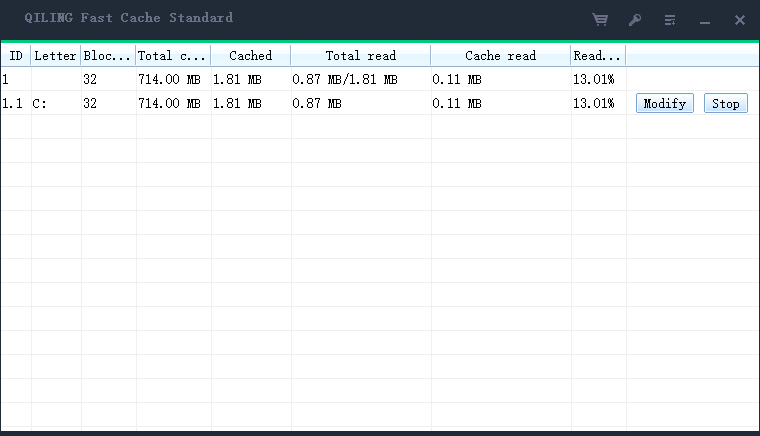
If you record to a mechanical or external drive, a cache is the cheapest way to smooth out the write stream. Qiling Fast Cache places the newest data in a RAM tier and the rest on an SSD tier, and reports the hit rate in the task list.
Step 1. Install Qiling Fast Cache and open the task list. Record a short clip with your normal settings and note the dropped frame count.

Step 2. Click the "+" button and select the volume you record to. If you record to a secondary drive, cache that one rather than the system drive.
Step 3. Give the SSD tier enough room for the length of a typical session, and keep the RAM tier moderate so the recorder still has buffer memory.
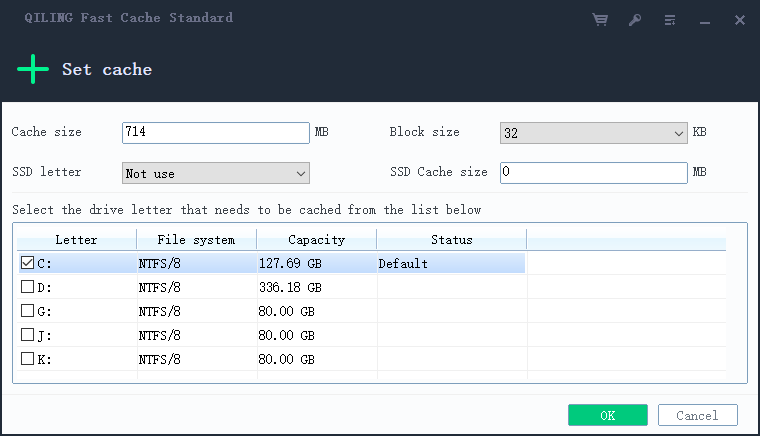
Step 4. Record the same test clip again and compare the dropped frames. Check the hit rate as well - see how to check cache hit rate - and remember that a cache only helps if the drive was the limit.
FAQs About Recording and Caching
Is a cache or a faster drive better for recording?
A faster drive is the more reliable fix. A cache helps on mechanical drives, but it cannot raise the sustained speed of the disk underneath.
Should I record to an SSD or an external drive?
An internal SSD if you have one. An external USB drive is the case where a write cache helps the most.
Why does recording drop frames when a game runs fine?
Because the frame rate on screen and the write stream are separate. The game may hit 60 FPS while the encoder or the disk falls behind.
Does recording wear out an SSD?
It does add writes, though a modern SSD handles years of recording. Reducing the bitrate is the simplest way to write less.
Can I record to a RAM disk?
Only for very short clips. A long session will not fit, and a crash loses the recording completely.
Back Up Windows Before You Change Settings
Reconfiguring storage and cache settings is easier to undo when you have a recent image. Qiling Disk Master creates a full Windows backup you can restore from.
Part 1: Create a Full System Backup
Step 1. Install and open Qiling Disk Master. On the home screen, open "Backup and Recovery" and choose "System Backup". This option automatically includes Windows and the hidden boot partitions, so you do not have to select them one by one.
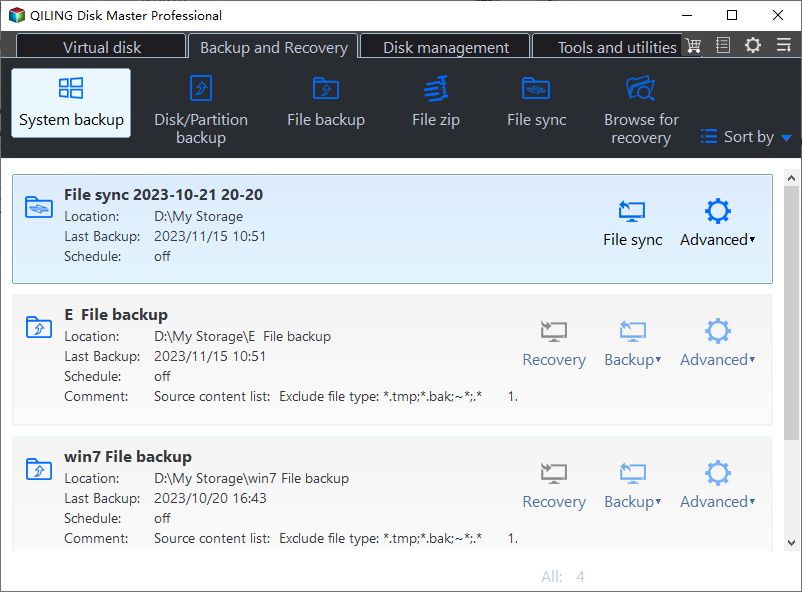
Step 2. Check the source. The disk where Windows is installed and its system partitions are already ticked for you. If you only need your personal documents, run a separate "File Backup" task instead.

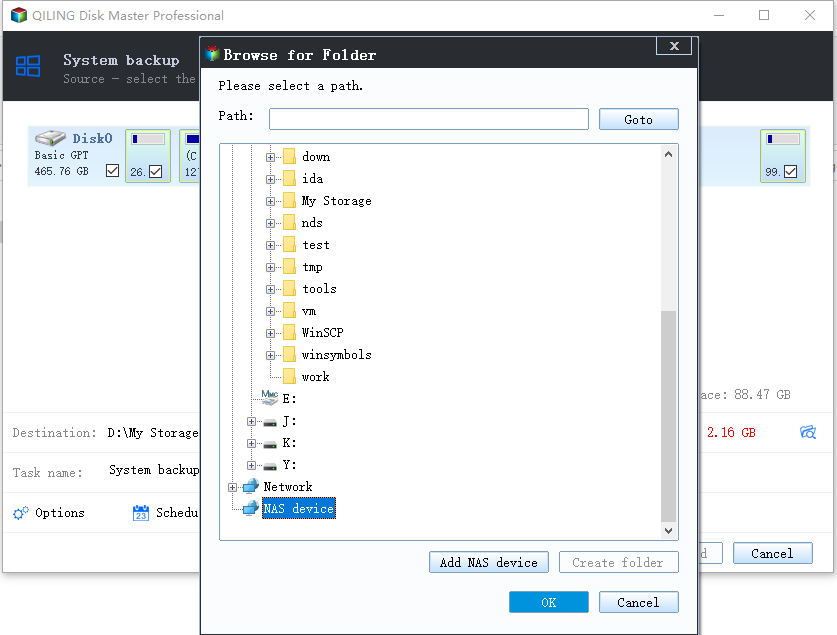
Step 3. Click the destination box and choose where the image should be saved. Use an external HDD or SSD, a NAS, or any drive other than the one Windows is installed on, and make sure it has enough free space.
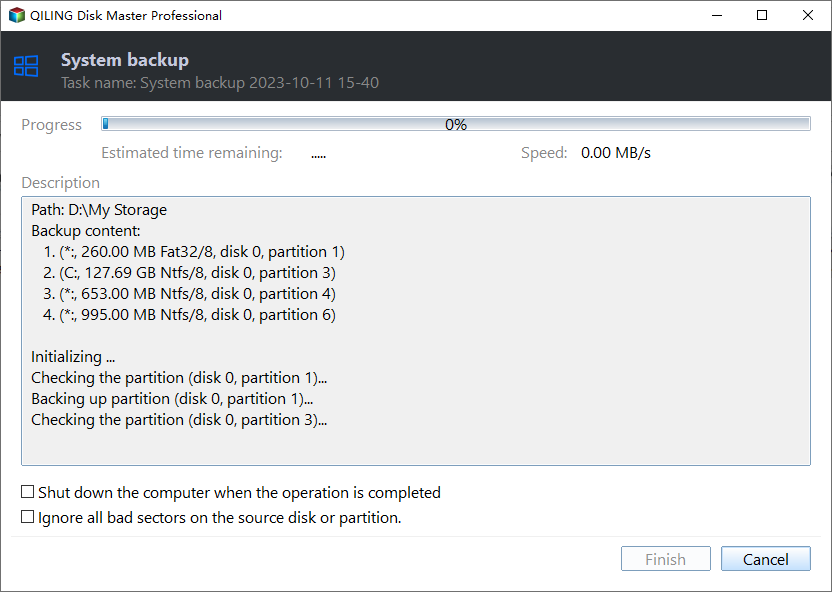
Step 4. Review the task summary and click "Proceed". Wait until the progress bar reaches 100%. Do not unplug the drive or turn off the PC while the backup is running.
Part 2: Restore Windows from the Backup
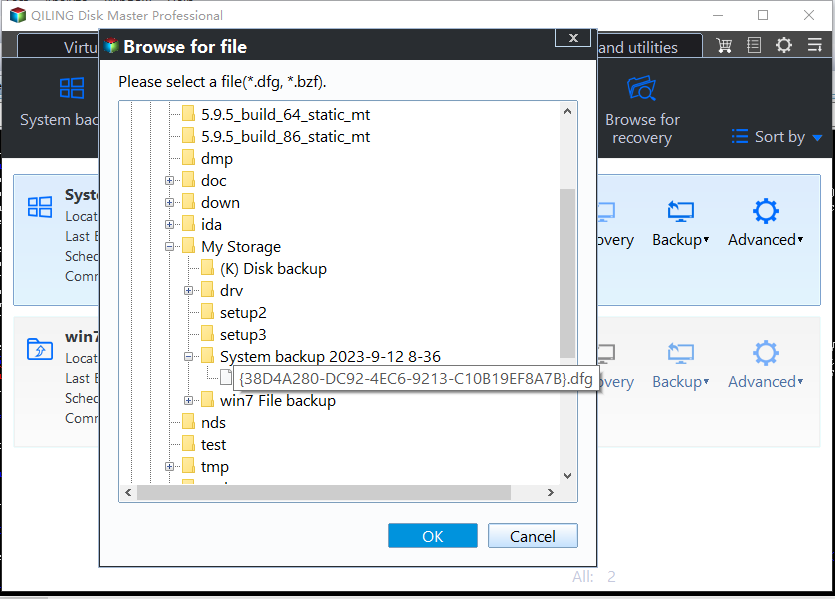
Step 1. Open Qiling Disk Master again, go to "Backup and Recovery", and select the recovery option. Your backup images are listed, so pick the one you created before the changes began.
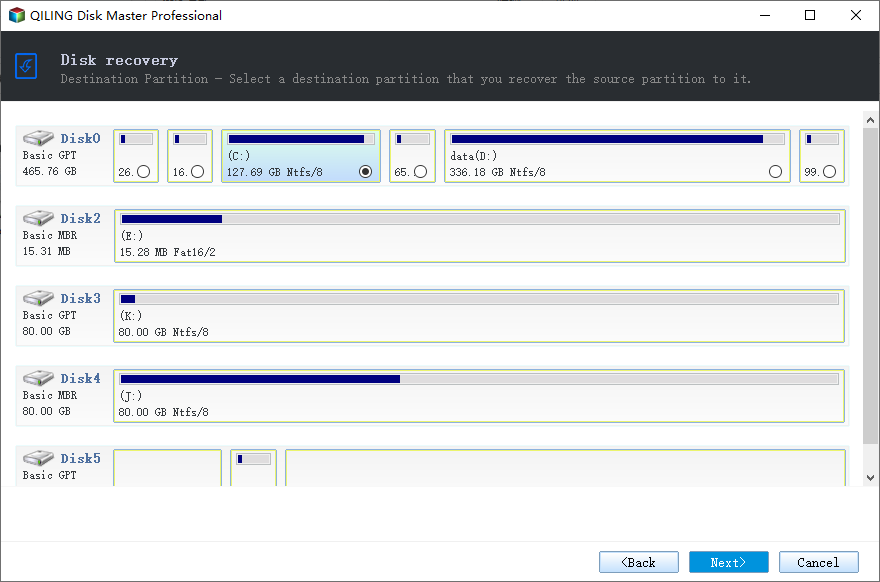
Step 2. Choose the target disk or partition. Normally you restore to the original system disk. If the drive was replaced, select the new disk instead, and the restore rebuilds Windows together with its boot partitions.
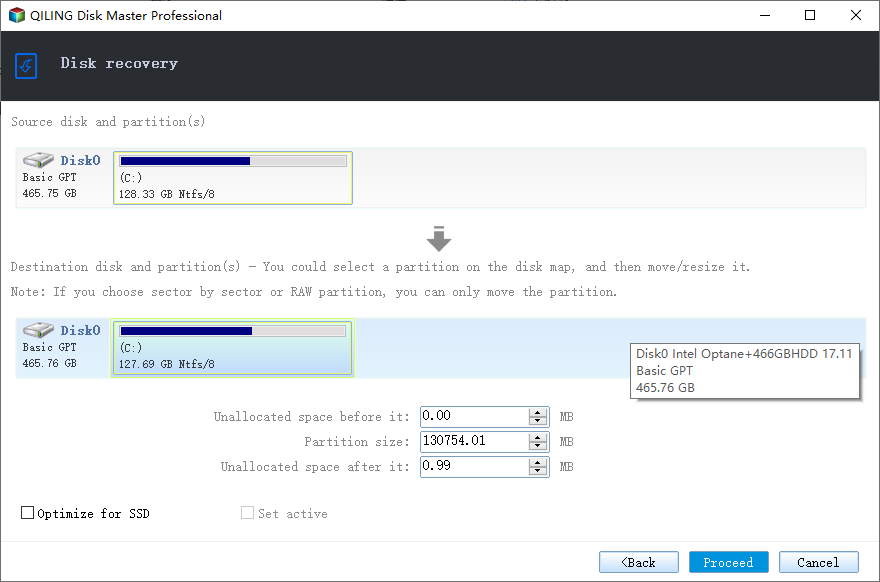
Step 3. Preview the restore plan, click "Proceed", and confirm the warning. The PC restarts to finish the job, and Windows comes back exactly as it was on the day the image was created.
- Note
- Keep the backup image on a separate drive, and refresh it before changing storage cache settings.
Conclusion
Recording is a continuous write, so the question is not whether the disk is fast on average but whether it ever stalls. A write cache covers exactly those stalls: it absorbs keyframes and heavy moments, batches small writes into larger ones, and keeps the recorder's buffer from overflowing. That makes the biggest difference on mechanical and external drives, and very little on a fast internal SSD. When frames still drop, look at the encoder settings, the capture buffer, and whether you are recording to the same drive Windows is using. Raise the cache only if the measurements point at the disk, because a cache that hides a slow drive is not the same as a drive that is fast enough.
Protect your PC with Qiling Backup—create a system image before your next round of settings changes.
For more Windows 11 performance guides, see How to Use a RAM Disk as a Scratch Disk for Video Editing, How to Speed Up a Plex Media Server with a Disk Cache, Caching for NVR and Surveillance Storage Explained, How to Extend SSD Lifespan by Reducing Writes, and Speed Up Music Production with a RAM Disk and SSD Cache.
Related Articles
- SATA vs NVMe: Does a Disk Cache Still Help?
The interface sets the ceiling for a sustained write, which is what a long recording needs. - Does Heat Slow Down Your SSD Cache?
- Should Your Disk Cache Live on the Windows Drive?
- Faster Gameplay with Fast Cache, Enhancing Your Gaming Experience
- Does a Disk Cache Help Video Conferencing?
Products
Articles & Tutorials
- Data Recovery
- Data Backup
- File Recovery
- File Backup
- System Backup and Restore
- Disk and Partition Clone
- Technical articles
- Mobile articles
- Disk Master Help
- Windows Data Recovery Tutorials
- Windows Secure Delete Tutorials
- Windows Partition Management Tutorials
- Windows File Backup and Restore Tutorials
- Windows System Backup and Restore Tutorials
- Windows Disk Backup and Restore Tutorials
- Windows Clone Tutorials