How to Check SMART Status on Windows 10 in 2024 - 2 Efficient Ways
This article shows you how to quickly and easily check the SMART status of Windows 10 to see if your hard drive is still reliable or on the verge of hardware failure.
What Is SMART Status on Windows 10
SMART status refers to the Self-Monitoring, Analysis, and Reporting Technology that detects and alerts users to potential issues with their hard drives, allowing them to take proactive measures to prevent data loss and maintain optimal system performance.
- The goal is to identify and document various reliability indicators to predict when hardware failures are likely to occur, allowing for proactive maintenance and minimizing downtime.
- This software alerts users of potential impending drive failure, enabling them to take preventative measures to avoid data loss and replace failed drives, thereby preserving data integrity.
To check the SMART status of your hard drive, you can use the command line tool "smartctl" on Linux or macOS, or the built-in "chkdsk" tool on Windows. On Linux or macOS, you can install the "smartctl" tool using your package manager, and then run the command "smartctl -a /dev/sdX" (replace "sdX" with the actual device name) to check the SMART status of your hard drive. On Windows, you can run the command "chkdsk /r" to check the disk for errors and display the SMART status. Alternatively, you can use a third-party tool such as CrystalDiskInfo or HD Tune to check the SMART status of your hard drive.
How to Check SMART Status on Windows 10 - 2 Ways
Here are two techniques to check the SMART status in Windows 10:
To check the SMART status on Windows 10 via Qiling Disk Master, follow these steps: First, download and install Qiling Disk Master from the official website. Then, launch the program and select the disk you want to check from the list. Click on the "SMART" button located at the top of the window.
To check the SMART status on Windows 10 via the Command Prompt, follow these steps: First, open the Command Prompt as an administrator. Then, type the command "wmic" followed by a space and "disk" followed by another space and "get" followed by a space and "status" followed by a space and "where" followed by a space and "SMART" followed by a space and "=" followed by a space and "TRUE" and press Enter. This will display the SMART status of all disks connected to your system.
When comparing options to CHKDSK commands, Qiling Disk Master emerges as a reliable substitute. It offers a range of features that make it a viable alternative, including the ability to scan and repair disk errors, back up data, and even clone disks. In contrast to CHKDSK, Qiling Disk Master provides a more comprehensive set of tools, making it a more attractive option for users seeking a reliable and efficient disk management solution.
Way 1. Check SMART Status on Windows 10 via Qiling Disk Master
The Qiling Disk Master tool displays host writes and reads, powered-on hours, and other disk metrics, and supports various Windows versions, allowing users to check their SSD/hard drive's condition in just two clicks.
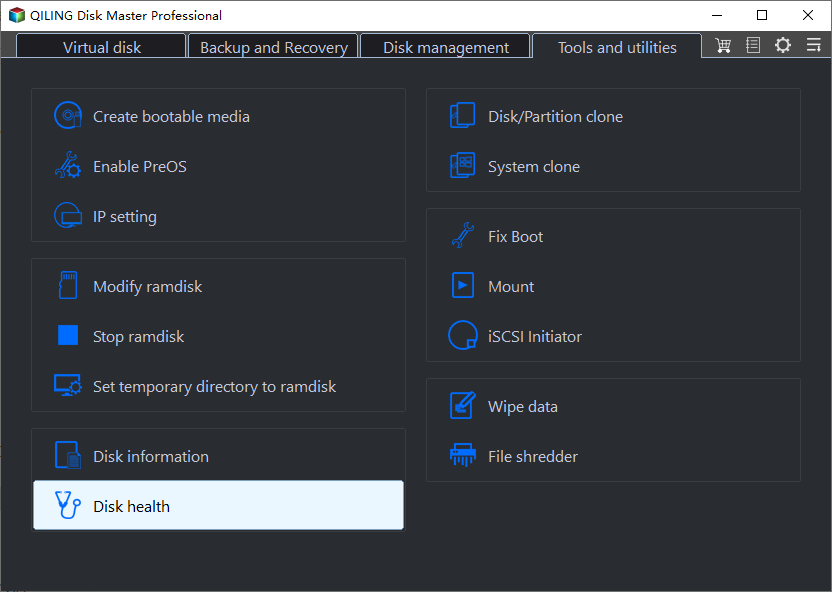
Step 1. Launch Qiling Disk Master and click the blue arrow to activate the "Disk Health" feature under the "Tools and utilities" section.
Step 2. To check the health condition of your disk, select the target disk first. This will display the current status of your disk, allowing you to monitor its overall health.
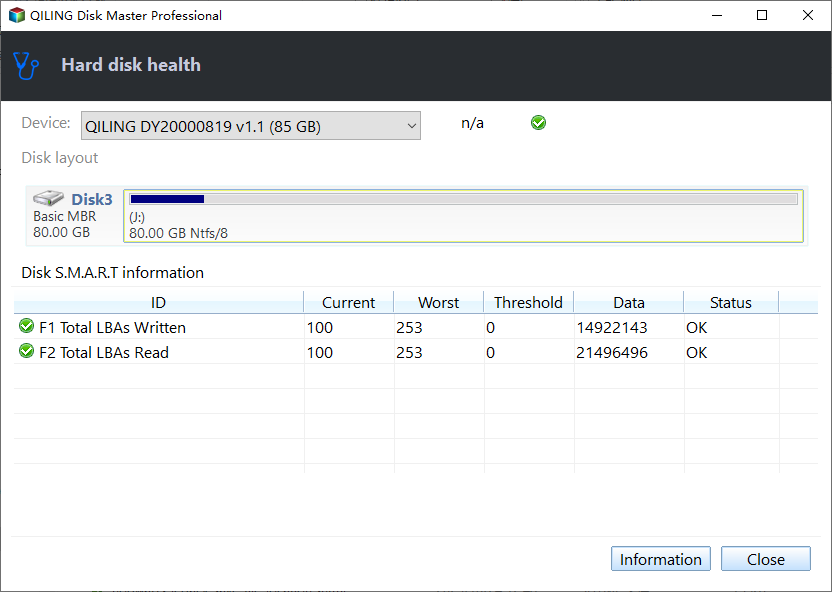
A clear indication of your SSD/HDD's health is a powerful tool in preventing failure. Qiling Disk Master offers many more capabilities beyond that, which we'll explore today.
Qiling Disk Master key features:
- Check if disk is healthy
- Run SD card speed test
- Check SSD health Windows 10
- Speed up hard drive and computer
- Check hard drive health on Windows 7
- Resize/create/delete/move partitions
- Check SSD temperature on Windows 10
Qiling Disk Master offers a range of features for SSD management, including disk cloning, partition management, and data recovery. It also provides a user-friendly interface and is compatible with various operating systems. Users can download and try it out to explore its capabilities.
Way 2. Check SMART Status on Windows 10 via CMD
To quickly determine SMART status using the Windows Management Instrumentation Command Prompt (WMIC) tool, follow these procedures:
Step 1. Open Start.
Step 2. To run the Command Prompt as an administrator, start by opening the Start menu, then type cmd in the search box. Next, right-click on the Command Prompt icon that appears in the search results, and from the context menu that appears, select "Run as administrator." This will launch the Command Prompt with elevated privileges, allowing you to perform administrative tasks.
Step 3. To check if your hard drive is failing, type the following commands and press Enter: `chkdsk /f`, `chkdsk /r`, `sfc /scannow`, `chkdsk /x`, and `chkdsk /v` in the Command Prompt to run disk checks and scans. If any errors are found, it may indicate a failing hard drive.
- wmic
- diskdrive get status
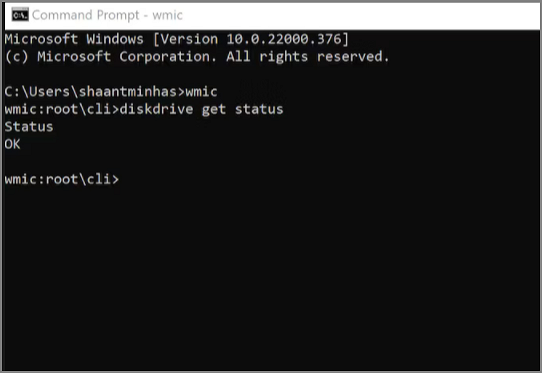
Step 4. Under the "Status" column, confirm that the result is OK.
- Notice:
- If the result is an "OK" message, you're good to go. If the status returns "bad," "unknown," or "caution," it means the hard disk is about to fail physically or the command is having trouble asking the status from the drive's firmware.
By the way, you may also like:
Conclusion
In Windows 10, it's essential to regularly check the SMART status to ensure data integrity, privacy, and gaming performance. You can do this in two simple ways: using Command Prompt for a basic health check, or using Qiling Disk Master, which offers a more intuitive interface and additional robust capabilities, making it the superior choice.
Check SMART Status on Windows 10 FAQs
To keep our device secure, we must perform regular disc checks. Here are some more concerns about using CMD to examine the state of an SSD in Windows 10.
1. How do I check my SMART hard drive status in Windows 10?
- Open Start
- To launch Command Prompt as an administrator, enter "Command Prompt" into the search bar and then right-click the first result.
- To check if the hard drive fails, type wmic diskdrive, get status, and hit Enter.
2. What is a SMART status check?
SMART means Self-The Monitoring, Analysis, and Reporting Technology (MART) was designed to autonomously monitor and detect indicators of a failing hard disk.
3. What is SMART status in BIOS?
The SMART protocol enables the system to analyze data from the storage device and issue a warning about impending failure when enabled in the BIOS.
Related Articles
- How to Fix Seagate External Hard Drive Write Protected
- How to Bypass Admin Password Windows 10 | 2024 Guideline
- How to Clone 2TB HDD to 1TB SSD in Windows 11/10/8/7? Your Guide Is Here
- SD Card Benchmark 2024 Tutorial with Full Step Guide
- How to Change Drive Letter [Full Tutorial]🔥
Do you need to change your drive letter? Is it safe to change drive letters? If you are having those doubts, this article may have answers to your questions. You can also learn how to change drive letter here. - How to Check Disk Read/Write Speed in Windows 10? 3 Practical Methods
To check the disk read/write speed in Windows 10, you can use one of three practical methods. By following these step-by-step guides, you can measure your disk's speed and identify potential issues with your storage devices, ultimately knowing the actual speed of your disk.
Products
Articles & Tutorials
- Data Recovery
- Data Backup
- File Recovery
- File Backup
- System Backup and Restore
- Disk and Partition Clone
- Technical articles
- Mobile articles
- Disk Master Help
- Windows Data Recovery Tutorials
- Windows Secure Delete Tutorials
- Windows Partition Management Tutorials
- Windows File Backup and Restore Tutorials
- Windows System Backup and Restore Tutorials
- Windows Disk Backup and Restore Tutorials
- Windows Clone Tutorials